How to Sell Your Services Online with WordPress


WordPress makes building almost any kind of website straightforward, but selling a service rather than a physical or digital product needs a slightly different setup than the standard ecommerce checkout most WordPress guides walk through. Services aren’t delivered the way a product is, there’s no file to download or package to ship, the value is the work itself, performed by a person after the order comes in. That difference changes what a store needs from its plugins even when it’s built on the same WordPress foundation as a typical online shop.
What selling services online through WordPress actually involves

Selling a service online means a customer pays upfront, the same way they would for a product, but what they receive afterward is work rather than a file. A copywriter selling blog posts, a designer selling logo packages, a consultant selling strategy sessions, all of these follow the same basic shape: purchase, then a period of actual work, then delivery of the finished result. The checkout and payment side can borrow directly from standard ecommerce tooling, but the fulfillment side needs something built specifically for that back-and-forth between buyer and seller rather than an instant, automatic download.
Easy Digital Downloads is a natural starting point for this because it’s built from the ground up for exactly this kind of transaction, a purchase followed by delivery that isn’t a simple file drop. Getting there takes a WordPress installation with EDD active as the core ecommerce engine, plus an addon that extends EDD’s product logic to handle the specific mechanics a service needs: requirement gathering, back-and-forth messaging, and delivery of a finished result rather than an instant file.
EDD Sell Services: the addon built specifically for this
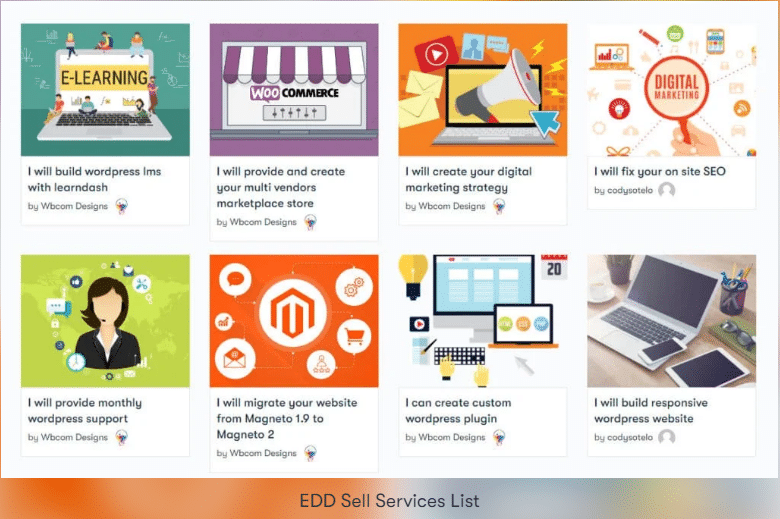
EDD Sell Services is the addon that turns a standard EDD product listing into a proper service marketplace. Rather than treating a service like a slightly unusual digital download, it adds the specific workflow a service transaction actually needs: a conversation thread attached to each order, a structured intake form for requirements, and a status flow that tracks a request from purchase through delivery rather than marking it complete the instant payment clears.
The conversation channel is the feature that matters most in practice. Every service order gets its own message thread between buyer and seller, with notifications firing at each stage, order placed, work in progress, delivery ready, so neither side is left checking email manually to figure out where things stand. Structured intake questions solve a related problem: a seller can define exactly what information a buyer needs to provide before work starts, word count, brand colors, target keywords, whatever the specific service actually requires, rather than fielding that information ad hoc through scattered messages after the sale.
Built-in reviews and ratings give a service-based storefront the same trust signal a marketplace like Fiverr relies on, letting past buyers vouch for quality in a way that a product description alone can’t, which matters a great deal for a first-time buyer deciding whether to trust an unfamiliar seller with real money. And because EDD Sell Services adds services as a standard product type inside EDD rather than requiring a separate system, a store already selling digital products can add a services tab without rebuilding anything, both product types share the same checkout, customer records, and reporting.
Turning a single-seller store into a marketplace
For anyone planning to host multiple sellers rather than just their own services, pairing EDD Sell Services with EDD Frontend Submissions extends the same setup into a full multi-vendor marketplace. Frontend Submissions lets independent sellers register, get approved, and manage their own service listings from a dashboard on the front end of the site rather than needing WordPress admin access, which is exactly the structure behind Fiverr-style platforms where the site owner earns a cut of transactions rather than doing the actual service work themselves. Vendors get their own service creation tools, order management, and earnings tracking, while the site owner retains oversight and approval control over what gets listed.
The range of services people actually sell this way

Professional services cover a broad range on stores like this: legal consultations, document preparation and review, real estate advice, medical consultations conducted remotely, and technical or business writing all fit naturally into a structured service listing with defined deliverables and turnaround expectations. Design work is another common category, brand identity packages, graphic design, photo editing, infographics, print collateral like business cards and brochures, where the intake form does real work capturing brand guidelines and reference materials upfront.
Marketing and consulting services round out a large share of what actually sells this way: copywriting, resume and CV writing, career coaching, life coaching, social media management, SEO audits, and general business consulting all translate cleanly into a purchase-then-deliver structure, since each one has a clear defined outcome a buyer can evaluate against what they actually receive. Technical services, printing, custom software development, audio mixing and mastering, technical support retainers, complete the picture for stores serving a more specialized or B2B audience where buyers tend to value clear scope and reliability over the lowest possible price.
Amazon’s professional services marketplace and Fiverr are the two most recognizable examples of this model at scale, both built around exactly the purchase-then-fulfill structure described above, just running on proprietary platforms rather than a self-hosted WordPress site the seller actually owns. Running the same model on an owned domain instead of a third-party marketplace means keeping the full sale price rather than a percentage cut, and it means the customer relationship, the email address, the order history, the repeat-buyer data, belongs to the seller rather than living inside someone else’s platform.
What this setup gets a store that a generic product listing doesn’t
The advantage over just listing a service as a plain digital product comes down to what happens after the sale. A plain EDD product delivers a file automatically the moment payment clears, which works fine for an ebook but breaks down completely for a service where the actual deliverable doesn’t exist yet at the moment of purchase. EDD Sell Services closes that gap with a structured order status flow, so both buyer and seller always know whether a request is still gathering requirements, actively being worked, or ready for delivery, rather than relying on email back-and-forth to track progress.
That structure also protects the seller. A clear requirements intake reduces the back-and-forth that eats into a service provider’s actual working time, and a visible order history with attached conversation threads gives both sides a paper trail if a dispute over scope or delivery ever comes up. For a service-based business running this on their own domain rather than a third-party marketplace, that ownership matters the same way it does for any other digital product business, no marketplace fee eating into margin, and full control over pricing, branding, and the customer relationship.
There’s a reputational upside too that’s easy to overlook. A buyer purchasing directly from a branded storefront, rather than from an anonymous seller profile on a crowded marketplace, associates the quality of the work with a specific business rather than with the marketplace hosting it. That association compounds over time into repeat business and referrals in a way that a marketplace seller profile, competing against thousands of other listings for the same attention, rarely builds as effectively.
Marketing a service storefront differently than a product store
A product listing sells largely on the strength of its description and images, since the buyer knows exactly what they’ll receive before purchase. A service listing sells more on trust, because the buyer is committing to an outcome that doesn’t exist yet, produced by a specific person or team they’re taking on faith. Portfolio samples, past client testimonials, and clearly documented process steps do more work in a service listing than they typically do for a straightforward digital product, since they’re the closest substitute a buyer has for actually seeing the finished result before paying.
Case studies work particularly well here, a short write-up of a past project, the problem, the approach, the outcome, gives a prospective buyer a concrete reference point that a generic feature list can’t match. For a service seller building this kind of storefront from scratch, investing early in three or four strong case studies pays off more than polishing the service description copy itself, since the case studies are what actually convince a hesitant first-time buyer to commit.
Getting started
The setup path is straightforward for a store already running WordPress: install and configure Easy Digital Downloads as the core commerce engine, add EDD Sell Services to unlock the service-specific order flow, and, if the plan involves hosting other sellers rather than just one, layer Frontend Submissions on top for vendor registration and dashboard access. Each piece builds cleanly on the last, so there’s no need to plan out the full multi-vendor structure before launching, a single-seller storefront can add vendor functionality later once demand justifies the extra complexity. From there, creating a first service listing follows the same basic pattern as any EDD product, a title, a description, a price, with the addon handling the requirement intake and conversation thread automatically once an order comes in.
For anyone still weighing whether to package existing work as digital downloads, live services, or some combination of both, our related guides on selling a digital service on a WordPress website and where to sell design work online cover adjacent angles worth reading alongside this one.
Pricing a service versus pricing a product
Product pricing on a digital storefront is mostly a matter of testing a number against conversion rate. Service pricing carries an extra dimension: the actual labor cost behind delivery has to hold up at whatever price gets set, since unlike a digital download that costs nothing extra to sell a hundred times, a service scales linearly with the seller’s own time. Flat-rate pricing works well for narrowly defined services with a predictable scope, a fixed word count for a blog post, a set number of design revisions, since both buyer and seller know exactly what’s included before the order starts.
Tiered packages solve the problem flat pricing runs into once a service has real variation in scope. A basic tier covering the core deliverable, a mid tier adding a revision round or faster turnaround, and a premium tier bundling in a consultation call all let the same underlying service serve buyers with different budgets and different urgency without needing entirely separate listings for each variation. Add-on pricing, an optional rush delivery fee, an extra revision round priced separately, captures additional revenue from buyers willing to pay for something beyond the base package without forcing every buyer into a higher tier just to access one extra feature.
Managing expectations around turnaround time
Nothing damages a service-based storefront’s reputation faster than a delivery date that quietly slips without communication. Setting a realistic turnaround estimate at the listing level, and actually testing whether that estimate holds up under real order volume, matters more for repeat business than shaving a day or two off the advertised delivery window ever will. A structured order status flow helps here specifically because it gives a buyer visibility into where their request actually stands without needing to ask, which reduces the anxious “is this still happening” messages that eat into a seller’s time on both sides of a transaction.
Building in a buffer between the advertised turnaround and the seller’s actual working capacity protects against the moment when several orders land in the same week. A service seller who consistently under-promises and over-delivers on timing builds a reputation that a seller running right up against their advertised deadline every single time never quite manages, even when both are technically meeting their stated terms.
Handling revisions and scope creep
Revision policy is worth defining explicitly in every service listing rather than leaving it implicit, since an undefined revision policy is one of the most common sources of disputes on any service marketplace. Stating clearly how many rounds of revision are included in the base price, and what happens once a buyer requests changes beyond that scope, sets expectations before a disagreement happens rather than during one. A structured intake form reduces scope creep at the source by capturing detailed requirements upfront, since a lot of “that’s not what I meant” disputes trace back to vague requirements gathered informally rather than through a defined form.
When a buyer’s request genuinely does expand beyond the original scope, having a clear, pre-defined process for pricing that additional work, rather than negotiating it awkwardly mid-project, keeps the relationship professional and keeps the seller’s time properly compensated instead of quietly absorbed into an ever-expanding original quote.
Frequently asked questions
Can I sell both digital products and services from the same store?
Yes, and that’s one of the real advantages of building services on top of EDD rather than a separate system. Since EDD Sell Services adds services as a standard product type, both product downloads and service listings share the same checkout, customer accounts, and order history without needing two separate storefronts.
Do I need coding experience to set this up?
No. EDD Sell Services and Frontend Submissions are both configured through standard WordPress admin settings and visual dashboards. Basic comfort installing and configuring WordPress plugins is enough to get a service store running.
How is this different from just listing a service as a regular product?
A regular digital product delivers automatically the instant payment clears, which doesn’t work for a service where the actual deliverable is produced after the sale. EDD Sell Services adds the order status tracking, requirement intake, and buyer-seller messaging that a service transaction actually needs, none of which exists in a plain product listing.
Is this suitable for a single freelancer, or only for marketplaces with multiple vendors?
Both. EDD Sell Services works on its own for a single seller managing their own service catalog. Frontend Submissions is the piece that’s only necessary once the plan involves hosting other sellers’ listings alongside your own.
How do payments and payouts work in a multi-vendor service marketplace?
The site owner’s payment gateway processes the customer’s payment at checkout, and the marketplace layer handles splitting that revenue between the platform and the individual vendor according to whatever commission structure the site owner sets. Vendors typically see their earnings tracked in their own dashboard, with payout timing and method configured separately from the checkout gateway itself.
What happens if a buyer isn’t satisfied with the delivered work?
That depends entirely on the refund and revision policy the seller sets at the listing level, since EDD Sell Services itself doesn’t impose a specific dispute resolution process. A clearly stated policy, covering what counts as a valid dissatisfaction claim and what remedy applies, whether that’s a revision, a partial refund, or a full refund, protects both sides far better than handling each disagreement as a one-off negotiation.
Interesting Reads:
How to sell my digital service on WordPress website?