Collect and Manage Feature Requests for Your EDD Digital Products

The Hidden Cost of Scattered Feature Requests
Every digital product business runs on customer feedback. The plugins and themes you sell through Easy Digital Downloads exist because someone had a need, and your product met it. But as your customer base grows, the volume of feature requests grows with it, and that is where things start breaking down.
Feature requests are not the problem. Scattered, unorganized, impossible-to-track feature requests are the problem. And for most EDD store owners, that is exactly what they are dealing with, whether they’ve admitted it to themselves yet or not.
The cost is not always obvious. It shows up as duplicated effort when two support agents respond to the same request differently. It shows up as missed opportunities when a request from a high-value customer gets buried in a support inbox. It shows up as roadmap decisions based on gut feeling instead of data, because nobody has a clear picture of what customers actually want.
When feature requests are scattered, you are flying blind. And flying blind in a competitive WordPress marketplace is a fast path to losing customers to someone who listens better and ships what people actually asked for.
Where Feature Requests Get Lost
Before we talk about solutions, let us be honest about where feature requests currently live for most plugin and theme sellers. The answer is: everywhere and nowhere.
Email Inbox
Customers email support with feature ideas. Those emails get read, maybe forwarded to a developer, and then buried under 50 new tickets. Six months later, the same feature gets requested again, and nobody remembers the first request ever happened.
Support Tickets
Feature requests arrive disguised as support tickets. A customer writes in saying something is “broken” when what they really mean is “I wish it worked differently.” The ticket gets closed as “not a bug,” and the feature idea disappears with it.
Social Media
A customer tweets about wanting a feature. Someone from your team likes the tweet. The feature idea now lives exclusively in a Twitter notification that will be forgotten by tomorrow.
WordPress.org Reviews
Plugin reviews on WordPress.org frequently contain feature requests mixed with praise or criticism. These are public and permanent, but they are also scattered across dozens of reviews with no way to aggregate or prioritize them.
Slack and Internal Chat
A support agent mentions a customer request in your team Slack. It gets a thumbs-up emoji. Nobody creates a task. The idea evaporates in the scroll.
The common thread is that none of these channels were designed for collecting, organizing, and prioritizing feature requests. They are communication tools being forced into a product management role, and they fail at it predictably.
A Centralized Request Board Changes Everything
The solution is straightforward: give feature requests a proper home. A dedicated, centralized board where every request is captured, categorized, and trackable. No more digging through email threads. No more lost ideas. No more guessing what customers want.
The Product Roadmap plugin by Wbcom Designs provides exactly this. It creates a public-facing feature request board that lives on your WordPress site, right alongside your Easy Digital Downloads store. Customers submit ideas, vote on existing ones, and track the status of their requests from submission to completion.
The “Suggest Feature” Flow for Customers
One of the smartest design decisions in Product Roadmap is the customer-facing “Suggest Feature” functionality. Instead of asking customers to email you, fill out a contact form, or navigate your support system, you give them a dedicated submission form right on the roadmap page.
Here is what the flow looks like from the customer’s perspective:
- They visit your roadmap page. This is linked from your EDD product pages, your footer, or your support documentation.
- They search existing requests first. Before submitting, the search and filter tools help them check whether someone else has already requested the same thing. If so, they simply vote for it instead of creating a duplicate.
- They submit their idea. A clean form captures the feature title, description, and optionally the product or category it relates to.
- The request enters your triage queue. You review it, categorize it, and decide whether to publish it on the public board.
- They track the status. Once published, the customer can see their request move through your workflow, from “Under Review” to “Planned” to “In Progress” to “Completed.”
This flow is intentionally low-friction. You want customers to submit ideas. Every feature request is a data point that helps you build a better product. Making the submission process difficult just means you get fewer data points and worse products, and worse products lose to competitors that made it easier to be heard.
Categorizing Requests by Product and Module
If you sell multiple digital products through EDD, categorization is critical. A feature request for your membership plugin should not be mixed in with requests for your e-commerce toolkit. Customers should be able to filter to see only the requests relevant to the product they use.
Product Roadmap supports this through its taxonomy system. You can create categories for each product in your EDD store, and customers select the relevant product when submitting a request. On the public board, filter controls let visitors narrow down to a specific product instantly.
Beyond product-level categories, you can use tags to organize requests by module or feature area. Examples include:
- UI/UX for requests about the user interface and experience.
- Performance for speed and optimization requests.
- Integrations for requests to connect with other plugins or services.
- Admin for backend management improvements.
- API for developer-facing feature requests.
This two-level organization (product categories plus feature tags) gives you a powerful filtering system without overcomplicating the submission form. Customers pick a product and optionally add a tag. Your team handles the detailed categorization during triage.
The Voting System: Let Customers Prioritize for You
Here is where feature request management stops being a chore and starts becoming a strategic advantage. Product Roadmap includes a voting system that lets customers upvote the features they want most. Instead of you guessing which requests matter, your customers tell you directly.
Voting transforms your feature request board from a suggestion box into a prioritization engine. When a request has 200 votes and another has 5, the development priority writes itself. Your team spends less time debating what to build next and more time building it.
The voting system also surfaces insights you would never get from support tickets alone:
- Silent majority signals. Many customers will never write a support ticket, but they will click an upvote button. Voting captures demand from your quiet majority.
- Relative importance. Support tickets tell you “someone wants this.” Vote counts tell you “312 people want this, while 18 people want that.” The relative difference is the insight.
- Trend detection. A request that suddenly starts getting votes after months of low activity signals a market shift. Maybe a competitor launched a similar feature, or maybe a blog post mentioned the need.
For EDD store owners, voting data is also valuable for product strategy beyond individual features. If you see heavy voting for integration requests, that tells you customers are trying to use your product as part of a larger stack. If UI requests dominate, your product might have a usability issue worth addressing holistically.
Search and Filter: Eliminating Duplicate Requests
Duplicate feature requests are a time sink. Every duplicate requires someone to identify it, merge or close it, and respond to the submitter. With a traditional email-based system, duplicates are inevitable because customers have no way to see what others have already requested.
Product Roadmap addresses this with built-in search and filter functionality. Before a customer submits a new request, they can search the existing board for similar ideas. The search is prominently placed and easy to use, making it natural for customers to check first.
This design has two benefits:
- Fewer duplicates. When a customer finds their idea already exists, they vote for it instead of creating a new entry. Your triage workload drops significantly.
- Higher vote accuracy. Instead of the same request appearing five times with 10 votes each, it appears once with 50 votes. The true demand signal is clearer.
Filter options let visitors narrow results by category, tag, status, and popularity. A customer who wants to see all open requests for a specific product, sorted by most votes, can do that in two clicks.
The Triage Workflow: From Request to Roadmap
Not every feature request belongs on your public roadmap. Some are impractical, some are already planned under a different name, and some are great ideas that you will get to eventually. The triage workflow is where you make these decisions.
Here is a practical triage process using Product Roadmap:
Step 1: Review New Submissions
Check your WordPress admin for new feature requests regularly. Each submission shows the customer’s description, which product it relates to, and any initial votes it received.
Step 2: Check for Duplicates
Search your existing roadmap for similar items. If a match exists, merge the new request with the existing one and transfer any votes.
Step 3: Categorize and Tag
Assign the correct product category and feature tags. This ensures the request shows up in the right filters on the public board.
Step 4: Set Initial Status
Place the request in the appropriate column on your Kanban board. Most new requests start in “Under Review” or “Considering.” Only move items to “Planned” when you have made a genuine commitment to build them.
Step 5: Publish or Archive
Publish requests that are clear, actionable, and relevant. Archive requests that are out of scope, duplicates, or not feasible. For archived requests, leave a comment explaining why so the customer gets closure.
This triage process takes minutes per request but saves hours of confusion downstream. When your roadmap is clean and accurately reflects your plans, customers trust it, and that trust translates to sales and renewals.
Commenting When Requests Are Addressed
Closing the loop is one of the most underrated aspects of feature request management. When you ship a feature that customers requested, telling them about it is almost as important as building it.
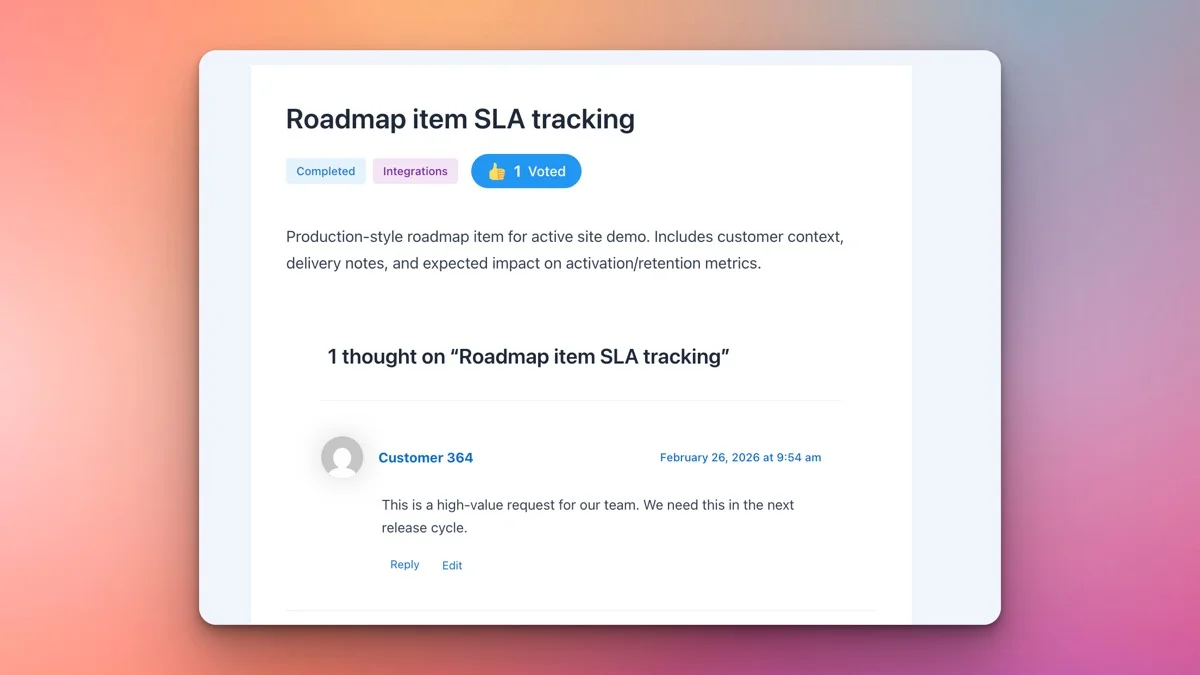
Product Roadmap makes this easy. When you move a roadmap item to “Completed,” you can add a comment explaining what was built, which version it shipped in, and any relevant details. Every customer who voted on or subscribed to that item sees the update.
This feedback loop creates a powerful engagement cycle:
- Customer submits a request or votes on an existing one.
- You build the feature and update the roadmap item.
- Customer sees their voice made a difference.
- Customer is more likely to submit future requests and remain a loyal buyer.
For EDD store owners with subscription-based products, this loop directly impacts renewal rates. Customers who feel heard and see their suggestions implemented are dramatically more likely to renew their license than customers who submitted an idea and never heard anything back.
Do not underestimate the emotional impact of a simple comment like: “This feature was requested by 87 customers and shipped in version 4.2. Thank you to everyone who voted and helped shape this release.” That sentence builds more loyalty than any marketing campaign.
Measuring What Customers Want: Votes vs. Revenue
Raw vote counts are a useful signal, but they are not the only signal. A feature with 500 votes from free users might be less strategically important than a feature with 50 votes from your highest-paying customers.
Smart EDD store owners layer additional context on top of vote data:
Votes as a Quantity Signal
High vote counts tell you that many people want something. This is useful for features that improve the product broadly, like performance improvements, UI redesigns, or new export formats. Volume matters here.
Revenue Context
Cross-reference feature requests with your EDD sales data. If the customers requesting a specific feature represent a disproportionate share of your revenue, that request deserves extra weight regardless of vote count. A request from 10 customers who each pay $299/year is worth more than 100 votes from free tier users.
Churn Signals
Pay attention to feature requests that come attached to cancellation threats or negative reviews. These are not just requests; they are retention risks. A feature that prevents 20 cancellations might be more valuable than one that attracts 50 new customers.
Market Positioning
Some feature requests align with where you want your product to go strategically. Even with low votes, a feature that positions your plugin for a growing market segment might be worth prioritizing. Use votes as input, not as the sole decision-maker.
Combining the Signals
The best approach is a weighted score that considers votes, revenue impact, churn risk, and strategic alignment. Product Roadmap gives you the vote data; your EDD reports give you the revenue data. Combining both leads to better roadmap decisions than either signal alone.
Common Mistakes That Undermine a Feature Request Board
A few patterns show up repeatedly when EDD sellers first launch a public roadmap, and most of them are avoidable with a bit of foresight.
The most common mistake is launching the board and then going quiet. A roadmap where every item sits in “Under Review” for six months teaches customers that voting doesn’t matter, and vote counts flatline as a result. Even a monthly triage pass that moves a handful of items forward keeps the board feeling alive rather than abandoned.
The second mistake is publishing every request without filtering for quality first. A board cluttered with vague one-line submissions (“make it better,” “add more options”) is hard to browse and makes genuine, well-described requests harder to find. Spend the extra minute during triage to tighten a vague request into something specific before it goes public, or ask the submitter a clarifying question first, rather than publishing something nobody else can meaningfully vote on.
The third mistake is treating the roadmap as a promise rather than a signal. Moving an item to “Planned” sets an expectation, and customers notice when planned items sit untouched for a year. Reserve that status for work you’ve genuinely committed engineering time to, and use “Considering” or “Under Review” for everything still in the evaluation stage. The distinction matters more to your customers than it might seem from the admin side, and getting it wrong repeatedly erodes trust in the board faster than having no public roadmap at all.
Setting Up Your First Roadmap Board
Getting a board live doesn’t require a large upfront investment of time. After installing the Product Roadmap plugin, the first real decision is how many boards you need. A single EDD product with a focused feature set can run on one board with category filters. A store selling several distinct products, a plugin and a theme, for instance, usually benefits from separate boards or at minimum separate top-level categories, so a theme customer isn’t wading through plugin-specific requests to find something relevant.
Before opening submissions to the public, seed the board with five to ten known requests pulled from old support tickets and reviews. An empty roadmap looks unfinished and gives new visitors nothing to vote on, while a board with a reasonable starting set signals that the feature has been running for a while and is worth engaging with. It also gives your first real visitors something to vote on immediately, rather than asking them to be the one who breaks the ice on an empty board.
Finally, link to the roadmap from somewhere customers will actually see it: the support documentation, the product’s changelog page, and the confirmation email after a purchase are all better placements than burying the link in a footer menu nobody scrolls to. A single sentence in your existing support ticket auto-reply, pointing frustrated users toward the board instead of a dead end, often drives more submissions than any dedicated announcement post.
From Chaos to Clarity
Managing feature requests does not have to be chaotic. With the right tool, you can transform scattered feedback into an organized, prioritized, transparent system that benefits both your team and your customers.
The Product Roadmap plugin gives EDD store owners a purpose-built solution that integrates directly into your WordPress site. Customers submit ideas, vote on priorities, and track progress. Your team triages efficiently, builds what matters, and closes the loop when features ship.
The result is a product that evolves based on real customer input, a support team that spends less time fielding repetitive questions, and a customer base that feels genuinely heard rather than shouting into a support inbox and hoping someone reads it.
Stop letting feature requests disappear into email threads and Slack messages. Give them a home, and give the team that reads them a workflow instead of a pile of unread notifications to feel guilty about.