The 10 Best Hivebrite Alternatives of 2025


Hivebrite built a name for itself among alumni networks, associations, and enterprise community teams, but the platform is not the only option, and it is not always the right one. Some teams outgrow its pricing tiers. Others need a lighter setup that does not require a six-figure implementation budget. And a growing number of community managers want a platform they can actually own, rather than rent forever from a vendor who can raise prices whenever a contract renews.
This guide walks through ten platforms worth evaluating against Hivebrite in 2025, covers what changed with a couple of well-known names in this space over the past few years, and closes with an honest look at what a self-hosted, WordPress-based option can offer if renting community software forever is not the plan.

What Are Hivebrite Alternatives?
Hivebrite is a community management platform originally built for alumni relations, and it later expanded into associations, professional networks, and nonprofit membership. It handles directories, events, groups, and payments in one dashboard, which is exactly why so many organizations picked it in the first place.
The catch shows up at renewal time. Hivebrite’s pricing is quote-based and typically starts in the low five figures annually, which prices out smaller nonprofits and associations before they even get a demo. A Hivebrite alternative, in practical terms, is any platform that covers the same core jobs – member directories, events, discussion, and payments – without forcing an organization into that budget bracket or into a rigid contract structure.
Why Look for a Hivebrite Alternative?
Cost is the most common trigger, but it is rarely the only one. Some community teams find Hivebrite’s interface dated compared to newer, mobile-first platforms. Others need deeper customization than Hivebrite’s theming options allow, or they need an integration Hivebrite does not natively support.
There is also a structural issue worth naming directly: renting a community platform means the vendor controls the roadmap, the pricing, and, in the worst case, the data export process if you ever decide to leave. Organizations that have been burned by a platform sunset, a surprise price hike, or a feature getting locked behind a higher tier tend to weigh that risk much more heavily on their second platform search than they did on their first.
How to Choose the Right Alternative?
Start with the jobs your community actually needs done today, not the feature list a sales deck shows you. A professional association running annual conferences has different requirements than a creator monetizing a paid Discord-style space, and a platform built for one rarely serves the other well without heavy customization.
Budget matters, but so does exit cost. Ask what happens to your member data, your discussion history, and your event archive if you cancel. A platform that makes data export painless is signaling something about how it treats customers generally. Request a trial account rather than trusting a sales demo alone, and put a handful of real members through the sign-up and posting flow before committing anything long term.
It also helps to separate must-haves from nice-to-haves before you start comparing vendors, since sales calls have a way of making every add-on sound essential. Write down the three or four things your community absolutely cannot function without, whether that is single sign-on for a university alumni network, chapter-level permissions for a professional association, or a mobile app for a creator audience that lives on their phone. Everything else is negotiable, and knowing that going in keeps a platform’s feature checklist from steering the decision instead of your actual members.
1. Mighty Networks – The All-In-One Creator Platform
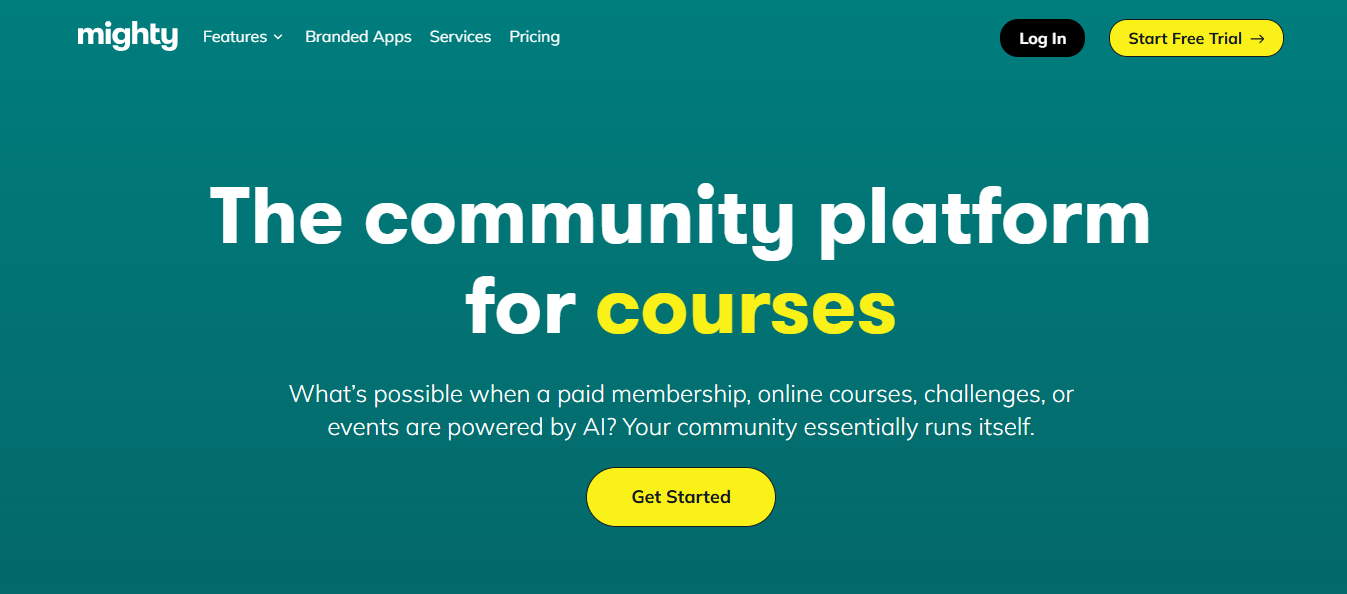
Mighty Networks bundles community spaces, courses, and paid memberships into one product, with its own branded mobile apps included on higher plans. That combination makes it a strong pick for creators and coaches who would otherwise be stitching together a separate course platform and a separate community tool.
Pricing runs on a monthly subscription with a percentage-based option on some plans, so it is worth modeling against your expected transaction volume before signing up. Communities that lean heavily on live events and cohort-based courses tend to get the most value from it; pure discussion-first communities sometimes find it more structured than they need.
2. Circle – Built for Coaches, Creators, and Small Teams
Circle has become one of the most-referenced Hivebrite alternatives for a reason: it is fast to set up, the interface reads clean on both desktop and mobile, and its native integrations with Zapier, Stripe, and email tools cut down on the glue work most platforms require.
Unlike Hivebrite’s enterprise focus, Circle targets solo creators, small agencies, and course businesses. That shows in its pricing, which starts far below Hivebrite’s quote-only model, and in its support, which leans on documentation and community forums rather than a dedicated account manager. Larger associations with complex membership tiers sometimes hit the ceiling of what Circle’s permission system can handle.
3. Discourse – Open Source and Built for Discussion
Discourse takes a different approach entirely. Where Hivebrite organizes a community around profiles and events, Discourse organizes it around threads and categories, which makes it the stronger pick for organizations whose members primarily want to ask questions and debate ideas rather than browse a directory.
Because it is open source, Discourse can be self-hosted for the cost of a server, or run through the official hosted plans if you would rather skip the maintenance. Its moderation tooling, including trust levels that unlock permissions as members participate more, has made it a favorite among developer communities, open source projects, and support forums that need to scale without a large moderation team.
4. Memberful – Monetization First, Community Second
Memberful is not trying to be a full community suite, and that focus is its main selling point. It plugs into WordPress and Stripe to handle gated content, recurring memberships, and paid newsletters with very little setup overhead, which makes it a common choice for independent writers, podcasters, and niche publishers.
Where it differs sharply from Hivebrite: there is no built-in event system, no member directory in the traditional sense, and no forum. Organizations that need those features layer Memberful’s paywall on top of a separate community tool, often a WordPress community plugin, rather than expecting Memberful to cover both jobs.
5. Higher Logic Vanilla – The Forum Platform, Now Under Higher Logic
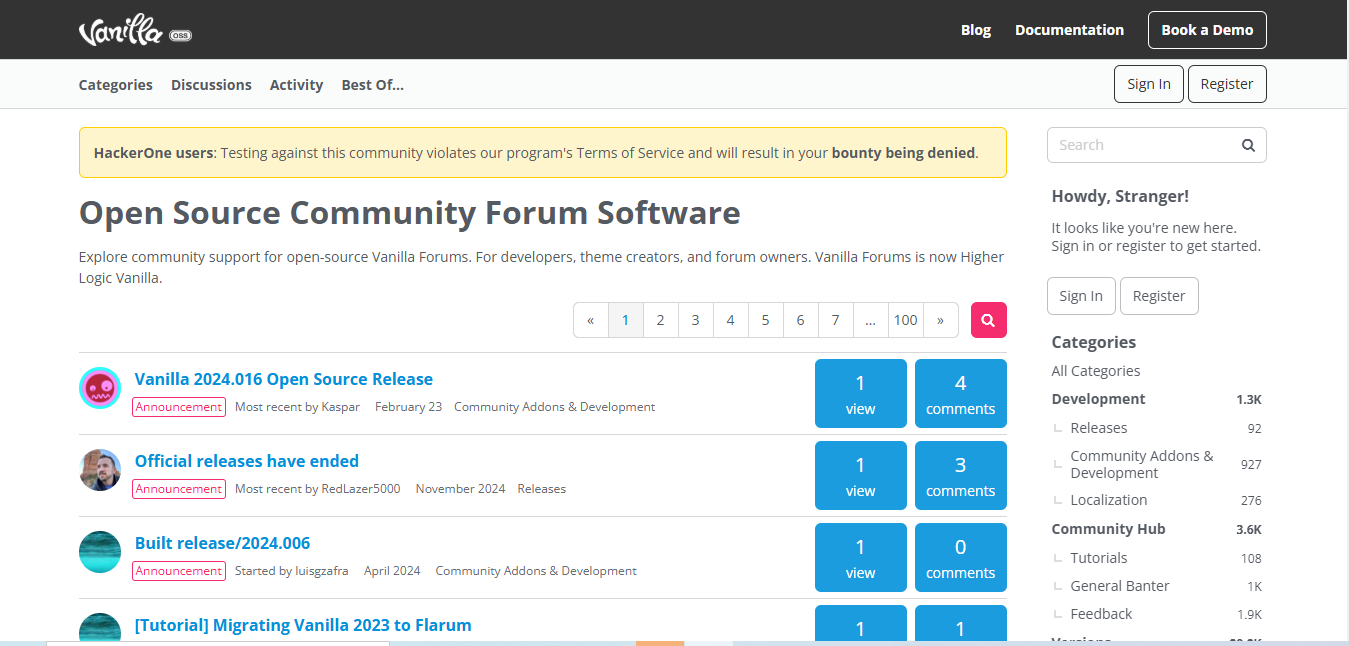
One correction worth flagging up front: Vanilla Forums, long known as a standalone customer community platform, was acquired by Higher Logic in 2022 and now operates as Higher Logic Vanilla. If a Vanilla Forums quote or demo request from a few years ago is sitting in your inbox, expect the current version to look and price differently, since it now ships as part of Higher Logic’s broader suite rather than as an independent product.
The core strength survived the acquisition, though. Vanilla’s gamification tools, its AI-assisted moderation queue, and its focus on customer support and brand communities specifically – as opposed to Hivebrite’s alumni and association focus – still make it a reasonable pick for companies building a support forum around a product rather than a professional network.
6. Bettermode (formerly Tribe) – AI-Driven Customer Communities
The platform that used to market itself as Tribe rebranded to Bettermode in 2022, and the new name is the one you will find if you go looking for it today. The rebrand came with a sharper focus on customer and product communities rather than general-purpose social networking, plus deeper AI features for content recommendations and automated tagging.
Bettermode’s integrations with HubSpot, Zendesk, and Zapier make it a fit for SaaS companies that want their community tied directly into a support and marketing stack. Its analytics dashboard breaks down engagement by cohort, which is useful for product teams trying to prove that community investment moves retention numbers, not just vanity metrics.
7. BuddyBoss – A WordPress-Native Option
BuddyBoss remains the most recognizable WordPress-based alternative in this list, built as a commercial layer on top of BuddyPress with its own theme and app builder. Organizations that already run their website on WordPress often gravitate toward it because member data, content, and the community itself all live in one system rather than being split across a website and a separate SaaS platform.
The tradeoff is complexity. BuddyBoss ships with a large number of settings and depends on BuddyPress’s underlying architecture, which means site owners either need WordPress comfort themselves or a developer on call. It is a strong choice for teams that value owning their platform outright and are willing to trade some of Hivebrite’s out-of-the-box simplicity for that control.
8. Podia – Simple Memberships for Solo Creators
Podia keeps its feature set intentionally narrow: courses, digital downloads, memberships, and a basic community space, all under one login with no-code setup. That narrowness is the appeal for solo creators and small teams who found Hivebrite’s enterprise feature set overwhelming for a community of a few hundred members.
What Podia does not try to be is telling too. There is no advanced event management, no complex membership tiering, and no enterprise SSO. Creators who need those things outgrow Podia fairly quickly, but for the audience it targets – someone selling a course with a companion community – it removes a lot of setup friction Hivebrite would otherwise require. Its flat monthly pricing, rather than a percentage of transactions, also makes revenue easier to forecast once a creator’s audience starts converting into paying members at scale.
9. Wild Apricot – Membership Management for Nonprofits and Associations
Wild Apricot, now operating under its parent company Personify, remains one of the more established options built specifically for nonprofits, chambers of commerce, and membership associations. Membership renewal automation, event registration, and donation tracking are handled natively, which covers ground Hivebrite requires more configuration to reach.
Its pricing tiers scale with contact list size rather than feature access, which tends to work in favor of small and mid-sized nonprofits that need the full feature set from day one but cannot justify Hivebrite’s enterprise pricing. Larger associations with more complex chapter structures sometimes find Wild Apricot’s customization ceiling lower than Hivebrite’s.
10. Higher Logic Thrive – The Direct Enterprise Competitor

Higher Logic Thrive is arguably the platform closest to Hivebrite in target market: enterprise associations, large nonprofits, and professional societies with complex membership structures and dedicated community management staff. It bundles CRM integration, marketing automation, and community management under one company, which is now also the parent company of Vanilla, mentioned above – so an organization evaluating both is effectively comparing two products from the same vendor at different price points.
That overlap is worth knowing before you request demos of both. If Higher Logic’s sales team routes an association-focused inquiry toward Thrive and a support-focused one toward Vanilla, it is because those two products inside the same company are built for different jobs, not because they compete with each other.

What If You Would Rather Own the Platform Outright?
Every platform on this list, Hivebrite included, is a rental. You pay monthly or annually, and the moment you stop paying, your community either goes read-only or disappears entirely. For organizations that have already built their website on WordPress, that is not the only path.
BuddyNext is a free, self-hosted community plugin for WordPress, built as its own architecture rather than as a BuddyPress add-on. It handles activity feeds, member profiles, groups, and private messaging on infrastructure you already control, and the Pro version adds native Stripe memberships if monetization is part of the plan. It will not replace an enterprise platform’s white-glove onboarding, but for an association or creator already comfortable in WordPress, it removes the recurring platform fee entirely. Read more about the broader options in our roundup of the best online community platforms or our walkthrough on how to build an online community with WordPress if a self-hosted approach is worth exploring further.
Hivebrite Alternatives Compared at a Glance
Reading through ten detailed write-ups takes time, so here is the short version. If your priority is speed of setup and a low monthly bill, start with Circle or Podia. If discussion volume matters more than profiles and directories, Discourse deserves a serious look before anything else on this list. If your organization is a nonprofit or association juggling dues, event registration, and chapter management, Wild Apricot or Higher Logic Thrive will feel closer to what you already expect from Hivebrite. If your website already runs on WordPress and long-term platform ownership matters more than a polished onboarding call, BuddyBoss and BuddyNext are the two worth trialing first.
Pay attention to how each vendor prices growth, not just the entry tier. Circle, Mighty Networks, and Bettermode all charge more as your member count or transaction volume climbs, the same way Hivebrite does, just starting from a lower base. Discourse and any self-hosted WordPress option flip that model: costs stay tied to server capacity rather than headcount, which changes the long-term math considerably once a community passes a few thousand active members.
Common Questions About Switching From Hivebrite
Can I export my member data out of Hivebrite before switching?
Yes, Hivebrite supports CSV exports of member records, though event history and discussion threads are more limited in what transfers cleanly. Request an export early in your evaluation process rather than waiting until you have already signed with a new vendor, since some data fields only surface through a support ticket rather than the self-serve dashboard.
Is a cheaper alternative always the right call?
Not automatically. A lower monthly price that forces your team to rebuild integrations Hivebrite handled natively can cost more in staff time than it saves in subscription fees. Weigh the total cost of ownership, including setup time and any developer hours needed, against the sticker price before deciding.
Do any of these platforms integrate with existing WordPress sites?
BuddyBoss and BuddyNext are built specifically for WordPress and keep member data inside your existing site. Memberful integrates with WordPress for paywall and subscription functionality but is not a full community platform on its own. The other platforms on this list are separate hosted products that typically connect to a WordPress site through embeds or single sign-on rather than living inside it.
How long does a realistic migration take?
For a community under a few thousand members, plan on two to six weeks for a clean migration, including data export, member communication, and a parallel-run period where both platforms stay active. Larger associations with complex chapter or committee structures should budget longer, particularly if custom fields or legacy integrations need to be rebuilt rather than simply copied over.
Final Thoughts
None of these ten platforms is a universal replacement for Hivebrite; each one wins for a different reason. Circle and Podia suit solo creators who want speed over depth. BuddyBoss and a self-hosted option like BuddyNext suit organizations that want to own their data and their platform long term. Wild Apricot and Higher Logic Thrive suit nonprofits and associations that need the enterprise feature set without necessarily paying Hivebrite’s price for it.
Whichever direction you take, run a real trial before committing. Import a sample of your member list, post a few discussion threads, and try exporting your data back out before you sign an annual contract. A platform that makes that process painless is telling you something true about how it will treat you a year from now. For a broader look at what makes a community stick once you have picked a platform, see our piece on building a thriving community.
One last thing worth checking before you sign anything: read the platform’s own status page and changelog, not just its marketing site. Vanilla Forums and Tribe both looked stable right up until their acquisitions and rebrands changed the product underneath existing customers. That is not a reason to avoid either company today, both are still solid options under their new names, but it is a reminder that “current” in this market has a shelf life. Bookmark your shortlist, revisit it in a year, and confirm the name on the login page still matches the name on the invoice.
Interesting Reads:
What to Include on Main Service Page SEO Website?