The Best AI Content Detector Tools (2026 Update)


A teacher flags an essay as AI-written based on a single percentage score. A marketing team rejects a freelancer’s article because a detector called it 80% machine-generated. Neither of those outcomes is as reliable as it sounds, because AI content detectors are probability estimates built on shifting ground, not lie detectors with a verified accuracy rate. They’re useful. They’re also frequently wrong in both directions, flagging genuine human writing as AI while missing text that’s been lightly edited to slip past them.
That doesn’t mean the tools are worthless, it means they need to be used the way any probabilistic tool should be: as one signal among several, not a verdict. Below are ten detectors that are genuinely still operating in 2026, what changed at a few of them since this list was first written, and where the real limitations sit.

What AI Content Detectors Actually Do
These tools analyze linguistic patterns, word predictability, sentence-length variance, repetition, and structural markers that tend to show up more often in machine-generated text than in typical human writing. Most compare a document’s statistical fingerprint against known patterns from large language models and produce a probability score rather than a binary yes-or-no answer, even when the interface presents it as a clean percentage.
That distinction matters more than most users realize. A “92% AI-generated” result isn’t a fact, it’s a confidence estimate from a model that’s frequently wrong on edge cases: text written by non-native English speakers, heavily formulaic writing like legal boilerplate or five-paragraph essays, and text that’s been paraphrased after AI assistance all trip up detectors in both directions.
Why Detection Accuracy Is Still an Open Problem
No AI content detector on the market, including the ones below, publishes an independently verified accuracy rate that holds up consistently across genres, languages, and editing styles. Vendors publish their own benchmark numbers, and those numbers vary significantly depending on the test set used. What’s consistent across independent testing is that false positives, human writing flagged as AI, happen often enough that responsible use of these tools means treating a flag as a prompt for a conversation, not proof of misconduct.
The Detectors Worth Knowing in 2026
1. GPTZero – Still the Academic Standard, Now Part of Superhuman
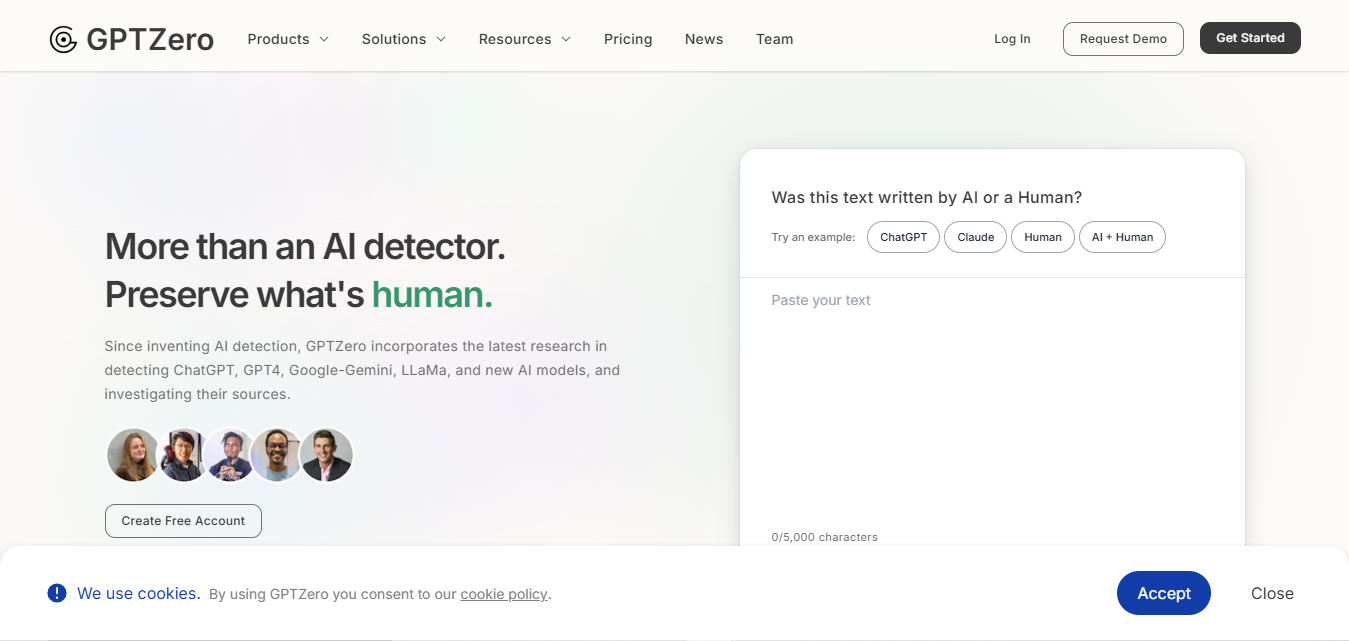
GPTZero remains the most widely used detector in classrooms, with a claimed user base in the tens of millions and detection support for current-generation models. One update worth flagging: GPTZero’s own homepage now states it’s part of Superhuman, the AI productivity company, which appears to have folded GPTZero in while keeping the product operating under its original name.
The tool still highlights specific flagged sentences rather than just returning a single score, which makes it more useful for an actual review conversation than a bare percentage would be.
2. Originality.ai – Built for Marketing and SEO Teams
Originality.ai remains the detector most commonly used by content marketing and SEO teams, largely because it bundles AI detection with plagiarism checking in one scan and supports team accounts for agencies reviewing freelance work at volume. Its detection model gets retrained periodically to keep pace with newer AI writing models, which matters given how quickly detection accuracy degrades against models it wasn’t trained to recognize.
3. CopyLeaks – Enterprise Scale With API Access
CopyLeaks targets larger organizations that need AI detection built into an existing content pipeline rather than used as a manual one-off check. Its API integration lets publishers and enterprise content teams scan submissions automatically, and it supports detection across multiple languages, which is a genuine differentiator since a lot of detectors are trained overwhelmingly on English text and perform worse elsewhere.
4. Writer’s AI Detector – Still Live, but No Longer a Standalone Product Page
This one’s worth a direct correction. Writer.com has repositioned itself around enterprise “agentic AI” tools rather than the writing-assistant and content-governance product it used to be known for, and its previously dedicated AI content detector page now redirects into an anchor section on the company’s main homepage rather than existing as its own tool. The underlying detection capability appears to still be there, but it’s no longer marketed as a standalone free tool the way it was when this list was first written, so don’t expect the same dedicated experience if you’re coming from an older bookmark.
5. Winston AI – Education-Focused Detection
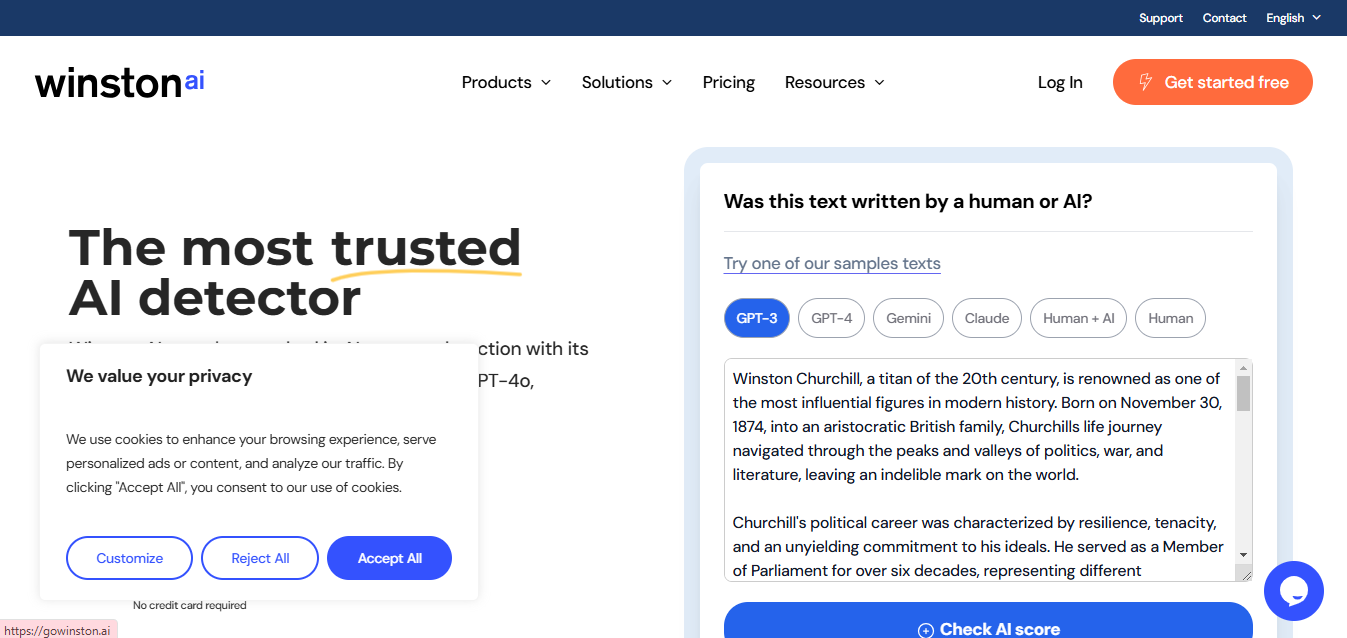
Winston AI continues to focus specifically on the education sector, positioning itself as a tool for teachers verifying student submissions rather than a general-purpose content checker. It scans for sentence structure and language-pattern markers and, like GPTZero, provides more than a single number by highlighting specific portions of text it considers suspicious.
6. Crossplag Is Gone – Absorbed Into Inspera
This is the biggest correction on the list. Crossplag no longer exists as an independent product; its domain now redirects directly to Inspera, an exam integrity and digital assessment platform. If you’re looking for the multilingual AI detection Crossplag used to offer, that capability appears to now live inside Inspera’s broader assessment security suite rather than as a standalone AI detector you can access the way Crossplag used to work. Anyone still linking to Crossplag directly is sending readers to a dead product.
7. Sapling AI Detector – Actively Updated, Free Tier Included
Sapling’s detector remains actively maintained, with recent updates adding support for detecting text from newer model families and sample texts you can test against directly on the tool’s page. It offers a free tier limited to a couple thousand characters per scan, with paid tiers and an API for higher-volume use, making it a reasonable option for teams that want to test the tool before committing to a subscription.
8. Turnitin’s AI Writing Detector – Still Standard in Higher Ed, Still Carries a Real Caveat
Turnitin remains the dominant plagiarism and AI detection tool inside higher education, integrated directly into the learning management systems many universities already use. The caveat that mattered when this list was first written still matters now: Turnitin itself has repeatedly cautioned institutions against using its AI score as the sole basis for an academic misconduct accusation, given the documented risk of false positives, particularly for non-native English writers and heavily formulaic academic writing styles. Any instructor using it should treat a flag as the start of a conversation with a student, not a verdict.
9. Undetectable AI Checker – A Real Conflict of Interest Worth Knowing About
This entry needs an honest caveat that the original version of this list glossed over. Undetectable AI sells a detection tool, but it also sells, on the same site, a “humanizer” tool explicitly marketed to rewrite AI text so that it “scores as human on every major detector.” That’s not a hidden feature buried in the fine print, it’s a headline offering on the company’s own homepage.
That dual business model is worth knowing before you rely on this specific tool to verify authenticity, particularly for anything with academic or compliance stakes. A company selling both the lock and the tool to pick it has an obvious incentive structure that’s different from a detector-only vendor, and it’s reasonable to want a second opinion from an independent tool before treating its detection result as final.
10. Content at Scale AI Detector – Still Free, Still Aimed at Publishers
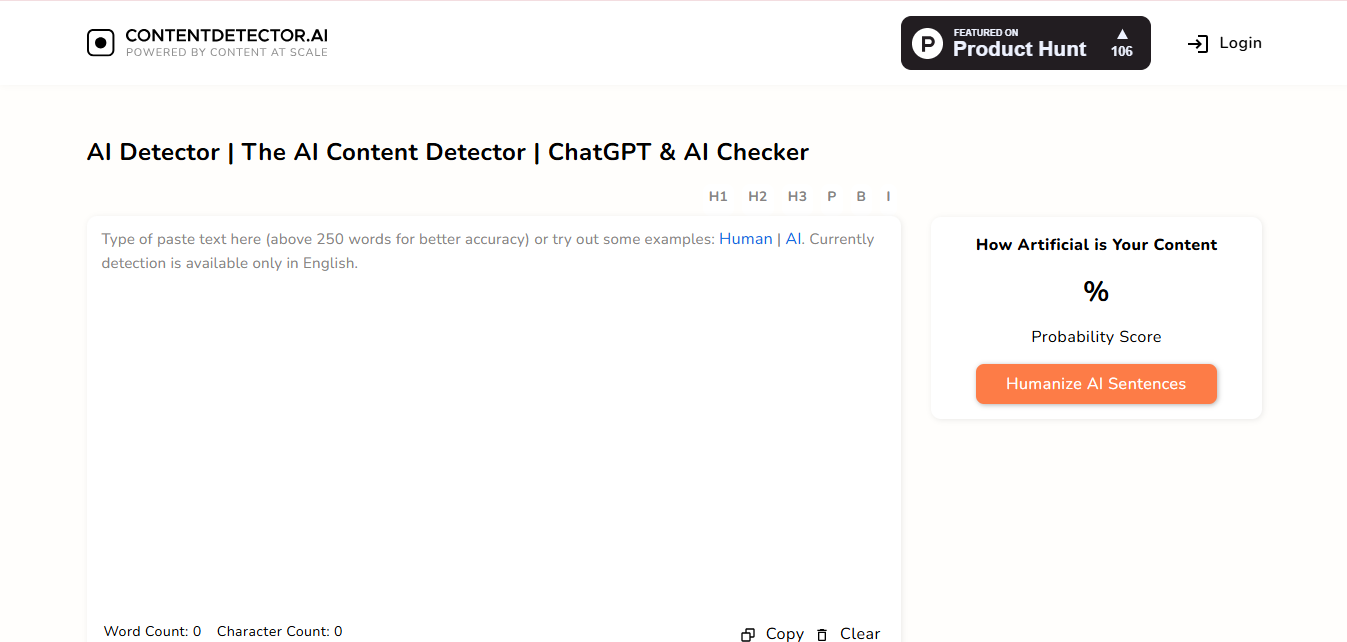
Content at Scale’s free detector remains aimed squarely at bloggers, SEO teams, and publishers who want a quick check before publishing, rather than at the academic integrity market the way Turnitin or Winston AI are. It’s simple to use for a fast gut check, though like every tool on this list, it shouldn’t be treated as the final word on its own.

Choosing a Detector Based on Who You Are
Not every detector on this list is built for the same job, and picking the wrong one for your actual use case is a common mistake.
If you’re an educator, GPTZero, Winston AI, and Turnitin are the three most purpose-built for classroom use, with reporting formats designed around academic integrity workflows and integration into learning management systems your institution likely already uses. Of the three, only Turnitin comes bundled with the plagiarism-checking infrastructure many universities already pay for, which matters if procurement and existing licensing are a factor.
If you’re a content marketer or agency, Originality.ai and Content at Scale’s detector are built around your actual workflow: reviewing freelance submissions at volume, checking your own team’s output before publishing, and in Originality.ai’s case, catching plagiarism in the same scan rather than requiring a second tool.
If you’re running an enterprise content pipeline, CopyLeaks’ API-first approach and multilingual support matter more than a polished single-document interface, since the goal is usually automated scanning integrated into an existing content management or publishing system rather than manual one-off checks.
If you just need a quick, free gut check, Sapling’s free tier or Content at Scale’s detector cover that without requiring a subscription commitment.
How These Models Actually Get Trained
Every detector on this list works from the same basic premise: train a classifier on large volumes of both human-written and AI-generated text, then have it learn statistical differences between the two. Common signals include “perplexity,” a measure of how predictable each word is given the words before it, and “burstiness,” which captures how much sentence length and structure vary across a passage. AI-generated text has historically scored lower on both measures, more predictable, more uniform, than typical human writing.
The problem is that this is a moving target on both sides. As language models get better at producing more varied, less predictable text, and as more people run AI output through paraphrasing tools before publishing it, the statistical gap detectors rely on keeps narrowing. Every major detector on this list has had to retrain against newer model generations just to maintain the accuracy it had a year or two earlier, which is part of why some of the smaller players in this space, like Crossplag, ended up folded into larger platforms with more resources to keep pace rather than continuing as standalone products.
What a Detector Score Doesn’t Tell You
A percentage score answers exactly one narrow question: does this text’s statistical fingerprint resemble known AI output more than known human output? It doesn’t tell you whether the content is accurate, whether it’s plagiarized from a specific source, whether it was AI-drafted then heavily human-edited, or whether an AI tool was used for research and outlining while the actual prose was written by a person. All of those scenarios can produce wildly different, sometimes contradictory, detector scores depending on which tool you use and how the text was produced.
That gap between what a score measures and what people assume it means is where most of the real-world harm happens, a confident-sounding percentage gets treated as settled fact when it’s actually a probabilistic guess with a documented error rate the tool’s own vendor usually acknowledges somewhere in their documentation, even when the marketing copy doesn’t emphasize it.
How to Use a Detector Result Responsibly
- Never rely on a single tool. Run suspicious text through at least two detectors before drawing any conclusion, since they’re trained differently and disagree often enough that a single result isn’t reliable evidence on its own.
- Treat a high score as a conversation starter, not a verdict, especially in an academic or employment context where the consequences of a false accusation are serious.
- Be extra cautious with non-native English writing. Independent research has repeatedly found detectors flag non-native English writers at disproportionately higher rates, likely because their sentence patterns statistically resemble some of the same simplicity markers detectors associate with AI text.
- Know which detectors have a conflict of interest. A vendor that also sells an AI-text humanizer, like Undetectable AI, has a different incentive structure than a detection-only tool.
- Re-check periodically. As shown by Crossplag disappearing entirely and GPTZero changing ownership, this category moves fast enough that a tool you relied on a year ago might not exist in its original form today.
Frequently Asked Questions
Can AI content detectors be fooled?
Yes, reliably. Paraphrasing tools, manual editing, and dedicated “humanizer” services are specifically built to reduce detection scores, and research consistently shows lightly edited AI text can slip past most detectors. Treat a clean result as inconclusive rather than proof of human authorship.
Why do detectors sometimes flag text I wrote myself?
Detectors look for statistical patterns like predictable word choice and consistent sentence structure, which can show up in genuinely human writing too, particularly formulaic writing like legal documents, technical documentation, or writing by non-native English speakers. A false positive doesn’t mean the tool is broken, it means the underlying method has real limits.
Are free and paid versions of these tools meaningfully different?
Usually yes, mostly in character limits, scan volume, and additional features like plagiarism checking or team accounts, rather than in core detection accuracy. If you only need occasional single-document checks, a free tier is often enough; teams scanning content at volume will hit those limits fast.
Should a business use AI detection to screen freelance writers?
Cautiously, and never as the sole criteria. Given documented false-positive rates, rejecting a freelancer’s work based purely on a detector score risks penalizing genuinely human writers whose style happens to trip the algorithm. Pairing a detector result with a direct conversation about process, drafts, or research notes is a fairer verification method.
Do search engines use these same detectors to penalize AI content?
Not directly, and not in the way a lot of site owners assume. Search engines have generally said they care about content quality and usefulness rather than how it was produced, and there’s no public evidence that Google runs content through third-party AI detectors like the ones on this list to make ranking decisions. That said, thin, generic, unedited AI output tends to perform poorly for the same reason thin human-written content always has: it doesn’t serve the reader well, independent of how it was drafted.
Is there a detector that works reliably across every language?
Not consistently. Most of these tools were trained predominantly on English text, and accuracy tends to drop for other languages even when a vendor advertises multilingual support. CopyLeaks and Crossplag’s successor, Inspera, both claim broader language coverage than most competitors, but treat any multilingual detection result with more skepticism than an English-language one until you’ve validated it against known samples in that language.
Why This Matters Beyond Academic Integrity
The stakes here extend well past classrooms. Publishers rejecting freelance submissions, hiring managers screening cover letters, and platforms moderating user-generated content are all increasingly leaning on these same detection tools to make decisions that affect people’s income and opportunities. A false positive in a classroom is a difficult conversation with a professor; a false positive in a hiring pipeline can mean a qualified candidate never gets a callback, without ever knowing why. The wider this technology gets deployed for consequential decisions, the more the responsible-use guidance above stops being optional best practice and starts being a basic fairness requirement.
The Bottom Line on AI Content Detection
The category has shifted meaningfully since detectors first went mainstream: some tools have changed ownership, one major name disappeared into a competitor’s platform entirely, and the honest conversation about false positives has gotten louder rather than quieter. None of that makes these tools useless, it just means the responsible way to use them in 2026 is the same as it’s always been: as a signal worth investigating, never as a verdict to act on alone.
Interesting Reads:
The Best Copywriting Frameworks 2025