The 10 Best Alumni Management Software Solutions


Building a strong alumni network is essential for educational institutions and organizations that want to maintain long-term relationships with their former students and members. Alumni play a crucial role in mentoring students, funding initiatives, and advocating for the institution’s growth. Managing an extensive alumni base manually through spreadsheets and disconnected email lists, though, quickly turns into a losing battle once a graduating class grows past a few hundred names.
This is where alumni management software comes in. These tools streamline communication, event management, and fundraising efforts, making it easier to keep alumni engaged years after they’ve left campus. Whether the goal is building a tight-knit community, increasing donor contributions, or creating professional networking opportunities between students and graduates, the right platform can shift alumni relations from a part-time chore to a genuine growth channel for the institution.
Below are the 10 alumni management software solutions worth evaluating in 2025, along with the practical differences between them, so the choice comes down to fit rather than guesswork.

What is Alumni Management Software?
Alumni management software is a specialized tool built to help educational institutions, organizations, and corporations maintain meaningful connections with former students, employees, or members. These platforms bundle contact management, event organization, fundraising tools, and communication channels into a single system instead of spreading the work across five different apps that don’t talk to each other.
The days of tracking alumni through spreadsheets or outdated Access databases are mostly gone at institutions that have scaled past a couple thousand graduates. Digital networking now means an office of two or three staff members can run reunions, donation drives, and newsletter campaigns for tens of thousands of alumni without losing track of who gave last year or who RSVP’d to which event. That capacity is the actual value proposition, not the dashboard itself.
Why is Alumni Management Software Important?
Alumni contribute to an institution’s success through mentorship, networking, financial support, and word-of-mouth advocacy that no marketing budget can buy. Keeping them engaged over decades, not just the first year after graduation, requires consistent outreach and organized relationship management that a volunteer committee can rarely sustain on its own.
Alumni management software automates the repetitive parts of that outreach so staff can spend their time on the relationships that actually move the needle, rather than manually updating contact records. Institutions that invest in the right platform tend to see stronger fundraising totals, better internship and job pipelines for current students, and a reputation among graduates as an institution that stays in touch instead of only calling when it needs a donation.
How to Choose the Right Alumni Management Software?
With this many options on the market, picking the right platform can feel overwhelming fast. Pricing matters, obviously, but so does ease of use for the volunteer coordinators who will actually log in every week, how well the software integrates with an existing student information system, and whether the vendor’s support team responds in hours or days when something breaks during a live fundraising event.
Some platforms lean heavily into social-network-style engagement features, encouraging alumni to post updates and connect with each other directly. Others are built primarily around fundraising and event logistics, with the networking piece treated as secondary. Neither approach is wrong, but they solve different problems, so it helps to write down what the alumni office actually struggles with today before comparing feature lists. An institution chasing donor retention needs different tooling than one trying to rebuild a dormant mentorship program from scratch.
It also helps to ask each vendor how alumni records get imported at the start and exported later if the relationship ever ends. Institutions with alumni data spread across a decades-old database, a spreadsheet the development office maintains separately, and whatever the registrar exports at graduation will find that migration complexity, not the sticker price, ends up being the real deciding factor between two otherwise similar platforms.
Trial periods are worth insisting on rather than skipping. A two-week free trial with real (not demo) alumni data uncovers usability problems that a sales demo never will, particularly around how quickly a volunteer coordinator with no technical background can build and send a segmented email campaign without submitting a support ticket first.
10 Best Alumni Management Software
1. Almabase
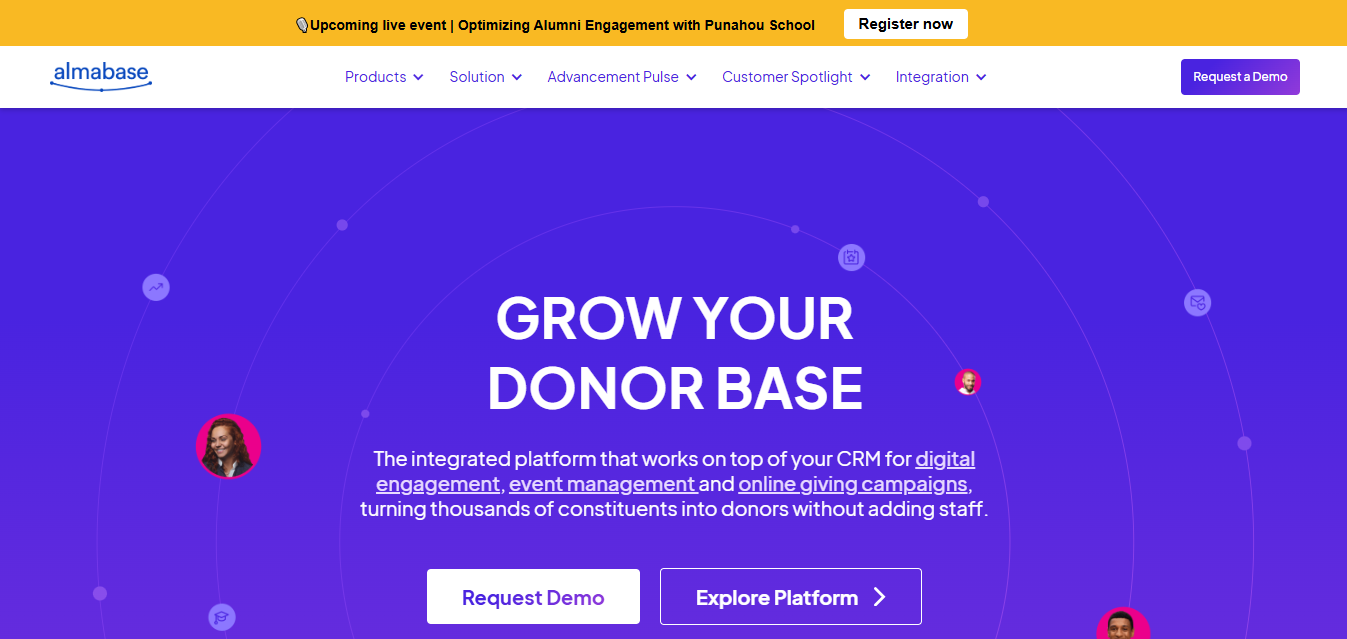
Almabase is an all-in-one alumni engagement platform aimed at institutions that want participation and fundraising numbers in the same dashboard rather than in separate spreadsheets. It handles email marketing, event management, and engagement tracking, and it plugs into common CRM tools so the advancement office isn’t re-entering donor data twice.
What stands out about Almabase is how much of its design centers on the giving officer’s actual workflow: knowing which alumni are warming up to a donation ask based on their event attendance and email opens, rather than sending the same appeal to everyone on the list. That personalization tends to pay for the subscription in a single successful campaign.
2. Graduway
Graduway is a well-established alumni networking platform built around mentorship, job placements, and community building rather than fundraising first. Institutions use it to spin up branded alumni portals where graduates can search for mentors, post job openings, or reconnect with old classmates.
Its AI-assisted matching engine pairs alumni with current students or fellow graduates for mentorship and career conversations, which is the feature most business schools cite as the reason they picked Graduway over a more generic CRM. The tradeoff is that fundraising tools are lighter here than on platforms like Almabase or Ellucian, so schools chasing both goals sometimes end up running two systems side by side.
3. Hivebrite
Hivebrite is a highly customizable alumni management platform suited to universities, nonprofits, and professional associations that want more control over branding and structure than an off-the-shelf template allows. It manages events, fundraising campaigns, and member communication from one console.
The feature that separates Hivebrite from competitors is its ability to spin up sub-communities inside the larger alumni network, letting a chapter of engineering graduates or a regional alumni club run its own space without needing a separate tool. That segmentation makes outreach feel targeted instead of generic, which matters once a network passes ten thousand members.
4. Vaave
Vaave is a cost-conscious alumni management option for institutions that need solid core functionality without an enterprise price tag. It covers networking, donation tracking, and event planning in a straightforward interface that doesn’t require weeks of onboarding.
Its job board lets alumni post openings directly and mentor current students, a feature smaller colleges often cite as the reason career services and alumni relations end up sharing the same platform. The tradeoff for that affordability is a smaller set of advanced analytics compared to enterprise tools like Ellucian.
5. Raklet
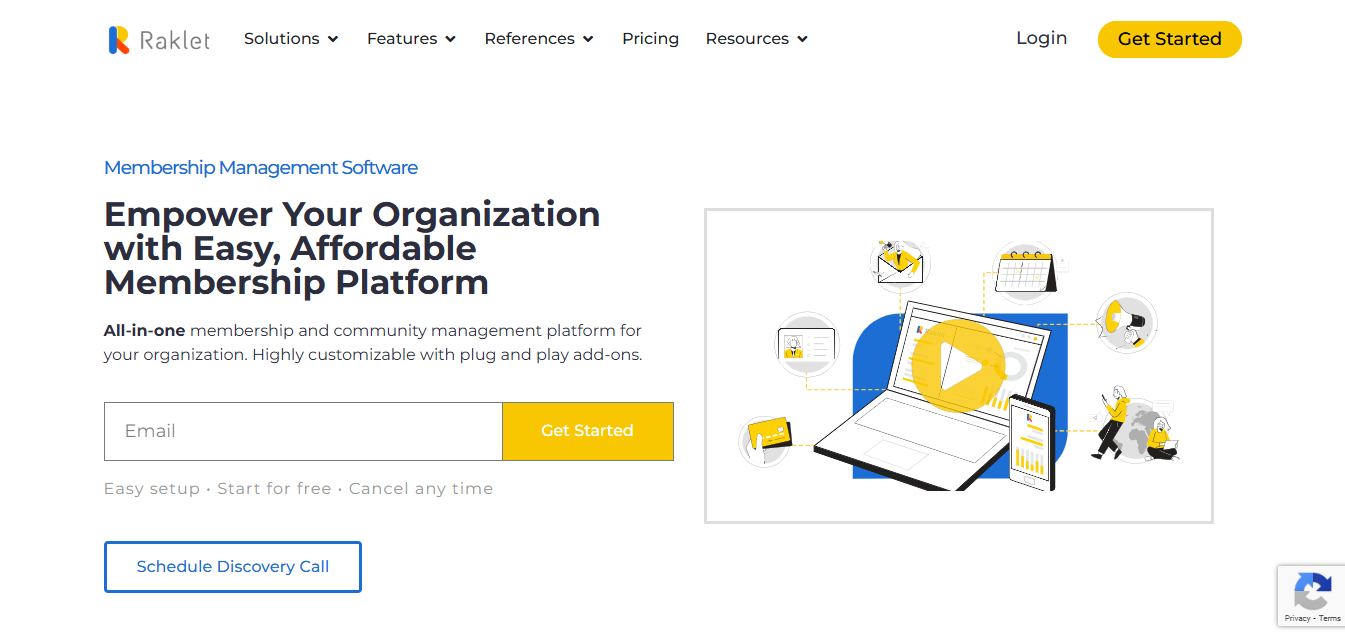
Raklet is a cloud-based alumni management platform that bundles engagement, fundraising, and event tools with the ability to build a custom-branded website or mobile app around them. Institutions that want alumni to have a dedicated app rather than just an email inbox tend to gravitate here.
Its automated communication tools cover email, SMS, and social media in one sequence, so a reunion announcement can go out across three channels without staff manually rebuilding the message for each one. Smaller alumni offices with limited headcount get the most value from that automation.
6. Almashines
Almashines is an AI-powered alumni engagement platform aimed at universities and colleges that want networking and community features driven by data rather than manual segmentation. It focuses on surfacing the relationships between alumni and their institution that are actually active.
Its analytics track engagement levels over time, flagging which segments of the alumni base are going quiet so outreach can be redirected before those relationships go cold entirely. That early-warning approach is more proactive than most competitors, which tend to report on engagement only after a campaign has already ended.
7. Wild Apricot
Wild Apricot started as a membership management platform and has since become a common choice for smaller alumni networks that don’t need the scale of a university-wide system. It covers event planning, automated emails, and a mobile app for members on the go.
Its straightforward interface and lower price point make it a practical fit for small to mid-sized institutions, community colleges, and single-department alumni chapters rather than large research universities. For a closer look at where it falls short for bigger networks, this comparison of the best Wild Apricot alternatives covers the gap in more detail.
8. ToucanTech
ToucanTech combines a contact database with fundraising tools built specifically for schools that need to maintain alumni relationships through targeted, well-timed communication rather than mass blasts.
Its strength is in data management: tracking donations, event participation, and general engagement so every outreach effort is grounded in what a given alumnus has actually done, not just guessed at. Development offices that already run on spreadsheets full of donor history tend to find the migration worthwhile specifically because ToucanTech keeps that history intact and searchable.
9. Graduway Community
Graduway Community is a companion product to the core Graduway platform, built specifically to deepen alumni relationships once the initial network is established. It leans on networking features that let alumni connect by shared interest, career field, or geography.
The mentorship tooling here is the standout, making it a strong pick for institutions that want to formalize career connections between current students and graduates rather than leaving those introductions to chance encounters at a homecoming event.
10. Ellucian CRM Advance
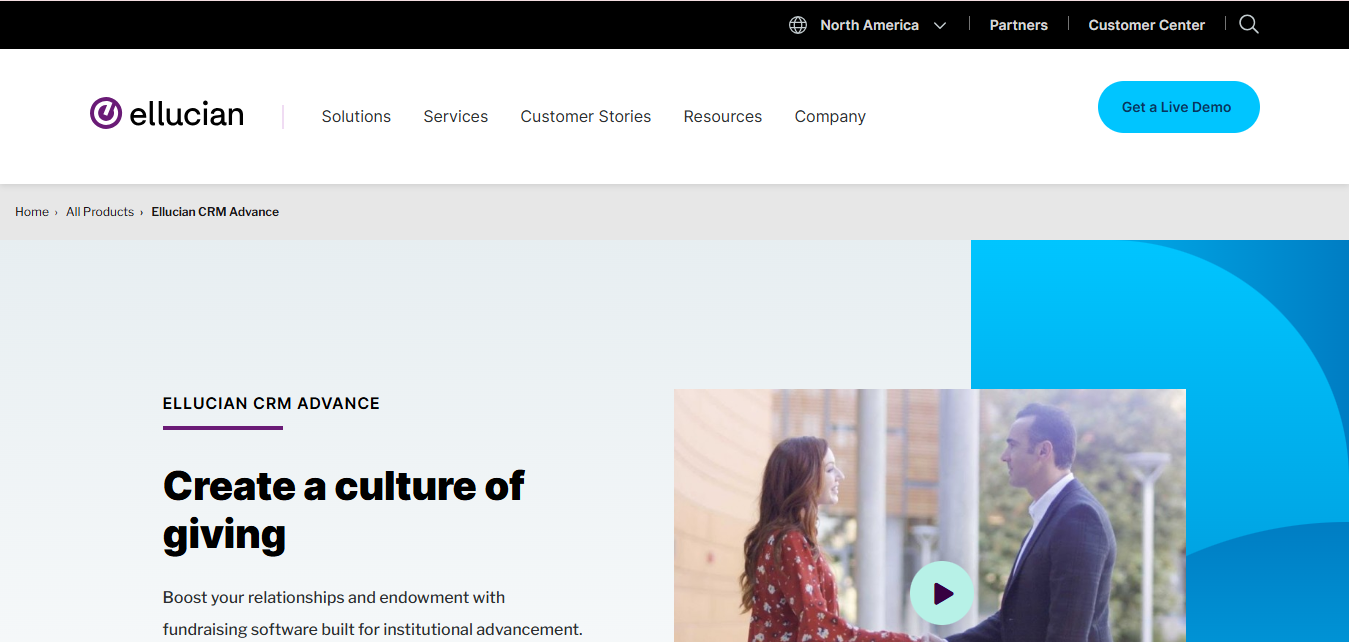
Ellucian CRM Advance is built for larger higher education institutions with an established fundraising staff and years of donor history to manage. It integrates directly with student information systems, so data moves from admissions through graduation to alumni status without anyone manually re-typing records into a second system.
Its donor management depth is the main draw for schools running major capital campaigns, where tracking pledge history, gift designations, and years of follow-up conversations across thousands of donors needs more structure than a general-purpose CRM provides. That depth comes with a steeper learning curve and a longer implementation timeline than smaller tools on this list. If your team is a two-person alumni office, this is probably more than you need.

What These Platforms Typically Cost
None of the vendors above publish flat public pricing, and that’s deliberate. Alumni management software is usually sold on tiers that scale with the number of alumni records in the database, so a college with five thousand graduates pays a fraction of what a state university with three hundred thousand alumni pays for the same tool. Expect a discovery call and a custom quote rather than a checkout page.
As a rough pattern across the category, tools like Wild Apricot and Vaave sit at the lower end and are realistic for small colleges or single-department chapters working with limited annual budgets. Almabase, Graduway, Hivebrite, and Raklet occupy the mid-market, usually requiring an annual contract and onboarding fee. Ellucian CRM Advance and ToucanTech skew toward large research universities and systems with dedicated fundraising staff, where the software is one line item inside a much bigger technology budget. Always confirm current pricing directly with the vendor before you budget for it, since these tiers shift as products add features.
Frequently Asked Questions
Can a small college realistically afford alumni management software?
Yes, and this is one of the more common misconceptions about the category. Platforms like Wild Apricot and Vaave were built with smaller budgets in mind, and several vendors offer discounted nonprofit or education pricing that isn’t always visible on the main pricing page. A single-department alumni chapter with a few thousand contacts is a realistic customer for most tools on this list, not just an afterthought.
How long does implementation usually take?
It depends heavily on how clean the existing alumni data is before migration starts. A school moving from a well-maintained spreadsheet can sometimes be live within a few weeks, while an institution consolidating alumni records from three different legacy systems should expect a multi-month project. Data cleanup, not the software configuration itself, is almost always the longest phase.
Do these platforms replace a general CRM like Salesforce?
Not usually. Most alumni management platforms are purpose-built for engagement and fundraising workflows specific to advancement offices, and larger institutions often run them alongside a general CRM for other departments, syncing data between the two rather than picking one over the other. Ellucian’s tighter integration with student information systems is the closest any tool on this list comes to functioning as a full institutional CRM.
What happens to alumni data if the institution switches platforms later?
Every reputable vendor in this space supports data export, typically as CSV files covering contact records, donation history, and event attendance. The real risk isn’t losing the data outright, it’s losing the relationships between records, like which donations tie to which campaigns or which mentorship pairs were made through the platform. Asking a vendor for a sample export before signing a contract is a reasonable way to gauge how painful a future migration would be.
Common Mistakes Institutions Make With Alumni Engagement
Even with the right software in place, plenty of alumni programs underperform because of habits that have nothing to do with the platform itself. The most common one is treating every graduate the same way, sending identical newsletters to a recent graduate looking for career advice and a fifty-year alumnus who mainly wants event invitations. Segmentation exists in nearly all of these tools for a reason, and skipping it wastes the software’s best feature.
Another recurring problem is only reaching out when there’s an ask attached, whether that’s a donation request or an event registration. Alumni notice the pattern quickly, and engagement drops once contact starts to feel transactional. The institutions that keep their numbers healthy tend to mix in genuinely useful touchpoints, like career resources or introductions to fellow graduates in the same field, between the fundraising campaigns.
Data hygiene is the third quiet killer. An alumni database that hasn’t been cleaned in years accumulates bounced emails, outdated job titles, and duplicate records that make segmentation and personalization far less effective than the software promises. Most of the platforms above include deduplication and data enrichment tools, but someone still has to run them on a schedule rather than assuming the system handles it automatically.
Metrics Worth Tracking Once the Software Is Live
Buying the platform is the easy part; knowing whether it’s working is where a lot of institutions lose the thread after the first few months. Event attendance rate among invited alumni is a good starting signal, since it reflects whether the community actually shows up when asked, not just whether emails get opened. A steady decline there usually points to fatigue from too many low-value touchpoints rather than a software problem.
Donor retention year over year matters more than total dollars raised in any single campaign, because it shows whether the relationship-building side of the platform is actually converting into recurring support rather than one-off gifts driven by a single well-timed appeal. Mentorship match completion rate is worth watching too, on any platform with a networking or mentorship component. A high number of matches made but few actually followed through with a conversation usually means the matching algorithm needs better filters, or the introduction email needs a clearer next step for both sides.
Bottom Line
If you’re picking between these ten, match the platform’s strengths to what your alumni office actually struggles with today, not to whichever tool had the flashiest sales demo. Each one covers different priorities, from Graduway’s mentorship focus to Ellucian’s donor management depth, and the right fit depends more on your institution’s size and goals than on any single feature comparison.
Whether the priority is stronger networking, higher fundraising totals, or simply getting reunion planning off a shared spreadsheet, the right software turns alumni relations from a once-a-year scramble into an ongoing relationship. Institutions building their alumni presence on WordPress can also pair that software with a theme like BuddyX Pro to give their alumni portal a community feel that matches the platform’s networking tools.
None of these platforms fix a broken engagement strategy on their own. The institutions getting the most out of their investment treat the software as infrastructure for a relationship-building effort that already has a plan behind it, not as a substitute for one. Start with a short list of two or three vendors based on institution size and primary goal, run an actual trial with live alumni data, and let the coordinators who will use it daily weigh in before signing a multi-year contract.
Interesting Reads:
The 3 Best Wild Apricot Alternatives for 2025
The 10 Best Virtual Event Platforms for Digital Engagement in 2025