Top 4 Strategies to Boost Customer Engagement

“Customer engagement” gets thrown around so often in marketing meetings that it’s easy to forget the term doesn’t have one fixed definition. There’s no single metric that proves a brand has it, and what counts as strong engagement for a SaaS company looks nothing like what counts as strong engagement for a boutique clothing store. That ambiguity is exactly why so many businesses chase engagement without a clear sense of whether their efforts are working.
Also Read: Create Ecommerce Sales Funnel
Still, a handful of strategies hold up across industries because they address something more basic than any single metric: whether a customer feels like the brand is paying attention to them as a person, not just a transaction. The four covered here are the ones that keep working regardless of which platform or trend happens to be dominant this year.
What is customer engagement?
Customer engagement covers every interaction a business has with a customer, online or offline, that shapes how that customer feels about the brand afterward. A few everyday examples: a customer opens an email about a new release and clicks through to look at it. Someone calls support to ask about a return and gets a fast, clear answer. A follower watches a behind-the-scenes video on a company’s Facebook page and comments on it.
What separates real engagement from noise is intent. Businesses that treat engagement as a genuine value exchange, rather than another channel for extracting a sale, tend to build the kind of loyalty that shows up later as repeat purchases and referrals. That means investing in things that help the customer even when there’s no immediate transaction attached: useful content, a responsive support team, or a product experience that doesn’t feel like a funnel.
A useful gut check: would this interaction still be worth doing if the customer never bought anything as a direct result? A genuinely helpful support answer, a piece of content that solves a real problem, an honest response to negative feedback, all pass that test. A thinly disguised upsell dressed up as “engagement” doesn’t, and customers notice the difference faster than most marketing teams assume.
How can we increase engagement with customers?
Four strategies consistently move the needle, regardless of industry:
1. Show up where your audience already is, and actually talk to them

There’s a meaningful difference between a brand that posts at its audience and one that talks with it. The first type treats social media as a billboard: product announcements, promotional graphics, repeat. The second asks questions, responds to comments, and shows up in the conversation instead of just starting it.
That second approach consistently produces higher engagement rates because it treats followers like people worth a reply, not an audience to broadcast at. A few concrete habits separate the two groups:
- Ask questions that invite a real comment, not a yes/no reaction
- Tag and thank individual customers publicly when they mention the brand
- Reshare customer content that fits the brand’s values
- Answer questions and comments promptly, not days later
- Run occasional contests with prizes people actually want
Also Read: Lifestyle WordPress Theme
2. Ask customers directly instead of guessing

When in doubt, ask. A short customer satisfaction survey gives more reliable insight into what’s working than any amount of internal speculation, and it doubles as a natural moment to request a review, which then drives engagement on the website and social channels.
Reviews compound in value because they give prospective customers something to react to and ask questions about, which is often the moment a happy customer becomes an informal advocate for the brand. Review-driven trust isn’t a minor factor either: independent surveys of online shoppers have repeatedly found that a strong majority of buyers say positive reviews make them more likely to trust a business, which is exactly why asking for feedback deliberately, rather than hoping it shows up unprompted, is worth building into a standard process after every purchase.
3. Define engagement goals specific to your business, not the industry average

Generic, industry-wide engagement benchmarks miss the specific opportunities a particular business has. A business running a newsletter should track subscriber growth and open rates as one of its core engagement metrics. A business leaning on social should watch its follower growth and share/comment/like rates. A content-heavy site should watch bounce rate and pages-per-session on the specific pages meant to hold attention.
The more specific the goal, the easier it becomes to design a tactic that actually moves it, instead of running generic campaigns and hoping something sticks.
Also Read: Best Open Source ERP Systems
4. Diversify the content format, not just the topics
Blog posts remain valuable for education, actionable advice, and building topical authority, and they’re worth continuing to invest in and share across social channels. But a blog shouldn’t be the only content format a brand relies on. It’s a starting point, not the whole strategy.
Mixing in short-form video, behind-the-scenes stories, and the occasional live stream keeps a brand feeling current to an audience that consumes content across several formats at once, and it gives people more ways to actually engage, comment, share, react, rather than passively read and move on.
The mistake to avoid here isn’t format laziness, it’s format sprawl without a plan. Adding a podcast, a YouTube channel, and a daily short-form video series all at once, on top of an already-running blog, usually produces four mediocre channels instead of one or two strong ones. A more sustainable approach: pick one additional format that best matches the content already being produced, repurpose the blog’s existing research and insight into that format rather than starting from a blank page, and give it a real quarter before judging whether it’s working.
How do you gauge customer engagement?
Measuring engagement matters as much as generating it. Without a way to track whether these strategies are working, a brand ends up guessing at effort instead of confirming results. Three metrics do most of the useful work for most businesses:
- Conversion rate: Whether the “conversion” is a completed purchase, a filled-out form, or a downloaded resource, this rate is the clearest signal that customers are engaged enough to actually act, not just browse.
- Time on page: How long visitors actually stay on a piece of content indicates how well it’s holding attention. Pages with strong dwell time are worth building more of; pages with weak dwell time are worth auditing or redesigning rather than assuming the traffic itself is the problem.
- Video completion rate: The share of viewers who watch a video all the way through is a direct read on whether the story or message actually lands, independent of how many people merely clicked play.
None of these three metrics needs to be tracked in isolation. The most useful read comes from watching them together over time: a rising conversion rate alongside falling time-on-page might mean visitors are getting to a decision faster, which is good, while a falling conversion rate alongside falling time-on-page usually means something on the page itself stopped working. Context between metrics tells a more honest story than any single number checked in isolation.
Common Mistakes That Quietly Undercut Engagement Efforts
Most engagement strategies don’t fail because the tactics are wrong. They fail because of a handful of avoidable habits that undo the tactic before it has a chance to work.
- Posting on a schedule that suits the business, not the audience. A brand that posts whenever it’s convenient internally, rather than when its actual audience is online and paying attention, will underperform an identical post published at a better time. Checking analytics for when an audience is actually active takes fifteen minutes and often doubles engagement on otherwise identical content.
- Asking for feedback and never acting on it visibly. A survey that goes out, gets responses, and produces no visible change trains customers to stop responding to the next one. Closing the loop, even a short “you told us X, so we changed Y” post, is what makes future surveys worth a customer’s time.
- Chasing vanity metrics instead of the ones tied to revenue. Follower count feels good to report internally but rarely predicts whether those followers actually buy or stay. Conversion rate and repeat-purchase rate are less flattering in a slide deck and far more useful for deciding what to keep doing.
- Running every channel at once instead of doing one channel well. A brand spreading thin effort across five platforms usually produces mediocre engagement on all five. Picking the one or two channels where the actual audience spends time, and doing those well, consistently beats a scattered presence everywhere.
Prioritizing Where to Invest First
Not every business needs to run all four strategies at full intensity simultaneously. A simple way to prioritize: start with whichever channel already has the most existing traffic or audience, since that’s where a small improvement in engagement produces the largest absolute gain fastest.
A business with an engaged email list of ten thousand people and a small, quiet social following gets more value from tightening its email strategy first than from launching a new social content push from zero. A business whose blog gets meaningful search traffic but converts poorly should prioritize the survey-and-goal-setting work described above before investing heavily in new content formats. Matching the investment to where the existing audience already is avoids the common trap of building a new channel from scratch while an underused existing one sits with real, untapped engagement potential.
Customer Engagement for Digital Product and EDD Sellers Specifically
Everything above applies broadly, but a store selling digital downloads, licenses, or courses through Easy Digital Downloads has engagement opportunities a physical-product store doesn’t: every purchase, download, and license renewal is a trackable, automatable touchpoint rather than a one-off transaction.
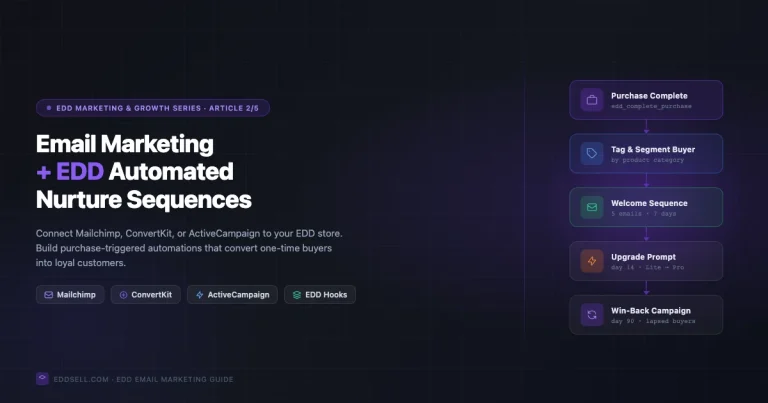
The most effective engagement layer for an EDD store is usually the post-purchase email sequence, not the social feed. A buyer who gets a genuinely useful “here’s how to get the most out of this” email a day after purchase, rather than a receipt and silence, is measurably more likely to open the next email and buy again. This guide to integrating email marketing with EDD covers building that sequence with real purchase-triggered automation rather than a generic newsletter blast.
The other EDD-specific opportunity is catching disengagement before it becomes churn. A customer who abandons checkout, or a license that’s approaching renewal with no recent activity, is a concrete, addressable engagement signal, not an abstract metric. This walkthrough of recovering abandoned carts in EDD covers the mechanics of catching the first kind of disengagement before the sale is lost entirely.
Segmentation is the piece that ties both of these together. A buyer of a $19 template and a buyer of a $499 software license shouldn’t get the same engagement cadence, one wants a light nudge and a useful tip, the other represents enough revenue to justify a more personal check-in before a renewal date. EDD’s purchase history data makes this kind of segmentation possible without guesswork; the mistake most stores make isn’t lacking the data, it’s never building the segments in the first place and treating every customer identically regardless of what they actually bought.
Building a Simple 90-Day Engagement Plan
Reading four strategies is easy. Turning them into a plan that actually gets executed is where most businesses stall out. A simple 90-day structure keeps the work from becoming an abstract goal that never gets scheduled.
- Days 1-30: Measure the baseline. Before changing anything, capture current conversion rate, average time on page for key content, email open rates, and social engagement rate. Without this, there’s no way to know later whether anything actually improved.
- Days 31-60: Run one experiment per channel. Not five changes at once, one per channel that’s actually in use, so it’s possible to tell which change caused which result. A new posting schedule on social, a redesigned survey, one new content format. Keep everything else constant.
- Days 61-90: Measure again and keep what worked. Compare against the baseline, drop what didn’t move the needle, and double down on what did. This is also the point to define the next quarter’s experiments based on actual evidence instead of guesses.
The structure matters more than the specific tactics chosen inside it. A business that tests one change at a time and measures honestly will out-improve one that tries everything at once and can never explain what worked.
It’s worth resisting the urge to declare victory or defeat after a single 90-day cycle, too. Some channels, email in particular, show results within weeks. Others, like building a following through consistent video content, take multiple cycles before the pattern becomes clear. Judging a slow-building channel by the same 90-day yardstick as a fast one is a common way to abandon something that was about to start working.
FAQ
How often should engagement metrics be reviewed?
Monthly for most businesses, with a lighter weekly glance at anything actively being tested, like a new content format or posting schedule. Reviewing daily usually reacts to noise rather than a real trend; reviewing quarterly means problems go unnoticed for months.
What’s the biggest mistake brands make when trying to boost engagement?
Treating every interaction as a sales opportunity. Customers can tell the difference between a brand that’s genuinely trying to help and one that’s using “engagement” as a euphemism for another pitch, and the second approach tends to suppress the exact behavior, comments, shares, replies, it’s trying to produce.
Does customer engagement matter more for subscription and recurring-revenue businesses?
It matters more visibly, because a disengaged subscriber cancels, while a disengaged one-time buyer simply doesn’t return, a quieter and easier problem to overlook. For any EDD store selling licenses, subscriptions, or memberships, engagement work has a direct, trackable link to renewal rates in a way that’s harder to isolate for a single-purchase product.
What’s a realistic first metric to track if a business has never measured engagement before?
Email open rate, if there’s an existing list, because it’s the cheapest to measure and the fastest to improve with a small change like better subject lines or send-time testing. For a business without an email list yet, conversion rate on the highest-traffic page is the next best starting point, since it ties most directly to revenue and doesn’t require new tooling to track.
Final Thoughts on Boosting Customer Engagement

What counts as strong engagement for a brand will keep shifting as channels, formats, and customer expectations change. What doesn’t shift is the underlying discipline: pay attention to what customers actually respond to, measure it honestly, and keep adjusting rather than running the same playbook long after it’s stopped working.
Interesting Reads:
Digital Product Marketplace By WordPress: Create Your Own Now