Community or Cohort: What Actually Keeps Students Engaged


“Community or cohort” gets framed as a binary decision on nearly every course-platform comparison page and feature list, as though picking one automatically rules out the other, and course creators researching engagement tactics often land on one or the other as if picking a side. It’s a false choice more often than not. A cohort is a structure: a fixed group that starts together and moves through content on a shared schedule. A community is a substrate: an ongoing space where people can find and talk to each other, cohort or no cohort. Confusing the two leads to some strange decisions, like running a rigid six-week cohort with zero peer interaction, or building an always-open community and wondering why nobody feels any urgency to show up.
The real question isn’t which one to pick. It’s which mechanism is actually doing the work of keeping a specific student engaged, and that answer changes depending on what stage of the course they’re in.
What each one is actually built to do
A cohort’s entire value proposition is synchrony. Everyone starts the same week, hits the same module at roughly the same time, and has a deadline that isn’t just internal motivation, it’s a shared calendar with other people watching. That synchrony creates real accountability: skipping a week doesn’t just mean falling behind an abstract schedule, it means falling behind people you’ve been introduced to, in a group small enough that your absence is at least theoretically noticeable.
Community, in the sense of an always-open space where students can talk to each other, creates a different kind of value: permanence and depth. A community doesn’t expire when the cohort’s six weeks are up. Someone who finished the course eight months ago can still answer a question from someone on day three, and that kind of longitudinal knowledge, accumulated from real students who’ve actually been through it, is something no cohort structure can produce on its own, because a cohort by definition resets.
Where cohorts win
Getting people to start
The single biggest engagement problem for most self-paced courses isn’t finishing, it’s starting. Courses sit in a customer’s downloads or dashboard for weeks before the first lesson gets opened, and by the time guilt about not starting sets in, a refund often feels easier than beginning. A cohort with a real start date attacks this directly: there’s a specific day everyone begins, which converts “I’ll get to it eventually” into “I need to be ready by Monday.” That deadline pressure, even a soft one, does more to get someone through lesson one than any amount of always-available community ever will.
Early-stage momentum
The first two weeks of any course are where a cohort’s synchrony pays off hardest. Everyone posting their week-one progress at roughly the same time creates a visible wave of activity that a purely asynchronous, always-open community structurally can’t replicate, because in an always-open format, any given week has some students on lesson one and others on lesson twelve, and that spread dilutes the sense that something is happening right now.
Clear finish lines
A cohort has an end date, and end dates create their own motivation: a live Q&A, a graduation moment, a specific date to have finished by. Purely self-paced courses in an open community rarely have an equivalent moment, because there’s no natural point where “the course” concludes for anyone in particular. That absence of a finish line is part of why self-paced completion rates lag cohort completion rates across the industry, even when the content itself is identical.
Where community wins
The long tail after the cohort ends
Every cohort eventually ends, and when it does, the accountability structure that was carrying engagement disappears with it. A student who finished 70% of the course during the live cohort window and needs another month to wrap up the rest now has nowhere to go if the cohort space closes on schedule. An ongoing community solves exactly this gap: it doesn’t care that the cohort officially ended, because it was never tied to the cohort’s calendar in the first place.
Answering questions a rigid schedule can’t accommodate
Cohorts are built around a shared pace, which means a student who’s genuinely stuck on something specific either has to wait for the group to move on or fall behind trying to resolve it during a window that’s already closing. A standing community isn’t bound by that clock. A question posted in month four of an evergreen space gets an answer whenever someone with relevant experience happens to see it, without any pressure to keep pace with a group that’s already moved past that module.
Compounding value across multiple purchases
If you sell more than one course, or plan to, a persistent community accumulates value that a fresh cohort every time cannot. Students who took your first course and are active in the community are primed, without any additional marketing spend, to hear about and buy your second course the moment it’s mentioned in the space they already check regularly. Cohorts reset that relationship every single time; a standing community compounds it.
The actual answer: cohort structure inside a persistent community
The strongest setup isn’t choosing one over the other. It’s running cohorts as a scheduling layer on top of a community that never closes. Concretely, that means the underlying space, the place where students can see each other, post, and get answers, stays open indefinitely, while specific cohorts get a scoped area (a private space, a tagged thread group, a dedicated section) that’s active and emphasized during the live weeks, then quietly folds back into the broader community once the cohort officially wraps.
This gets you the synchrony benefit of a cohort during the highest-leverage early weeks, when getting people to start and building early momentum matters most, without losing anyone the moment the official cohort window closes. A student who’s three weeks behind when the cohort ends doesn’t hit a wall; they’re still in a live space with people to talk to, just without the synchronized deadline pressure that got them started in the first place.
Where a standalone community layer fits
BuddyNext maps onto this hybrid model directly because Spaces support exactly the structure described above. A space can be scoped to a specific cohort (private, time-bound in practice even if not technically time-limited in the software) while sitting inside the same overall community as every other cohort that’s run before or since. Students from cohort three can still see and interact with activity from the general course space even after their specific cohort space goes quiet, because the underlying community layer, not the cohort, is what’s actually permanent.
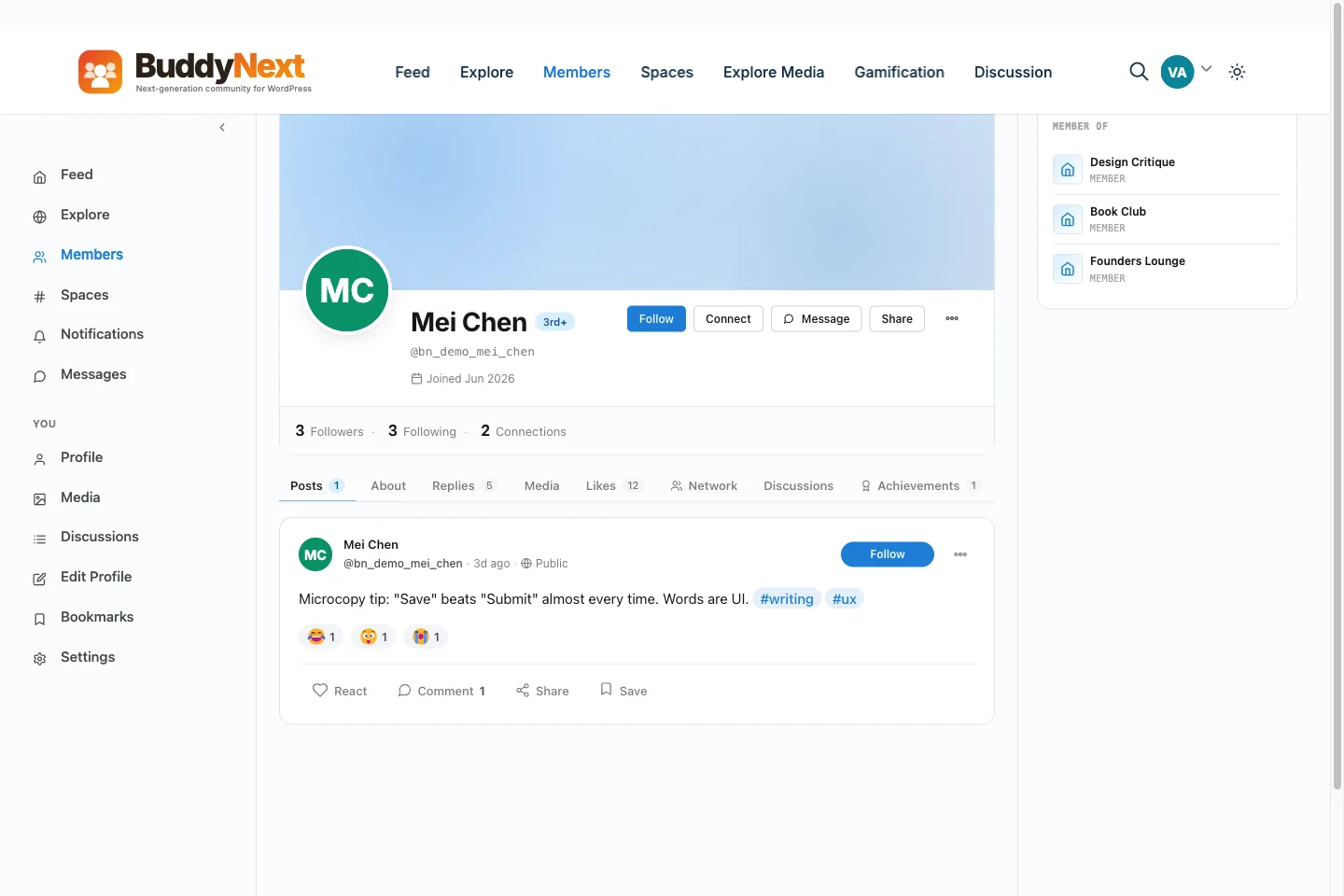
A persistent profile means a student’s history carries across cohorts, so someone who finished cohort one can be recognized and found by someone starting cohort four.
The Explore and directory features matter specifically for the long-tail engagement case. A student who finished their cohort months ago and comes back with a specific question can search or explore the space and actually find relevant past discussion, rather than starting from zero in a space with no memory. That searchable permanence is the exact thing a fresh cohort, rebuilt from scratch every time, structurally cannot offer.
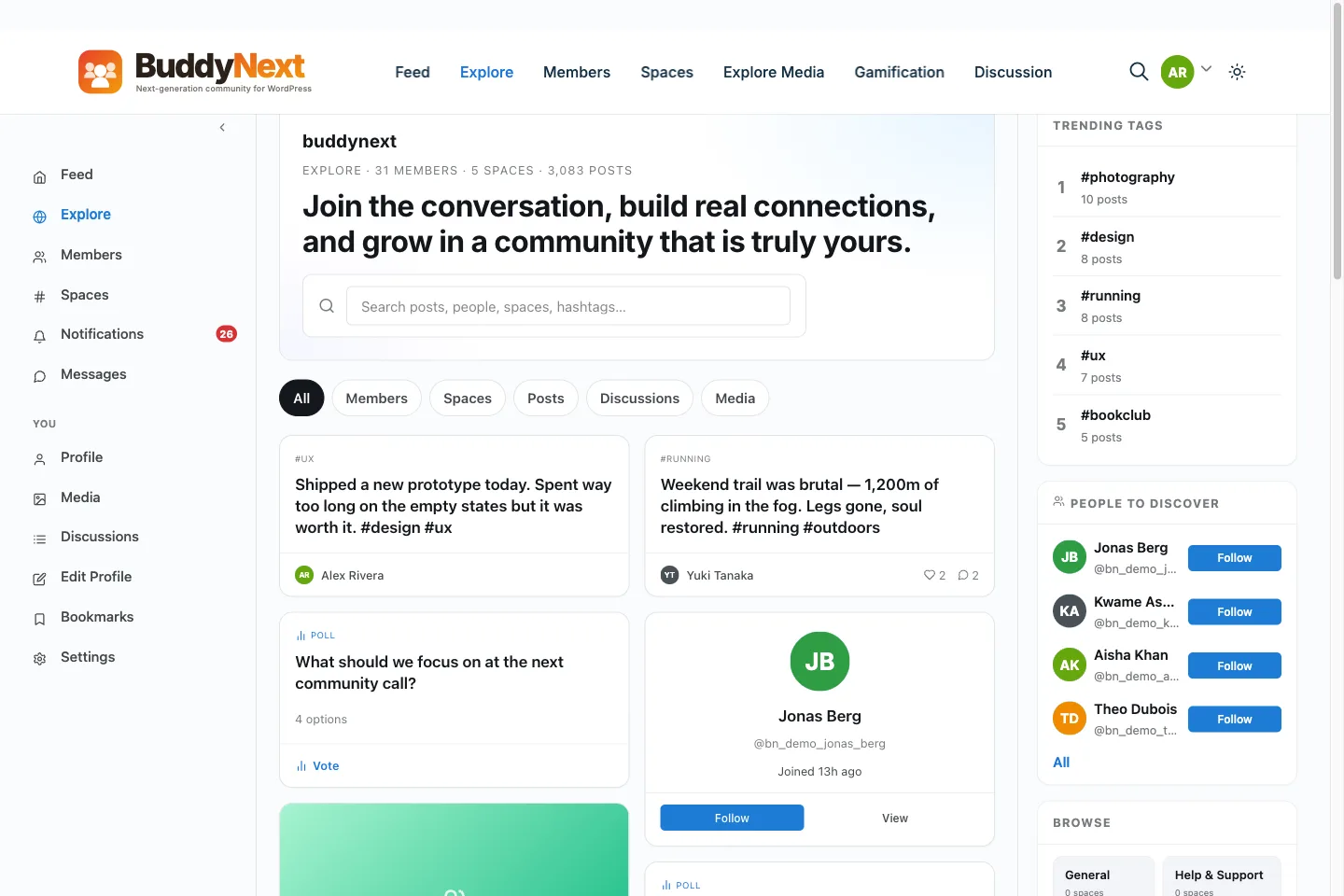
Explore and unified search work even with JavaScript off, which matters more than it sounds: a student searching for “how do I fix X” six months after their cohort ended shouldn’t hit a dead end.
On the free tier, this hybrid setup doesn’t require anything beyond what’s already included: Spaces (open, private, or secret) for cohort scoping, the activity feed for synchrony during live weeks, and profiles plus the member directory for the persistent, cross-cohort identity that makes the long tail work. If you eventually want automatic cohort assignment tied to purchase date, so a student buying in March lands in the March cohort space without manual sorting, that’s where Pro’s gated spaces and Stripe membership tiers become useful, but it’s an optimization on top of a model the free tier already supports.
How to decide the balance for your specific course
The right ratio of cohort structure to open community depends on what your course actually needs, not on a general best practice.
Technical, skill-building courses where students genuinely benefit from working at the same pace (learning a new tool, a coding bootcamp-style curriculum, anything with sequential dependencies between modules) lean toward heavier cohort structure, because working out of sync with the material genuinely costs something; module four assumes you’ve internalized module three, and a purely asynchronous format makes that harder to guarantee.
Reference-style or skill-application courses, where students are applying a framework to their own specific situation rather than following sequential dependencies (marketing strategy, business planning, creative practice), lean toward a lighter cohort layer and heavier open community, because the value is less about staying in lockstep and more about ongoing access to other practitioners solving similar problems at their own pace.
High-price, high-touch courses generally justify more cohort investment, live calls, synchronized deadlines, a defined start and end, because the price point supports the staffing cost of running a tighter structure. Lower-priced, high-volume courses generally can’t sustain that same cohort overhead per student and lean more heavily on a persistent, lighter-touch community instead. Whichever balance fits, the checkout and delivery mechanics matter less than people assume; whether you’re running Easy Digital Downloads directly or pairing it with a dedicated LMS plugin as covered in our comparison of selling online courses with EDD and an LMS plugin, the cohort-versus-community decision sits on top of that infrastructure rather than being dictated by it.
What this means for retention specifically
If the metric you actually care about is retention, not just completion, the hybrid model has a specific advantage worth calling out directly. Pure cohort models tend to produce a retention cliff: engagement is high during the live weeks, then drops sharply the moment the cohort ends, because there’s often nowhere left to be engaged. Pure community models tend to produce slow, diffuse engagement that never spikes high enough to actually get people started or moving in the first place.
The hybrid avoids both failure modes. The cohort layer produces the spike needed to get people started and moving. The persistent community underneath it means that spike doesn’t have to end in a cliff; it can taper into ongoing, lower-intensity engagement instead of stopping outright. That taper is where renewal and repeat-purchase decisions actually get made, weeks or months after the original cohort wrapped, not during the six weeks when everyone was already paying attention.
What the research on cohort-based learning actually supports
Online learning platforms have observed this pattern for years without needing a formal citation to justify it: shared deadlines and peer visibility increase completion, largely because social accountability substitutes for the self-discipline that fully self-paced formats demand entirely from the individual. It’s a big part of why cohort-based programs tend to report stronger completion than open-enrollment self-paced courses covering the same material. It’s not that the content is better paced for learning; it’s that the social structure does work the content alone cannot.
What that research doesn’t say, and what gets lost when “add a cohort” becomes shorthand for “fix engagement,” is what happens after the cohort’s accountability window closes. A synchronized deadline is extremely good at getting someone through the material once, under time pressure. It says nothing about whether that person stays engaged with your brand, your future products, or the skill they just learned, six months later. That’s a separate problem, and it’s the one a persistent community is actually built to solve.
A concrete example of the difference in practice
Picture two versions of the same twelve-week course. Version one runs as a pure cohort: a private space opens on day one, closes permanently on day eighty-four, and every trace of the discussion disappears with it. Students who finish on time get the full accountability benefit. Students who fall behind, and in any cohort of meaningful size, some always do, hit a hard wall: the space they’d use to catch up closes on schedule regardless of where they personally are in the material.
Version two runs the identical twelve-week structure, but the space itself never closes. The cohort still gets its own scoped area for the live twelve weeks, still gets the synchronized momentum of starting together, still gets a defined finish line. The difference shows up for the students who fall behind, who now have somewhere to keep going past week twelve without being cut off, and for the students who finished on time, who now have a reason to check back in three months later when they hit a real-world problem the course covered. Same content, same cohort mechanics, meaningfully different long-term engagement because one version treats the space as disposable and the other treats it as permanent infrastructure.
Common mistakes when trying to run both
The most common failure is running a cohort with zero connection to any lasting space. The cohort ends, the private group chat or temporary space gets archived or deleted, and every ounce of relationship-building from those six weeks evaporates. Students who might have stuck around for a second course have no path back in, because the door they came through no longer exists.
The second common failure is the opposite: building a single open community and calling every new enrollment period a “cohort” without any actual structural difference, no shared start date, no synchronized pacing, no cohort-specific space. That’s just a community with a marketing label attached, and it doesn’t produce the accountability benefits real cohort structure provides.
The third failure is understaffing the transition moment. The point where a cohort’s dedicated space folds back into the general community is exactly when students are most likely to feel forgotten, moved from a space where they were getting personal attention into a bigger pool where they’re one of many. A brief, deliberate transition, a welcome-back post in the general space, an invitation to keep participating, matters more than it seems at this exact moment.
Frequently asked questions
Should every course run cohorts, or is a pure community enough for some?
Pure community, without any cohort structure, works fine for reference-style courses where students dip in and out based on need rather than following a sequence. It works poorly for anything with real sequential dependencies or for courses that struggle with people never starting in the first place, where the deadline pressure of a cohort is doing real work.
How long should a cohort’s dedicated space stay separate before folding into the general community?
Most courses see diminishing returns on keeping a cohort space separate more than a few weeks past the official end date. A short tail, two to four weeks, gives stragglers room to finish without the schedule pressure of the live cohort, after which folding the space into the general community keeps things from fragmenting into dozens of dead, cohort-specific ghost spaces.
Does running cohorts require more staffing than a pure community?
During the live weeks, generally yes, because the synchronized activity creates a concentrated burst of questions that all arrive around the same time rather than spreading out. The persistent community layer underneath actually reduces total staffing over time, because older cohorts’ accumulated answers mean fewer entirely new questions as the community matures.
What if I only run one cohort a year, is a persistent community still worth it?
Yes, arguably more so. With infrequent cohorts, the gap between sessions is exactly where students are most likely to forget about you entirely if there’s nowhere for them to stay connected. A persistent community keeps last year’s cohort at least loosely engaged until the next one opens, which is valuable both for their own continued progress and for word-of-mouth into the next enrollment period.
Can I start with just a cohort and add the persistent community layer later?
Yes, and for a first course this is often the more realistic order. Run the first cohort with whatever lightweight space you can manage, see where students actually needed more support after it ended, and build the persistent layer around those specific gaps rather than guessing at the full structure in advance.
Does this apply the same way to a fully self-paced, no-cohort course?
The persistent community half applies fully. The cohort half doesn’t, obviously, but you can borrow the synchrony trick in a lighter form by grouping students loosely by start month or start week inside the same open space, which gives new enrollees something recent and active to see without running a formal cohort schedule.
How does this relate to the broader decision of whether to add a community at all?
This piece assumes you’ve already decided some form of peer interaction makes sense for your course and is really about which structure, cohort-based, always-open, or a hybrid, fits your specific material and audience best. If you haven’t made that first decision yet, our broader look at whether your online course should have a community attached to it covers the cases where no community, of any structure, is the right call.
The actual takeaway
Whichever platform choice underlies your course, the shape of the engagement problem is the same, and it’s worth reading your own numbers before committing to either extreme. Look at when students actually stop showing up, whether that’s during a live cohort window or months into a self-paced format, and let that timing tell you whether the fix is more synchrony, more permanence, or genuinely both. Stop treating this as a binary choice on a sales page or a course-platform feature list. Cohorts get people started and moving; community keeps them from disappearing the moment the structure that got them started goes away. Build the persistent layer once, run cohorts as a scoped, time-bound structure inside it, and let the students who need deadline pressure get it while the students who need ongoing access to other practitioners get that too, without forcing every student through the same shape of engagement regardless of what they actually need.