Do Digital Product Sellers Need a Marketplace Plugin or Just a Contact Form?


A “Hire Me” contact form takes maybe fifteen minutes to set up. A marketplace plugin, even a lightweight one, takes an afternoon and a real decision about how much of the buying process to formalize. Given that gap, it’s a fair question to ask before doing either: does a digital product seller who occasionally sells custom work actually need marketplace software, or is a contact form, cheap, familiar, already built into half the form plugins on the market, genuinely enough?
The honest answer is that it depends on volume and consequence, not on some fixed rule about what “real” businesses use. This post is the actual marketplace plugin vs contact form comparison: what a contact form can and can’t do, what a marketplace plugin adds, and where the line sits between “this is overkill” and “this is overdue.”
Marketplace plugin vs contact form: what the form actually does well
It’s worth being fair to the contact form before dismissing it, because for a specific and common situation, it’s genuinely the right tool. A seller getting one or two custom-work inquiries a year, where each one is different enough that no fixed pricing structure would make sense anyway, doesn’t need an order-management system. A contact form routes an inquiry to an inbox, the seller replies, negotiates over email, and invoices through whatever payment tool they already use. That’s not a broken process at low volume, it’s proportionate.
Contact forms are also genuinely better than a marketplace plugin for the specific case of highly bespoke, hard-to-scope work, a full custom build with a vague brief, a consulting engagement whose shape isn’t clear until a call happens. Forcing that kind of request into a fixed-tier pricing structure produces awkward, inaccurate tiers nobody’s happy with. Some work really does need a conversation before a price makes sense, and a form that starts that conversation is the right shape for it.
Where a contact form quietly stops being enough
The form itself doesn’t change. What changes is volume, and volume exposes everything a simple inquiry form was never built to handle.
There’s no order record, only a message
A contact form submission is an email. It’s not a payment record, not a scope document, not a status tracker. At one inquiry a month, that’s fine, the seller remembers the context. At six inquiries a month across different buyers at different stages, “remembering the context” turns into scrolling through an inbox trying to reconstruct who paid what for what, which is exactly the informal-system problem covered in our post on selling custom services alongside digital downloads.
Payment and inquiry are disconnected
A contact form doesn’t take payment. It generates a lead, and payment happens somewhere else entirely, a separate invoice tool, a PayPal link, a bank transfer, with no structural link between “buyer asked” and “buyer paid.” That gap is where scope disputes and forgotten follow-ups live. It’s also where a buyer can quietly vanish after inquiring, because there’s real friction between “filled out a form” and “committed to paying,” friction a direct checkout button doesn’t have.
There’s no public listing, so nobody discovers the offer passively
A contact form is only useful to a buyer who already knows to look for it, it doesn’t advertise itself, doesn’t show pricing, doesn’t let a browsing visitor understand what’s actually being offered before deciding to reach out. A marketplace-style listing, by contrast, functions like any other product page: discoverable, self-explanatory, and able to convert a browsing visitor into a buyer without a single email exchange. At low volume this doesn’t matter because the seller isn’t trying to grow the custom-work side of the business. Once growth becomes the goal, an inquiry-only form becomes an active ceiling on it.
Every quote gets reinvented, every time
Without a pricing structure attached to the form, every single inquiry gets a custom, manually-typed quote. This is the exact problem covered in depth in our piece on turning one-off custom work into a repeatable service package, once a request repeats, reinventing its price and scope from scratch every time is pure waste, and a contact form has no mechanism to prevent that waste from continuing indefinitely.
What a marketplace plugin actually adds, concretely, not abstractly
“Marketplace plugin” sounds like heavier infrastructure than what most digital product sellers actually need, and that reputation is part of why so many default to a contact form instead. But a plugin built specifically for service listings, as opposed to a general-purpose multi-vendor commerce platform meant for physical goods, adds a narrower, more directly relevant set of capabilities.
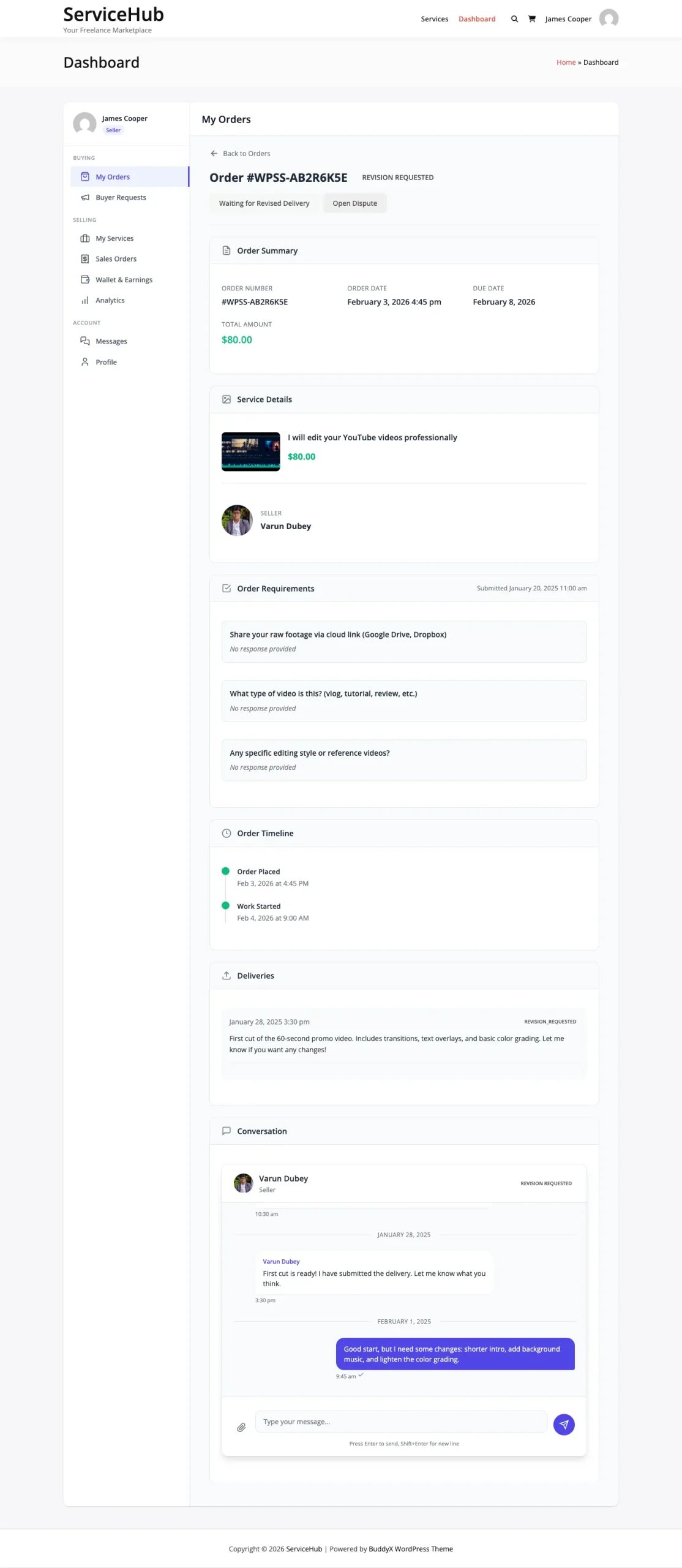
Where a contact form generates a one-off email, a service listing’s order messaging keeps every exchange attached to a specific, trackable order.
WP Sell Services, for instance, runs standalone with no WooCommerce, BuddyPress, or EDD dependency, and covers the specific gaps a contact form leaves open: a multi-step service creation flow with three-tier pricing (so buyers see a defined price instead of submitting a blind inquiry), built-in Stripe and PayPal checkout (so payment and request are the same event instead of two disconnected ones), an 11-status order lifecycle (so there’s an actual record of where each request stands), and order messaging with file attachments (so the back-and-forth lives on the order itself, not scattered across an inbox).
None of that is exotic infrastructure. It’s the specific missing pieces a contact form never had, assembled into one system instead of stitched together from an inbox, a separate payment link, and a personal memory of who’s owed what.
The vendor and trust layer a form can’t replicate
A subtler gap, easy to miss until it’s pointed out: a contact form generates zero social proof. Every inquiry starts from zero trust, because there’s nothing on the page showing that anyone has ever successfully bought this service before. A vendor system with auto-calculated seller levels solves exactly this, a visible history of completed orders functions the same way a review count or a “Top Rated” badge does anywhere else online, and it compounds over time in a way an inquiry form structurally cannot, because an inquiry form doesn’t track completed transactions at all.

A vendor profile with order history gives buyers a trust signal a contact form has no way to provide.
A decision framework, not a rule of thumb
Rather than a single volume threshold, three questions do a better job of separating the two situations.
Is the pricing structure knowable in advance? If most requests fall into a handful of recognizable categories with roughly predictable scope, a fixed-tier listing beats a blind-inquiry form, buyers get instant clarity, and the seller stops quoting from scratch. If every request is genuinely unique and needs a conversation before pricing makes sense, a contact form (or a hybrid, a form that funnels into a custom quote, which some marketplace setups also support) is the better starting point.
Does volume justify order tracking? One or two custom jobs a year don’t need an order lifecycle; a spreadsheet or a good memory covers it. Several a month absolutely do, because the cost of losing track of a single order, a missed file, a forgotten deadline, a disputed scope, starts outweighing the setup cost of a proper system almost immediately.
Does the seller want this to grow, or just to exist? A contact form is a passive safety valve for occasional requests. A marketplace-style listing is an active growth channel, discoverable, self-serve, capable of converting browsing visitors who never would have sent an email. If the goal is to keep custom work as a minor, occasional sideline, the form is proportionate. If the goal is to grow it into a real second revenue line, the form is actively capping that growth.
Three sellers, three different right answers
Abstract volume thresholds are less useful than seeing how the decision actually plays out for different kinds of sellers, because “how many inquiries a month” isn’t the only variable that matters.
The first is a photographer who sells preset packs on EDD and occasionally gets asked for a custom photo-editing session, maybe four times a year, always from a different kind of client with a different kind of shoot. For this seller, a contact form is correct and will likely stay correct. The requests are too infrequent and too varied to justify fixed pricing tiers, and the cost of occasionally losing a thread in an inbox is genuinely low at four inquiries a year. Building a structured listing here would be solving a problem that doesn’t really exist yet.
The second is a WordPress plugin developer selling a handful of premium extensions, who gets weekly requests to build custom integrations against client-specific setups. Here the contact form has already become a bottleneck, the developer is spending hours a week reconstructing scope from old email threads, quoting inconsistently, and losing track of which client is owed what. This is squarely in structured-listing territory: the requests repeat often enough that packaging even a subset of them (the most common integration types) into fixed-tier listings would immediately reduce the quoting overhead and give buyers a self-serve path that doesn’t require waiting on a reply.
The third is a course creator who sells a flagship course and occasionally offers one-on-one coaching calls tied to it. Volume is moderate, a handful of buyers a month, but each engagement is genuinely personal and hard to standardize into rigid tiers. The right setup here is often the hybrid mentioned above: a structured listing for a clearly defined package (say, a fixed 3-call coaching bundle with a set price), alongside a contact-first path for anything more custom than that. Volume alone doesn’t answer the question for this seller; the shape of the work does.
A middle path that some sellers miss entirely
It’s worth naming explicitly that this isn’t strictly binary. A seller can run a structured service listing for the requests that fit a definable scope, the repeatable ones, per the packaging framework above, while keeping a separate contact form or “let’s talk” link for the genuinely bespoke, hard-to-scope engagements that don’t fit neatly into three pricing tiers. This hybrid is often the actual right answer for a seller whose custom work spans both categories: some requests are predictable enough to package, others aren’t, and forcing everything into one model or the other wastes the strengths of whichever one gets discarded.
The hidden cost of a contact form: buyers who never send the message
Most sellers evaluate the contact form against the inquiries they actually received, which misses the more important number, the inquiries that never got sent because the friction of “email a stranger and wait for a reply” was enough to talk a hesitant buyer out of it entirely. That lost demand is invisible in a way that makes a contact form look more sufficient than it actually is. A seller sees, say, six inquiries a month and concludes the form is handling demand fine, with no way of knowing how many browsing visitors considered reaching out and quietly decided it wasn’t worth the effort.
This matters because the psychology of a checkout button and the psychology of a contact form are genuinely different. A checkout button implies a known, low-risk commitment, pick a tier, pay, get what’s described. A contact form implies an open-ended, unpredictable one, send a message, wait an unknown amount of time, negotiate an unknown price, possibly get a “sorry, I don’t do that” reply after all. Buyers who are on the fence, who might have converted if the path were simpler, disproportionately choose to just close the tab instead of sending the email. There’s no clean way to measure this loss after the fact, which is exactly why it tends to go unaddressed, the seller never sees the visitors who left, only the smaller number who pushed through the friction anyway.
What happens to response-time pressure once a listing exists
A less obvious benefit of a structured listing: it removes a specific kind of pressure a contact form quietly imposes on the seller. Every inquiry sitting unanswered in an inbox carries an implicit clock, the longer it sits, the colder the lead gets, and the seller often knows it, which turns a growing inbox of unanswered custom-work emails into a low-grade source of guilt and urgency that has nothing to do with the actual difficulty of the work itself.
A listing with clear pricing and turnaround expectations doesn’t remove the need to respond to buyer questions, but it does remove the negotiation itself from the response-time pressure. A buyer who lands on a well-described listing can often just purchase without waiting on a reply at all, the seller finds out about the order at the same time the buyer commits to it, rather than needing to personally unstick every single inquiry before it can move forward. That shift, from every request needing an individual human response before anything can happen, to most requests self-serving through checkout, is a meaningful reduction in day-to-day operational load that rarely gets counted when sellers weigh the setup cost of a structured system against staying with a form.
What migrating from a contact form to a structured listing actually involves
For a seller already running on the inbox-and-invoice system, the move to a structured listing isn’t a full rebuild. The existing informal pricing and scope, refined over however many past inquiries, becomes the starting draft for the first service listing’s tier descriptions, this is real product research already done, not a blank page. The main new work is deciding on Stripe or PayPal connection (both built in), writing the requirements-collection questions that used to happen ad hoc over email, and picking where the listing gets linked from so existing inquiry-generating traffic finds the new, faster path instead of the old form.
Sellers who’ve been running the contact-form version for a while often already know exactly what questions they always end up asking every inquiry by email, that list is the requirements form, nearly ready-made. The setup mechanics themselves, covered step by step in our practical setup guide for EDD store owners, tend to move faster for a seller migrating from an existing informal process than for one starting completely from scratch, because so much of the thinking, what to charge, what to include, how long things take, has already happened through trial and error.
Testing the waters without fully committing
A seller genuinely unsure which side of this decision they fall on doesn’t have to guess blind. Publishing one structured listing for the single most common custom-work request, while keeping the contact form live for everything else, is a reasonable way to test actual demand and behavior before deciding whether to formalize further. If that one listing starts converting buyers who never would have sent an inquiry email, that’s a real signal the structured approach is worth expanding. If it sits mostly unused while the contact form keeps generating the same trickle of inquiries as before, that’s useful information too, it suggests the volume genuinely doesn’t justify more structure yet, and the contact form was the right call all along.
This kind of small, reversible test costs an afternoon of setup and produces real data instead of a guess. It’s a far better way to resolve the plugin-versus-form question than trying to reason it out entirely in the abstract before a single real buyer has seen either option.
Frequently asked questions
Isn’t a marketplace plugin overkill for just one or two services?
Not necessarily, the core value isn’t about having many listings, it’s about giving even a single service a defined price, a real checkout, and an order record instead of an ad hoc email-and-invoice process. A seller with exactly one repeatable service still benefits from all of that structure.
Can I keep using a contact form for some requests and a structured listing for others?
Yes, this is a common and sensible hybrid, covered above. Predictable, repeatable requests fit a tiered listing; genuinely bespoke, hard-to-scope work often still benefits from an inquiry-first conversation before any pricing gets set.
Does switching to a marketplace-style listing mean losing the personal, conversational feel of email inquiries?
No, order messaging with file attachments still supports a full back-and-forth conversation once an order starts. What changes is that the conversation happens inside a structured order with a price and a record already attached, rather than as a completely open-ended negotiation with nothing settled yet.
What does this cost compared to just using a free contact form plugin?
WP Sell Services is free at the core, with no WooCommerce, BuddyPress, or EDD dependency required, so the cost comparison against a free contact form plugin isn’t really about price, it’s about the order management, checkout, and trust-building features that make a listing worth the extra setup time. A paid Pro Personal tier ($69/yr) adds WooCommerce integration, vendor analytics, and scheduled payouts for sellers who outgrow the free tier’s needs.
How do I know if my volume actually justifies making the switch?
A rough gut check: if the same three or four types of request keep repeating monthly, and reconstructing “who’s owed what” from an inbox is starting to take real time each week, the exact symptom our guide to email organization software addresses from the inbox-management side, that’s well past the point where a contact form is still proportionate to the workload.
The real question isn’t plugin versus form
Framed as “marketplace plugin or contact form,” this sounds like a binary technology choice. It isn’t, really, it’s a question about how much of the buying process a seller wants to formalize, and that answer changes as volume changes. A contact form is the right answer at low volume and for genuinely bespoke work. A structured listing is the right answer once requests repeat, once payment and inquiry need to be the same event, and once a growing track record starts to matter more than a single friendly reply ever could. Most sellers don’t need to choose once and commit forever, they need to notice when the volume has quietly outgrown the form, and switch before the inbox does.