Reducing Course Refunds With a Peer Community Layer


A peer community layer, in this context, means a gated space where students in the same course can see each other’s activity and talk to each other, not just to you. Most refund requests don’t start the day someone clicks the refund button. They start weeks earlier, at the exact moment a student gets stuck on something and has nobody to ask. By the time the request lands in your inbox, the decision was made days or weeks ago; the email is just the paperwork.
That timing gap is the whole argument for using a course refunds community strategy: catching students before they quit rather than reacting after the request arrives. It’s not about talking people out of refunds they’ve already decided on. It’s about catching the moment of confusion before it turns into a decision at all.
What course refunds and community activity actually have in common
This matters because most refund policy conversations focus on the wrong lever entirely, tightening the window, adding friction to the request form, requiring a reason before processing. Those changes might shave a few points off the raw number, but they don’t touch why the student wanted a refund in the first place, and a customer who feels stonewalled on a refund request is far more likely to leave a negative review than one who got their money back cleanly. The more durable fix works upstream of the request, not on the form itself. Pull up your last twenty refund requests and read the reasons customers gave, not the category you filed them under, the actual words. A striking number will not say “the course was bad.” They’ll say some version of “I didn’t have time,” “it wasn’t what I expected,” or “I got busy and never finished.” Vague reasons like these usually aren’t about content quality. They’re the polite version of “I got stuck somewhere and stopped trying,” dressed up because nobody wants to admit to a stranger in a refund form that they gave up on module three.
Compare that to the small minority of refund requests that are specific: a technical bug, content that genuinely didn’t match the sales page, a feature that was promised and never delivered. Those are real quality problems, and no community layer fixes them. Fix the actual product issue. But the vague, evasive refund reasons, which in most course businesses are the majority, are usually a symptom of isolation, not a symptom of bad teaching.
The mechanism: how isolation turns into a refund
Picture the typical path. A student buys a course with real enthusiasm, works through the first two or three modules over a weekend, then hits real life: a busy week at work, a module that’s more technical than expected, a concept that doesn’t click the first time. In a course with no community, there’s nowhere for that moment to go except quietly closing the tab.
Nothing happens for a while. No prompt, no nudge, no visible sign that anyone else is also stuck or that getting unstuck is normal. Three weeks pass. The student opens their email, sees the course sitting there unused, and instead of feeling motivated, feels a small wave of guilt, which is a genuinely unpleasant feeling to have attached to a purchase. Somewhere around week four to six, most refund policies still have a window open, and the guilt resolves itself the easiest way available: request a refund, close the loop, stop feeling behind on something they paid for.
Now run the same scenario with an active peer space attached to the course. The student hits the same rough module. Instead of silently closing the tab, they see, right there in the space, that three other people posted about the exact same module being harder than expected, one of them a week ago with a reply underneath explaining what finally clicked. That single data point changes the story the student tells themselves. It’s not “I’m failing at this,” it’s “this part is just genuinely harder, and I’m not alone in finding it that way.” That reframe is often the entire difference between someone who pushes through and someone who quietly gives up.
Why this works better than more content or better emails
The instinctive fix for a rough module is to make the module easier or add more explanation. Sometimes that’s the right call, and if a specific piece of content is objectively confusing, fix it. But a lot of the friction that leads to refunds isn’t a content problem at all; it’s a “am I the only one struggling” problem, and no amount of additional video content solves that, because the student never opens the additional video content either. They’ve already stopped watching.
Drip email sequences try to solve the same problem from a different angle: reminder emails, motivational nudges, progress check-ins. These help at the margins, but they’re one-directional. An email can tell a student “you’re not alone,” but it can’t show them. A peer space does, because the evidence is right there: real people, real posts, real proof that getting stuck at this exact point is normal and survivable.
Where a standalone community layer fits
BuddyNext is relevant here specifically because it’s a standalone WordPress community plugin, not something that requires BuddyPress underneath it or forces you to rebuild your existing course stack. For a course business already running Easy Digital Downloads for checkout, whether that’s using EDD directly as your LMS platform or pairing it with a separate LMS plugin, adding a peer layer shouldn’t mean replacing anything that already works, and BuddyNext is built so it doesn’t have to.
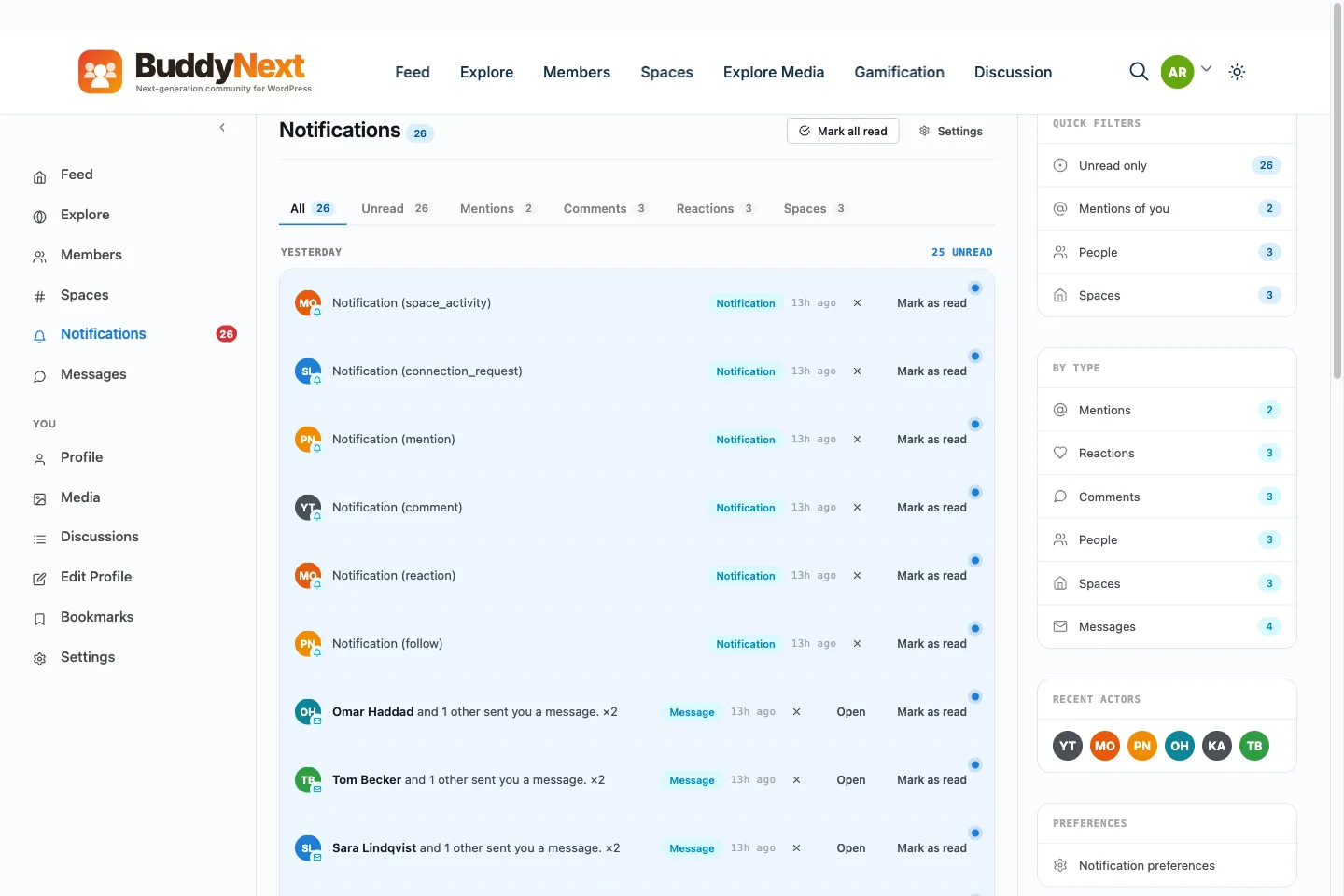
Notifications matter more here than they might seem to. A student who gets a reply notification a day after posting a stuck question is far more likely to come back and finish than one who never knows anyone answered.
The free tier’s activity feed, with its For You and Following tabs, does something specifically useful for this problem: it surfaces recent activity from people in the same course rather than burying it in a generic timeline. A student who logs in to check a lesson sees, without hunting for it, that someone else in their cohort posted a question yesterday and got three replies. That ambient visibility is doing the refund-prevention work even for students who never post anything themselves; seeing that the space is alive is often enough.

For the students who won’t post publicly even when stuck, direct messaging (via the free WPMediaVerse companion) gives a private path to the same reassurance.
Not every stuck student wants to post publicly, and that’s fine. Messaging and direct communication, which BuddyNext handles through its free WPMediaVerse companion for DMs and media sharing, gives you a private channel for the students who would rather ask quietly than post in front of the group. Between the public feed reassurance and the private messaging option, most of the isolation gap gets covered without forcing anyone into a format they’re uncomfortable with.
Deep moderation tooling matters here too, in a way that’s easy to overlook. A student’s first post in a stuck moment is often frustrated or blunt. A space with reasonable moderation defaults, rather than an unmoderated free-for-all, keeps that first vulnerable post from getting a dismissive or unhelpful reply, which would do more damage to retention than no reply at all.
Setting this up specifically to catch the refund window
Knowing when refunds actually happen changes how you should structure the space. Most course refund windows sit somewhere between fourteen and sixty days. That window is your real target, not the whole lifetime of the course.
Prompt check-ins around the points where students typically go quiet, not at random intervals. If your analytics show a drop-off around day ten to fourteen, that’s exactly where a pinned post, a check-in thread, or a simple “how’s it going” prompt in the space does the most good, because it catches students right as they’re deciding whether to keep going or quietly disappear.
Make sure someone (you, an assistant, an engaged top student) is actually replying inside that same refund window, not just around launch week. A space that was active during the first week of a cohort and goes quiet by week three is worse than useless for this purpose, because week three is exactly when the students most likely to request a refund are the ones checking whether anyone’s still there.
Surface unanswered questions to yourself deliberately. It’s easy for a single unanswered post to sit for days in a space with moderate activity, and that one unanswered post might be exactly the moment that tips a borderline student toward a refund. A quick daily or every-other-day scan for anything without a reply is worth the ten minutes it takes.
What this doesn’t fix
It would be dishonest to present a community layer as a fix for every source of refunds, because it isn’t one.
If your refund reasons are specific and content-based (a module that’s factually wrong, a promised bonus that never showed up, software instructions that don’t match the current version of a tool), fix the actual content. A peer space full of people confirming “yeah, this part is broken” doesn’t reduce refunds; it documents the problem in public, which is worse for you, not better.
If your price point and promise mismatch, a $497 course sold with “become an expert in a weekend” messaging, no amount of community support fixes the gap between the sales page and the reality once a customer starts the course. That’s a positioning problem, and it shows up as refunds regardless of what support exists.
And if your course genuinely has too little content for the price, adding a peer space doesn’t pad it out. Students will notice the difference between a thin course with an active community and a thin course, community or not.
Why the size of the effect varies so much between courses
There isn’t a single reliable industry number for how much a peer community reduces course refunds, and anyone who quotes you a precise percentage without knowing your specific refund reasons is guessing. What’s consistent, based on the mechanism itself rather than a borrowed statistic, is which courses see a real effect and which don’t. A course whose refunds are mostly isolation-driven (vague “didn’t get to it” reasons, quiet disengagement, no specific complaint) is exactly the profile this tactic targets, because the entire mechanism is about catching that isolation before it becomes a decision. A course whose refunds are mostly content-driven, specific complaints about quality, missing material, mismatched expectations, sees little to no change from adding a community, because a community doesn’t fix a content problem no matter how active it is.
This is exactly why reading your own refund reasons before investing in a community layer matters more than chasing a number from someone else’s case study. The size of the effect depends entirely on what’s actually driving your refunds today, and that’s something only your own refund data can tell you. Pull the last few months of requests, categorize them honestly into “isolation-shaped” versus “content-shaped,” and let that ratio tell you how much to expect before you build anything.
What to actually track, instead of just watching the refund number
Waiting until the end of a cohort to check whether refunds dropped is too slow to be useful for adjusting anything mid-course. A few earlier signals tell you whether the peer space is doing its job long before the refund window closes.
Watch for questions that get zero replies after twenty-four hours. Every one of those is a moment where the exact mechanism this whole approach depends on failed to fire: a student got stuck, reached out, and got silence instead of reassurance. If that’s happening regularly, the space isn’t understaffed by a little, it’s understaffed in a way that’s actively working against you, because a stuck student who posts and gets no answer may feel more isolated than one who never tried the space at all.
Track whether students who post in the space at all finish at a different rate than students who never post. This is usually the clearest internal evidence you’ll get that the mechanism is real. If posters consistently finish more often than lurkers, that’s your signal to actively encourage participation, not just leave the space open and hope people find it.
And watch the timing of when students go quiet in the space itself, not just when they stop watching lessons. A student whose last post was “struggling with this part, will try again tomorrow” and then never returns is a specific, actionable case, worth a direct check-in, in a way that a student who simply stopped opening lessons with no trace isn’t.
A note on cohort-based versus fully self-paced courses
The refund-prevention effect of a peer space is stronger in cohort-based courses than in fully evergreen, buy-anytime self-paced ones, and it’s worth being honest about why. A cohort creates natural synchrony: everyone hits module four in roughly the same week, so the reassurance of “other people are stuck here too, right now” is immediate and obviously current. In a fully self-paced, always-open course, a new student might post a stuck question into a space where the last relevant activity was two months old, which doesn’t produce the same reassurance at all. It can even backfire, making the course look abandoned rather than active.
If your course is fully self-paced with rolling enrollment, consider lightly grouping new students by start month rather than leaving the space as one undifferentiated pool. Even an informal “started this month” thread gives new students something recent and synchronous to see, without requiring you to run true fixed-date cohorts. If you’re deciding between an LMS plugin and running courses directly through EDD, our comparison of selling online courses with EDD and an LMS plugin covers how each approach handles cohort structure and drip scheduling.
How this connects to the broader question of whether to add a community at all
Refund reduction is one piece of a larger decision, not a standalone reason to build a community if nothing else about your course fits the shape. We’ve covered the fuller picture, including when a community is the wrong move entirely, in should your online course have a community attached to it. If refunds are your main pain point but the rest of your course doesn’t fit a community model (very low price, students who explicitly want to work alone, no bandwidth to staff even a light presence), it’s worth reading that fuller decision before building anything specifically to chase refund numbers down.
Frequently asked questions
How quickly should I expect refund rates to change after adding a community?
Give it at least one full refund window, meaning if your policy is 30 days, wait a full 30 to 45 days after a cohort starts before drawing conclusions. Community effects on refunds are gradual; a space needs enough real activity and enough students seeing that activity before it changes anyone’s decision.
What if my refund reasons are mostly vague and I can’t tell what’s really driving them?
Vague reasons like “didn’t have time” or “wasn’t what I expected” are themselves the signal. When a customer can’t or won’t articulate a specific content problem, that’s usually evidence the underlying issue is motivation or isolation rather than quality, which is exactly the category a peer space addresses.
Does adding a community increase support load in a way that offsets the refund savings?
Initially, somewhat, because a live space needs monitoring. But most of what a community absorbs is exactly the kind of question that would otherwise arrive as an individual support email or, worse, never get asked at all and turn into a silent refund. Net support load tends to stay flat or drop once the community reaches enough activity that students start answering each other.
Should I mention the community as a refund-prevention tool in my marketing?
No. Frame it as a benefit to the student’s success, not as a mechanism aimed at your refund rate. Students who sense a feature exists mainly to make it harder for them to get their money back will trust it less, and rightly so. The framing that works honestly is “you won’t be doing this alone,” which happens to also be the thing that reduces refunds.
What if students are stuck but never post about it?
This is common, and it’s why passive visibility (seeing that others are active, even without posting yourself) matters as much as direct participation. Pair the public space with a private messaging option for students who won’t post publicly, and consider a light check-in prompt around the point where your data shows drop-off typically happens.
Is this worth doing for a low-priced course?
Usually not on its own. The moderation and staffing time a working peer space requires doesn’t pencil out against refund savings on a course under roughly fifty dollars, where the total refund exposure per student is small to begin with. This tactic earns its cost most clearly on mid-to-higher-priced courses where each individual refund is a meaningful dollar amount.
Do I need to disclose to students that I’m tracking their activity for this purpose?
You’re not doing anything unusual by noticing who’s active in a space you run, the same way you’d notice who’s opening emails or logging into lessons. But if you plan to reach out proactively to a specific student based on their activity (or lack of it), keep that outreach genuinely helpful and low-pressure rather than framing it as surveillance. “Noticed you hit module four, that one trips a lot of people up, here’s what helped others” reads very differently from “we saw you haven’t logged in.”
What actually moves the number
Cutting refunds with a peer community isn’t about persuading anyone out of a decision they’ve already made. It’s about making sure fewer students ever reach that decision in the first place, by giving them visible proof, at the exact moment they’d otherwise quietly give up, that getting stuck is normal and getting unstuck is one post away. Get that timing right, staff the window that actually matters, and the refund number moves on its own without you ever mentioning refunds to a single student.
None of this requires guessing at what your students need in the abstract. It requires reading your actual refund reasons, noticing where in the course people tend to go quiet, and making sure a real human presence shows up in that window, not just at launch. That’s a smaller, more specific project than “build a community,” and it’s the version of this that actually moves the number.