Turning One-Off Custom Work Into a Repeatable Service Package


The third time a buyer asks for “the same thing as before, but for my new project,” most sellers still write out a fresh quote from scratch. It’s a strange habit, because by the third repeat request, the work is no longer custom in any meaningful sense, it’s a known process with a known scope and a known price, just not written down anywhere as one. The seller is doing repeatable work while pricing and describing it as if it were being invented fresh every time, which costs time on the quoting side and costs trust on the buyer side, because “let me think about pricing” sounds a lot less confident on request three than it did on request one.
This post is about the moment a one-off favor becomes a real product: how to recognize when custom work has turned repeatable, how to turn that pattern into a repeatable service package, and where the mechanics of running it live once it’s no longer a special favor but a standing offer.
The signal a custom request is ready to become a repeatable service package
Most sellers can feel this shift happening before they consciously name it. The same email arrives with slightly different details three or four times in a couple of months. Each time, the seller quotes a similar price without quite remembering what they charged last time, and does similar work without quite remembering what they included last time. That fuzziness is the tell, a genuinely one-off job doesn’t get fuzzy on repeat, because there’s no repeat to compare against. A pattern does.
A useful way to check: pull up the last three or four custom-work invoices or payment records and compare them side by side. If the deliverables overlap by 70% or more, the “custom” label has stopped being accurate. What’s actually happening is a product with a name nobody’s given it yet.
The reluctance to name it is understandable. Turning a favor into a package feels like it removes flexibility, and flexibility feels safer when every buyer’s situation is slightly different. But the flexibility was already limited in practice, the seller wasn’t reinventing the process each time, just re-describing it. Naming the pattern doesn’t remove real flexibility; it just stops charging the mental tax of pretending each request is unprecedented.
What changes when a favor becomes a package
Pricing stops being a negotiation and starts being a fact
A one-off favor gets priced through a mental negotiation every time: what did I charge last time, does this feel bigger or smaller, will this buyer push back. A packaged service has a price. The negotiation happens once, during setup, and every subsequent buyer sees the same number. This alone removes a surprising amount of the emotional overhead that makes custom work exhausting at volume, the seller stops having to make a pricing decision under time pressure with a buyer waiting on a reply.
Scope stops being remembered and starts being written
“What did I include last time” is a question that shouldn’t need answering from memory. A packaged service has a fixed scope description that exists independently of any specific seller’s recollection, which matters enormously the moment a seller takes a week off, brings on help, or simply forgets a detail six months later. Written scope also protects against scope creep on the buyer side, because there’s a document to point back to instead of a vague sense of what was probably agreed.
Delivery stops being ad hoc and starts being a process
The first time through, everything about delivering a piece of custom work is invented as it happens. By the fourth time, there’s a template file, a starting checklist tracked in whatever task management tool the seller already relies on, a rough time estimate, the actual production process has already been repeatable for a while, even if nothing on the sales side reflected that. Packaging just makes that internal efficiency visible and chargeable, instead of quietly absorbing it as free extra margin nobody notices.
Turning the pattern into an actual package listing
The mechanical step is building a defined listing, and this is where a plugin like WP Sell Services earns its place, because a package deserves the same structural treatment a digital download already gets: a fixed price (or price tiers), a defined scope, a checkout, and an order record, rather than living as an invoice template a seller manually adjusts each time.
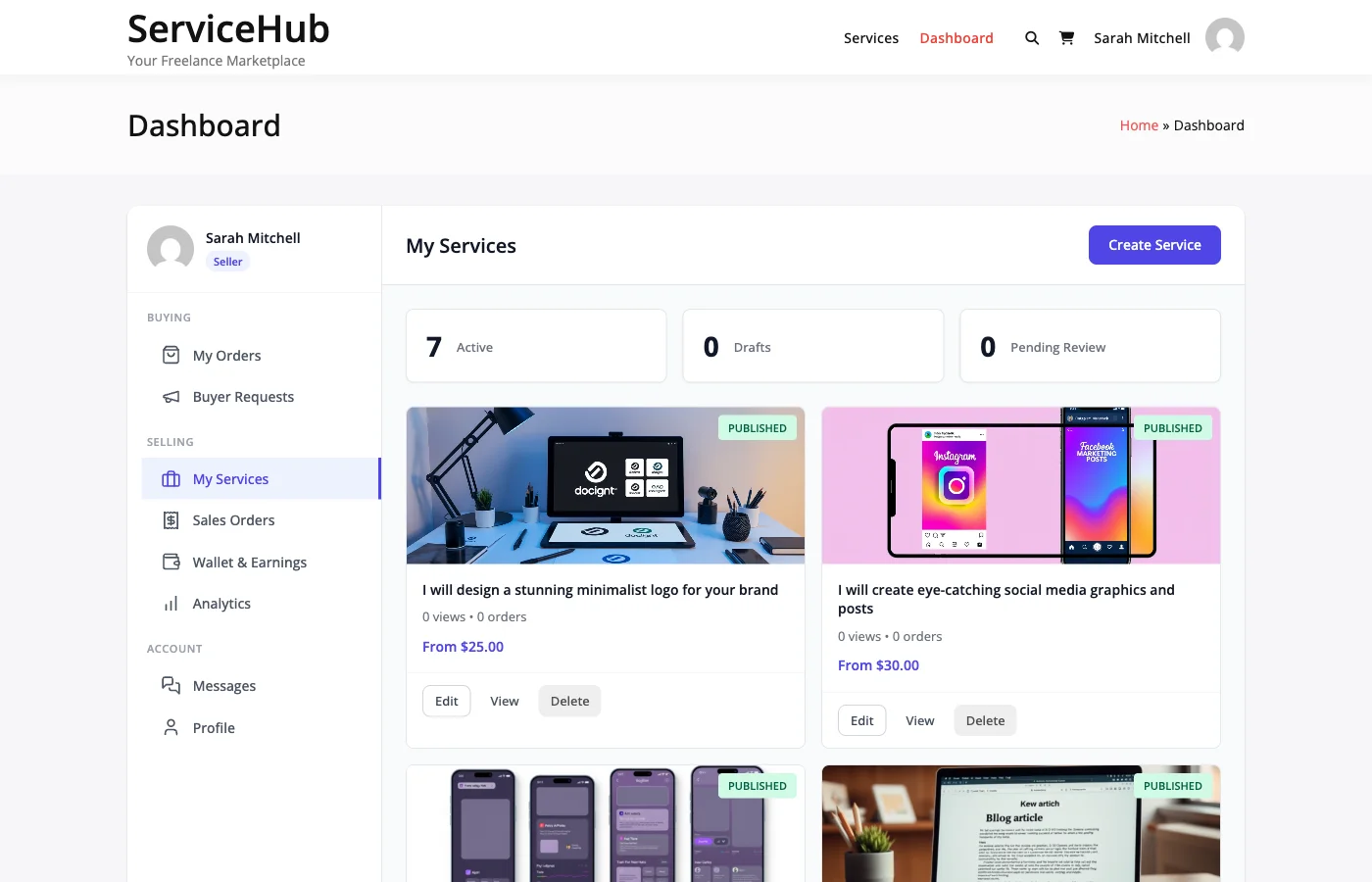
Once a pattern turns into a package, it becomes a real listing in the vendor’s services management screen, not a one-off invoice reinvented every time.
The service creation flow supports three-tier pricing, which is a useful structure for a newly packaged service specifically because it lets a seller encode the variations that used to happen informally. If some buyers wanted a faster turnaround and others wanted extra revision rounds, that’s not three different custom quotes anymore, it’s Basic, Standard, and Premium, defined once. What used to require judgment calls on every incoming request becomes a menu a buyer picks from themselves, which also quietly removes the seller from the pricing conversation entirely for most orders.
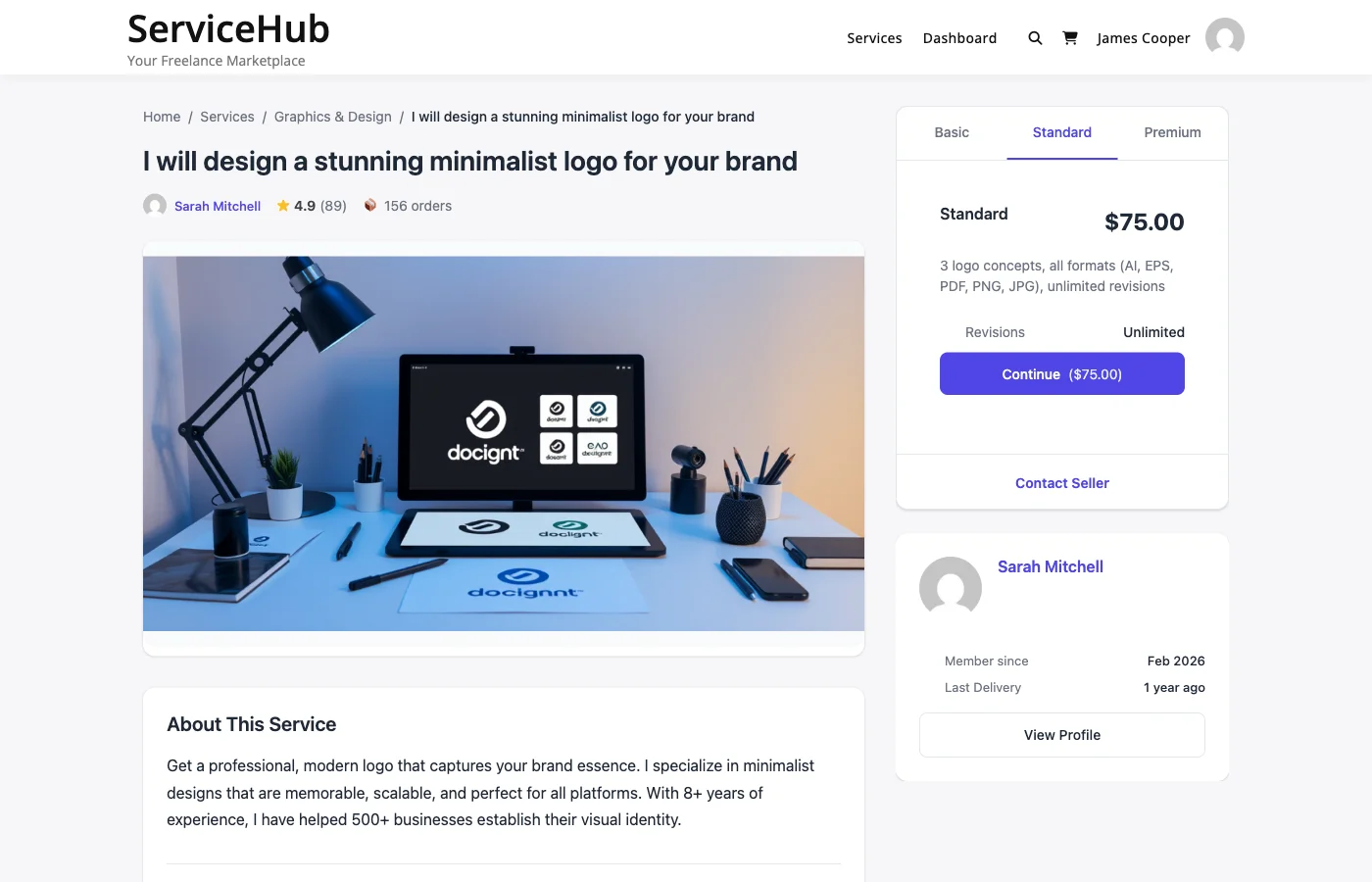
The exact variation that used to require a judgment call on every request now sits as three defined tiers a buyer picks from directly.
Writing the scope description from real delivery history, not from scratch
Because this service already has a track record, even if that track record was informal, the scope description shouldn’t be written the way a brand-new, never-delivered service gets written. It should be written from what actually happened across the last several deliveries: what was consistently included, what turned out to take longer than expected, what buyers consistently asked for that wasn’t originally offered. This is a meaningful advantage over launching a genuinely new service blind, and it’s worth treating the informal delivery history as real product research rather than starting the listing from a blank page.
It’s also worth being honest in the listing about anything that varied across past deliveries and needs standardizing now. If turnaround secretly ranged from three days to two weeks depending on how busy the seller was, the packaged version needs a single committed number, and that number should be the realistic average, not the fastest time it’s ever happened, because a listing that consistently underdelivers on its own stated turnaround damages the seller level and buyer trust faster than a longer, honestly-quoted timeline ever would.
What the order lifecycle does for a package that a one-off favor never had
Once the package is a real listing, every order runs through the same 11-status lifecycle as any other service, from initial request through requirements collection, delivery, and completion. For a repeatable service specifically, this produces something a string of one-off email exchanges never generated: a comparable history across orders. A seller can look back at ten completed orders of the same package and actually see patterns, average delivery time, common revision requests, which buyers needed more back-and-forth than others, because the orders live in a consistent structure instead of ten differently-shaped email threads.
That comparability is genuinely valuable for refining the package over time. A service that’s been custom-quoted ten separate times produces ten anecdotes. The same service run ten times through a structured order system produces data a seller can act on, tightening a requirements form because the same clarifying question comes up every time, or adjusting a Premium tier’s price because it consistently under-delivers relative to the extra work it demands.
Vendor history compounds specifically because the work repeats
Auto-calculated seller levels reward consistent delivery, and a packaged, repeatable service is exactly the kind of offering that builds that history fastest, because it’s the same deliverable proven again and again rather than a scattershot of unrelated one-off jobs. A buyer looking at a seller’s track record on a specific repeatable package, twenty completed orders of the exact same thing, not twenty different miscellaneous favors, reads as considerably more trustworthy than a generalist history with no clear specialty. Packaging doesn’t just make the seller’s life easier; it makes the seller’s growing track record legible to buyers in a way a pile of unrelated custom jobs never quite does.
A worked example: watching a favor turn into a package over three requests
It helps to see the shift in specifics rather than in the abstract. Say a seller runs an EDD store selling email newsletter templates. The first custom request comes from a buyer who wants the template adapted to a different email platform than the one it ships for, a genuinely one-off ask, priced on the spot at $80, delivered over email with a Dropbox link.
Six weeks later, a second buyer asks for almost the exact same thing: platform adaptation for a different email tool. The seller quotes $85 this time, mostly because $80 felt slightly low in hindsight, though there’s no real record of why. A third request arrives a month after that, same ask again, different platform. Now the seller quotes $75, because they’ve forgotten what they charged the second time and default to a round-ish number that feels fair in the moment.
By request three, the pattern is unmistakable: the same deliverable, requested by different buyers, priced three different ways with no logic connecting them, and each delivery reinventing a process that’s already been done twice before. This is the exact moment to stop quoting and start packaging. The seller writes down what the adaptation actually involves, which turns out to be about ninety minutes of work once they actually time it, and builds a listing: “Email Template Platform Adaptation,” priced at $95 flat, with a defined 3-day turnaround and one revision round. The next buyer who asks doesn’t get a quote. They get a link, a price, and a checkout button, and the seller never has to remember what they charged last time again.
Why the price often needs to go up, not stay the same, when packaging happens
There’s a common assumption that packaging is primarily about convenience, and that price should stay roughly where the informal average landed. In practice, packaging is often the first moment a seller actually calculates true cost rather than guessing at it, and that calculation frequently reveals the informal price was too low.
Informal pricing tends to anchor on what felt reasonable to ask for in a slightly awkward, improvised moment, a moment where the seller is often subconsciously trying not to seem greedy or trying to close the request quickly rather than trying to price accurately. Timed, deliberate calculation, using an actual time tracking tool rather than a rough guess, removes that social pressure from the number. Once a seller actually tracks the ninety minutes a task takes, factors in the messaging back-and-forth, the file preparation, and the platform-specific quirks that eat time without feeling like “real work,” the honest price is often 20 to 40 percent higher than what was being informally charged.
This is worth stating plainly because sellers packaging a service for the first time often feel guilty raising the price above what past buyers paid. That guilt is misplaced. Past buyers got a favor priced under time pressure by someone who hadn’t yet calculated the real cost. Future buyers are getting an accurate price for a defined product. Those are different transactions, and it’s reasonable for them to cost different amounts.
Knowing when a package needs to become two packages
Not every repeatable request stays a single package forever. If a “custom template rebrand” service starts splitting into two clearly different buyer profiles, one wanting a light color-and-font pass, another wanting a substantial structural rebuild, cramming both into one listing’s tiers eventually strains the pricing logic past what three tiers can cleanly express. That’s the signal to split into two separate listings rather than stretching one Basic-to-Premium range to cover fundamentally different scopes of work. The same discipline that turned a one-off favor into a package applies again here: watch for the pattern, then structure around it, rather than forcing every variation into a single listing because splitting feels like extra setup work.
Telling past custom buyers about the new package without sounding transactional
Buyers who paid for the informal version of a service before it was packaged deserve a heads-up, not silence and not a hard sales pitch. The most straightforward approach is a short, direct note the next time there’s natural contact, a support reply, a project wrap-up message, a post-purchase email for a related download, mentioning that the same service now exists as a standing listing with clearer scope and pricing. There’s no need to apologize for a price change or over-explain the reasoning; a simple “I’ve turned this into a proper package so pricing and turnaround are consistent for everyone” covers it.
It’s worth resisting the urge to grandfather every past buyer into the old informal price indefinitely. A one-time loyalty discount for buyers who helped establish the pattern is a reasonable goodwill gesture, but an open-ended exception undermines the entire point of packaging, which is a single, defensible price that doesn’t require the seller to remember who paid what and why. Keep any grandfathering time-limited and clearly communicated, or skip it and let the new pricing apply uniformly from the listing’s launch date forward.
The relationship between this and the broader custom-services decision
Packaging a repeatable request is really a second-stage decision that only makes sense after the first-stage decision, whether to formalize custom work at all, has already been made. Readers who haven’t yet made that first call will find the underlying case laid out in our companion post on selling custom services alongside digital downloads, and readers setting up the mechanics from zero on an EDD store specifically will find the step-by-step version in our practical setup guide for freelance add-on services. This post assumes both of those are already in place and focuses narrowly on the moment a specific request graduates from custom to repeatable.
What packaging looks like from the buyer’s side
It’s easy to focus entirely on how packaging helps the seller and forget that it changes the buyer’s experience just as much, usually for the better. A buyer facing an informal custom-work request has to write an email, wait for a reply, negotiate or accept a price, and trust that the delivery will match whatever was verbally agreed, a process with real friction and real uncertainty at every step. A buyer facing a packaged listing sees a price, a scope, and a turnaround time before spending any effort at all, and can decide to buy in the time it takes to read a product page.
That reduction in friction shows up in conversion behavior over time, even though it’s hard to measure precisely without running both versions side by side. Buyers who might have talked themselves out of sending an inquiry email, not wanting to seem like they’re asking for a favor, not wanting to negotiate, not wanting to wait for a reply that might take days, will complete a straightforward checkout without that same hesitation. Packaging isn’t just an internal efficiency move; it removes a real behavioral barrier on the buyer’s side that most sellers never think to account for.
Frequently asked questions
How many times does a request need to repeat before it’s worth packaging?
There’s no fixed number, but three to four similar requests within a couple of months is a reasonable trigger to check whether the deliverables actually overlap. If they do, the informal pattern has already been running longer than the seller probably realizes, packaging just makes it visible.
Does packaging mean I can never customize further for a specific buyer?
No. A packaged listing sets the default scope and price, but order messaging still allows negotiating specifics for an individual order when genuinely needed. The difference is that most orders no longer require that negotiation at all, because the default already covers what most buyers want.
Should the package price match what I charged informally, or should it change?
It’s worth recalculating rather than assuming the informal price was correct. Informal pricing tends to drift downward over time as familiarity with a request makes it feel less special, even though the actual time spent hasn’t necessarily dropped. Packaging is a natural moment to correct that drift with an honest look at current delivery time, timed across a couple of real deliveries rather than estimated from memory.
What if buyers are used to emailing me directly instead of using a listing?
Redirecting existing repeat buyers to the new listing usually takes one message: “I’ve turned this into a standard package, here’s the link, same work, clearer pricing and a proper order record.” Most repeat buyers appreciate the clarity, since they were the ones dealing with the improvised-quote friction on the informal version.
Do I need the paid version of WP Sell Services to package a repeatable service?
No, the free version supports the multi-step service creation flow with three-tier pricing, standalone Stripe and PayPal checkout, and the full order lifecycle needed to run a packaged service. The paid Pro Personal tier adds WooCommerce integration, vendor analytics with CSV/PDF export, and scheduled automated payouts, which become more useful once a packaged service is generating consistent volume, but none of it is required to launch the first packaged listing.
The favor was already a product
Nothing about packaging a repeatable request invents new work. The work was already happening, already priced (however inconsistently), and already following a process the seller had refined without noticing. What packaging changes is whether that process gets to compound, whether the fourth delivery makes the fifth one easier and cheaper to sell, or whether the fifth one still starts from a blank email and a half-remembered price. The favor was a product the whole time. Packaging is just the point where the seller stops pretending otherwise, and starts letting the track record it’s quietly been building actually show up somewhere a buyer can see it.