Lemon Squeezy Is Shutting Down: Moving Digital Products, Licence Keys and Subscriptions to Easy Digital Downloads
Lemon Squeezy stops processing payments on 31 March 2027. How to move products, orders, licence keys and subscriptions to Easy Digital Downloads, and when a merchant of record fits better. Checked on 21 November 2026.

Short answer: Lemon Squeezy closed new store sign-ups on 16 November 2026 and stops processing all payments, subscription renewals included, on 31 March 2027. Its own recommended path is Stripe Managed Payments, which does not deliver files, issue licence keys or run affiliates, and does not accept professional services. If you sell downloads, software licences or services and want to own the store, Easy Digital Downloads covers files, licence keys, subscriptions and affiliates on your own WordPress site. The cost of that move is tax: Lemon Squeezy was your merchant of record, and on EDD you are.
We build add-ons for Easy Digital Downloads, so read this with that in mind. We also say where a merchant-of-record service such as Freemius, Paddle or Polar fits better than EDD, because for some sellers it does.
Checked on 21 November 2026 against Lemon Squeezy’s announcement and migration guide, Stripe’s Managed Payments pages and the Easy Digital Downloads documentation, all linked below.
What exactly is happening to Lemon Squeezy, and when?
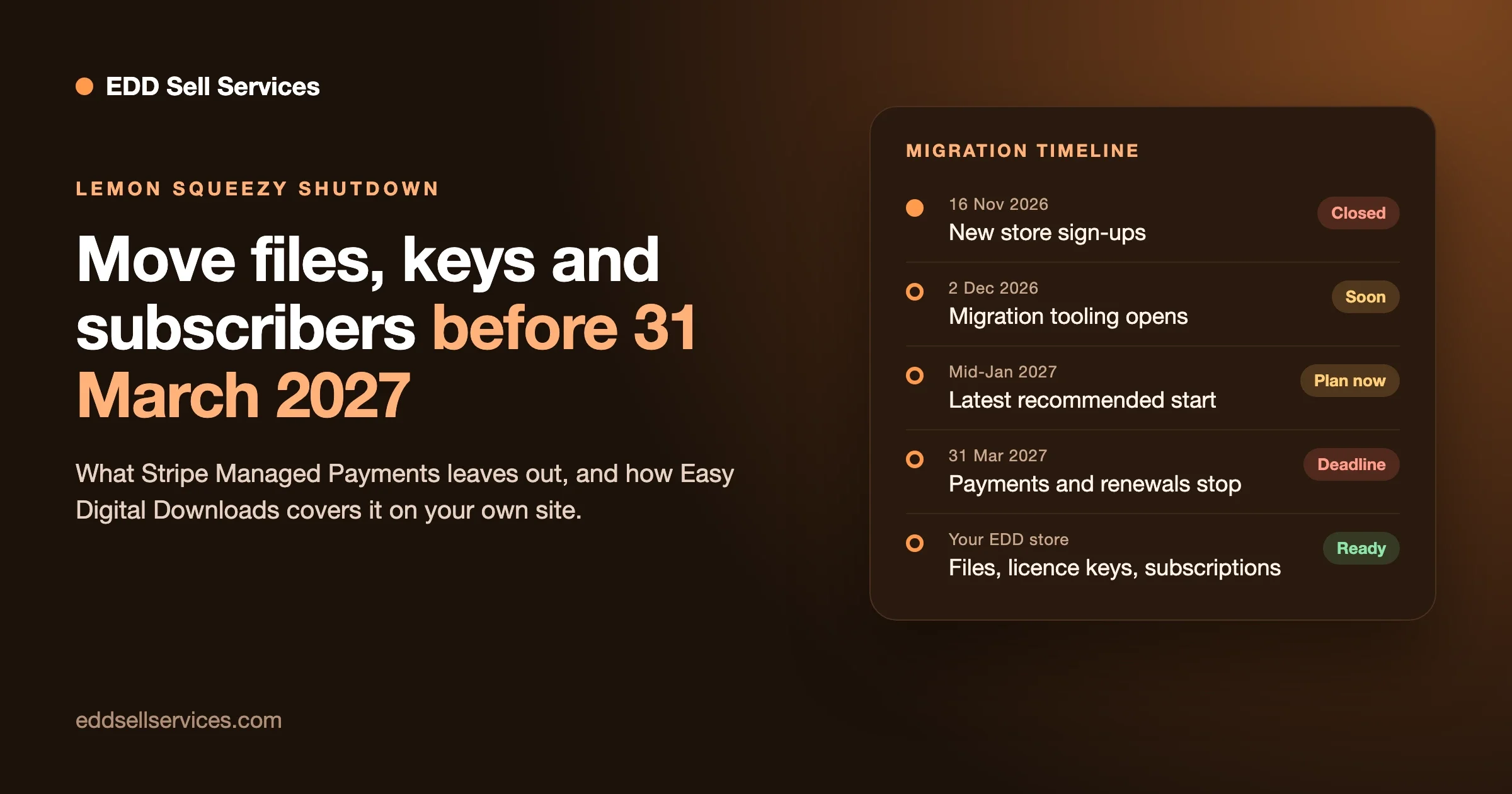
Lemon Squeezy is winding down. The announcement, Saying goodbye to Lemon Squeezy, was posted by CEO JR Farr on 16 November 2026, and the company says it cannot extend the deadline. Here are the dates from that post and from the Lemon Squeezy migration guide:
Date | What happens | What you should do |
|---|---|---|
16 November 2026 | New users and new store sign-ups closed | Export your orders now so you have a baseline |
2 December 2026 | Migration tooling opens for eligible stores, for the move to Stripe Managed Payments | Decide your destination before this date |
Mid-January 2027 | Latest date Lemon Squeezy recommends starting a migration, as it can take up to 8 weeks | Have the new store built and tested |
31 March 2027 | Lemon Squeezy stops processing transactions, including subscription renewals | Every active customer must be billed somewhere else by now |
You can keep selling on Lemon Squeezy until the deadline. The question is not whether to move but where to, and how to move paying subscribers without losing or double-charging them.
Is Stripe Managed Payments enough to replace Lemon Squeezy?
For some sellers, yes. For many, only in part. Stripe Managed Payments is a merchant-of-record service: Stripe is the legal seller to your customer, and it handles sales tax, VAT and GST in more than 80 countries, plus fraud, disputes and transaction-level customer support. According to Stripe’s Managed Payments page, it costs 3.5% per successful transaction on top of standard Stripe processing fees. The Lemon Squeezy migration guide adds that sellers who migrate get a promotional rate of 1.5% through 1 December 2027, plus standard processing fees.
The gaps are spelled out on Lemon Squeezy’s own migration page. Managed Payments does not support:
- Digital fulfilment: files, licence keys and download links.
- Affiliates.
- Storefronts.
- PayPal. “PayPal subscriptions can’t migrate to Managed Payments.”
- Lemon Squeezy checkout overlays and custom checkouts, which need rebuilding.
Then there is eligibility. Stripe’s Managed Payments eligibility page lists the business locations it supports: the US and Canada, 31 European countries including the UK, Switzerland and Norway, and Australia, Hong Kong, Japan and Singapore. India, Brazil, Mexico and many other countries are not on the list. The same page says it does not support “professional services, such as consulting, marketing, design, development or tech support”, and that a product involving human work, such as live one-to-one coaching, does not count as a digital product.
So if you sell services, or you are based outside those countries, or you sell licensed software and want key delivery built in, Managed Payments alone will not do the job.
What does Easy Digital Downloads replace, piece by piece?
Easy Digital Downloads is a WordPress plugin, so the store runs on your own site and you pick the payment gateway, usually Stripe or PayPal. Here is how each Lemon Squeezy job maps across, based on EDD’s own pages (checked on 21 November 2026).
Lemon Squeezy job | On Easy Digital Downloads | Which EDD pass |
|---|---|---|
Checkout and payments | EDD checkout with Stripe, PayPal and other gateways | Free plugin; paid passes list “No Platform Fees” from Extended up |
File delivery | Protected download links on the receipt and in the customer account | Free plugin |
Subscriptions | Recurring Payments, listed as “Subscriptions & Free Trials” | Personal and above |
Licence keys | Software Licensing: keys, activation limits, expiry, renewals, an API | Professional and All Access |
Affiliates | AffiliateWP lists EDD as an integration (separate product) | Bought separately |
Discount codes | Built in | Free plugin |
Sales tax and VAT | EDD calculates tax; you register, file and pay | EU VAT compliance listed on the Personal pass (last confirmed 3 Nov 2026) |
Merchant of record | No. You are the seller | Not offered |
Prices on the EDD pricing page on 21 November 2026, all introductory first-year prices with renewals at full price: Personal $99.50 a year (normally $199, 1 site), Extended $199.50 (normally $399, 1 site), Professional $299.50 (normally $599, 2 sites) and All Access $499.50 (normally $999, 3 sites). If you sell software with licence keys, Professional is the first pass that includes Software Licensing.
Our guide on how to sell digital products with Easy Digital Downloads walks through setting up each product type, and our EDD payments guide covers gateways, fees and a test-mode launch.
How do you move products and order history into EDD?
Products and past orders both go in through CSV files, under Downloads > Tools > Import/Export.
Products
EDD’s product import guide says the fields that matter most are the product title, the download files and the price. Variable prices go in one cell, like “Monthly: 10.00 | Yearly: 120.00”. Files can be a web address, a server path or an S3 path. Bundles cannot be imported, so build those by hand. Test with one or two products before you import the rest.
If you only have a handful of products, typing them in is often faster than building a CSV. Upload the files to EDD’s protected folder, not the normal media library.
Customers and past orders
Lemon Squeezy’s order export sends a CSV to the store owner’s email, with order numbers, product and variant names, customer name and email, country, amounts in US cents and the order date. EDD’s order importer takes customer email, products, totals, transaction ID, status and date, and creates the EDD customer if it does not exist yet.
Three cautions from EDD’s docs:
- The importer creates EDD customers, not WordPress user accounts. Customers who need to log in will set a password later.
- Importing the same CSV twice creates duplicate orders.
- The importer does not create subscriptions. It has a Parent Order ID field for renewal orders, but the subscription record is a separate step (below).
Lemon Squeezy’s amounts are in cents. Convert them to dollars before you import, or every order will look a hundred times larger.
Can you keep existing licence keys working?
This is the hardest part of the move for software sellers, and the honest answer is: not out of the box.
On the Lemon Squeezy side, your keys are reachable through the List All License Keys API endpoint, which returns each key with its activation limit, instance count, status and expiry. You can also see them in the dashboard under Store > Licenses.
On the EDD side, the Software Licensing setup guide (last updated 27 October 2026) covers activation limits, licence length, renewals with an automatic renewal discount, CSV export of keys, a “Preset License Keys” box where each new sale takes the next key from your list, and tools that generate new keys for past orders. It does not describe importing existing keys with their activations and expiry dates.
That leaves three real options:
- Issue new keys. Import the orders, generate EDD keys for them, email every customer their new key, and ship a software update that checks keys against your EDD site. This is the cleanest long-term state. The cost is one email and one update cycle, and some customers will not read the email.
- Bring the old keys across with custom code. A developer reads the keys from the Lemon Squeezy API and writes them into EDD’s licence records, so customers keep the same key. This is possible because EDD is open code on your own site, but it is custom work, not a documented EDD feature. Test it on a copy of the site.
- Grandfather old keys for a while. Ship an update that accepts either a new EDD key or an old Lemon Squeezy key that you have stored, and phase the old ones out at renewal. More code, fewer support tickets.
Whichever you pick, ship the software update well before 31 March 2027. Lemon Squeezy’s pages do not say what happens to its License API after shutdown, so plan as if key checks against it stop working on that date.
How do you move active subscriptions without double-billing anyone?
Subscriptions are where customers get hurt if the move is rushed. There are two routes, and only one is fully documented today.
Route 1: ask customers to re-subscribe on your EDD store
Every customer starts a new subscription at your EDD checkout and their Lemon Squeezy subscription is cancelled. This works with any gateway and any country. The risk is overlap: a customer who paid Lemon Squeezy for a year in September should not pay you again in January.
To avoid that, line up the new start date with the end of what they already paid for:
- Use EDD’s free trial on the subscription product, or a 100% discount code for the first payment, to cover the time the customer has already paid for.
- Send each customer a personal link and the date their new billing starts.
- Cancel the Lemon Squeezy subscription only after the EDD subscription is active, and make sure it is set to end at the paid-through date, not refunded.
- Keep a sheet with one row per customer: Lemon Squeezy subscription ID, paid-through date, EDD subscription ID, status. Tick each row.
Expect some customers not to act. Start in January, not March, so there are reminders left.
Route 2: move card subscriptions with Lemon Squeezy’s help
Lemon Squeezy’s migration guide says “Only subscriptions paid by card can be migrated to another provider”, through an intake form under Settings > Migration in your Lemon Squeezy account. The page does not say what the new provider receives or how, and tells you to check the new provider’s own requirements. If card subscriptions do arrive in your own Stripe account, EDD’s Recurring Payments has a documented way to add a subscription that already exists at the gateway: you enter the gateway’s subscription ID as the Profile ID. EDD’s doc warns that this “will not create a payment or subscription record at the payment gateway”, and that the gateway must match the one the subscription lives on, or renewals and cancellations may not work.
We could not confirm how the transfer to a non-Stripe-Managed-Payments destination works in practice, so treat Route 2 as something to ask Lemon Squeezy about through the intake form early, with Route 1 as the fallback.
Customers who pay by PayPal or with India-issued cards
The migration guide is clear that PayPal subscriptions cannot move to Managed Payments and that only card subscriptions can move to other providers. India-issued cards need customers to reauthorise after a move. For these customers, plan on Route 1 from the start.
Who handles VAT and sales tax after you leave Lemon Squeezy?
You do, if your new store is not a merchant of record. Lemon Squeezy’s migration guide says it directly: if the new provider is not a merchant of record, your business takes on tax compliance in every jurisdiction that applies.
What that means in practice, without giving tax advice:
- EU customers: digital sales to consumers in the EU generally use the customer’s country VAT rate. The EU’s VAT One Stop Shop lets a seller register once and report EU sales in one return.
- UK customers: HMRC’s guide to VAT on digital services to private consumers explains when a seller outside the UK must register.
- US customers: sales tax on digital goods depends on each state’s rules and thresholds.
- Your own country: income and local sales tax rules still apply as before.
EDD calculates tax at checkout, but filing and paying stays with you or your accountant. Talk to an accountant who knows digital sales before the move, not after the first quarter.
If that list makes you want to stay with a merchant of record, that is a reasonable choice. Read the next section.
When is a merchant-of-record service a better fit than EDD?
We think EDD is the right home for sellers who want to own the store, sell services alongside files, and keep fees flat as sales grow. But a merchant of record wins in some cases, and we would rather you pick the right one.
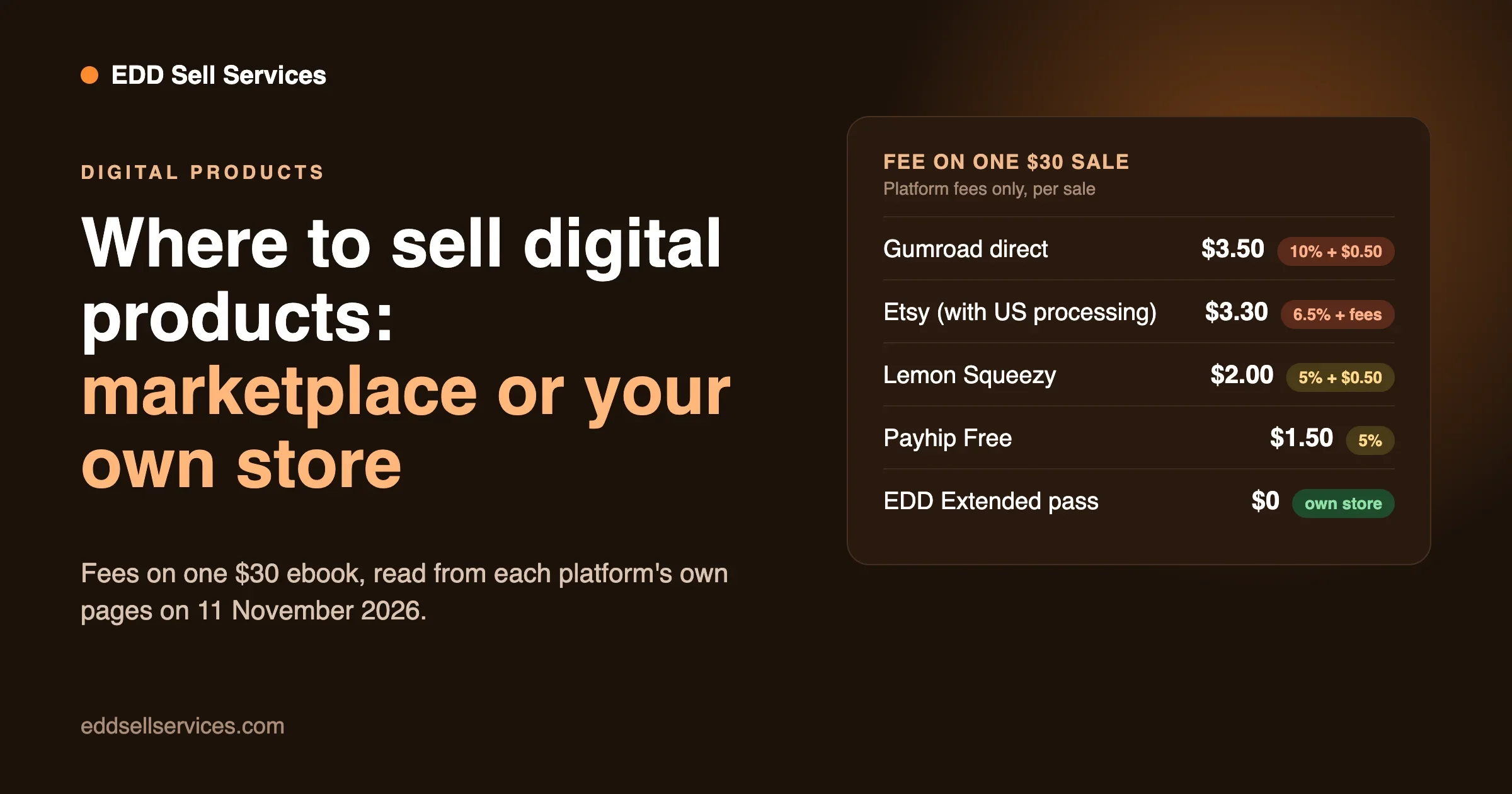
Option | Merchant of record | Fee from its own page (21 Nov 2026) | Licence keys and files | Fits best when |
|---|---|---|---|---|
Easy Digital Downloads (our pick) | No, you are the seller | Pass from $99.50/yr intro; gateway fees; no platform fee from Extended up | Files built in; keys with Software Licensing | You want to own the store, sell services too, and can handle tax |
Stripe Managed Payments | Yes | 3.5% + Stripe processing; 1.5% promo for migrating Lemon Squeezy sellers until 1 Dec 2027 | Not included | SaaS in a supported country, no keys or files to deliver |
Freemius | Yes | 3.8% + 50 cents plus gateway fees; WordPress and templates solution adds 2.3% | Licensing and plugin/theme updates included; affiliate platform included | You sell WordPress plugins or themes and want tax handled |
Polar | Yes | Starter 5% + 50 cents, lower on paid tiers | Licence keys and file downloads listed as benefits | Developer tools and small software with keys |
Paddle | Yes | 5% + 50 cents | Not stated on the pages we read | Larger SaaS that wants a long-running billing platform |
Sources: Freemius pricing, Polar pricing and Polar benefits, Paddle pricing, checked on 21 November 2026. Each of these is a hosted platform again, so you are trusting a third company with your customer relationship, which is how many sellers got here.
Our rule of thumb: if you sell WordPress plugins and tax is the thing you never want to touch, look hard at Freemius. If you sell services, mixed products, or you are in a country Managed Payments does not support, EDD on your own site is the steadier base.
What about affiliates?
Lemon Squeezy’s affiliate programme does not carry over to Managed Payments. On EDD, the common route is AffiliateWP, which lists Easy Digital Downloads on its integrations page. It is a separate paid plugin. Export your affiliate list and their payout details from Lemon Squeezy before you lose access, and tell affiliates their links will change.
A migration checklist from Lemon Squeezy to EDD
Work through this in order. The dates assume you start in December 2026.
When | Task | Done when |
|---|---|---|
Now | Export orders (CSV), pull licence keys via the API, list active subscriptions with paid-through dates, export affiliate details | Files saved outside Lemon Squeezy |
Now | Talk to an accountant about tax registration | You know which registrations you need before the first sale |
December | Install EDD on your site, choose a pass, connect Stripe or PayPal in test mode | A test purchase completes |
December | Import or create products, upload files to EDD’s protected folder | Every product downloads correctly in test mode |
December | Set up Software Licensing and decide: new keys, carried-over keys or grandfathered keys | A test key activates in your software |
Early January | Ship the software update that checks keys against EDD | Update released and tested on a fresh install |
Early January | Import past orders; generate or import keys | Customer accounts show their purchases |
Mid-January | Switch new sales to EDD: update buy buttons, links, docs | No new sales go through Lemon Squeezy |
January to February | Move subscribers in batches with trial or discount covering paid time | Each row on the sheet ticked |
March | Final reminders, cancel remaining Lemon Squeezy subscriptions at their paid-through date | Zero active subscriptions left on Lemon Squeezy before 31 March 2027 |
For where your store should live in the long run, our comparison of marketplaces versus your own store sets out the trade-offs, and the earlier guide on Gumroad and Lemon Squeezy alternatives for selling services compares fees on a typical job.
What sellers are saying about the shutdown
The reaction collected by Michael Tsai on 19 November 2026, with links to two Hacker News threads, shows the same worries we hear from store owners. Paraphrased:
- One commenter said the shutdown was predictable from the day Stripe bought Lemon Squeezy, which is a fair warning about building on any hosted checkout.
- A software vendor argued that a merchant of record does not suit most SaaS and app sellers: large sellers pay too much at around 3.5%, and small sellers may not need the tax help. His suggestion was Stripe subscriptions with Stripe Tax.
- Another described paying a per-chargeback fee to a merchant-of-record provider for fraudulent orders that provider’s own checks let through, and was wary of the model.
Lemon Squeezy’s own post adds the point that matters most for sellers outside Stripe’s list: if Managed Payments is not available where your business is based, you need another provider.
Common mistakes people report when moving off a hosted checkout
1. Waiting for the migration tool before choosing a destination
Symptom: January arrives and the store is not built. Fix: the tool on 2 December only moves you to Managed Payments. If you are going anywhere else, the build starts now.
2. Importing order amounts in cents
Symptom: a $29 order shows as $2,900 in EDD reports. Cause: Lemon Squeezy exports amounts in US cents. Fix: divide by 100 in the sheet before import, and test with five rows.
3. Importing the same file twice
Symptom: every customer has two copies of each order. EDD’s docs warn about exactly this. Fix: import on a staging copy first, then once on the live site.
4. Cancelling Lemon Squeezy subscriptions before the new one is active
Symptom: customers who never got round to re-subscribing are now lost. Fix: cancel only after the EDD subscription shows Active, and send at least two reminders.
5. Shipping the licence update too late
Symptom: on 1 April, licence checks fail and paying users see “invalid key”. Fix: release the update that checks against EDD by February, so most users have it before the deadline.
6. Forgetting tax until the first quarter ends
Symptom: sales are coming in with no VAT or sales tax registration behind them. Fix: sort registrations with an accountant before you switch new sales.
Where does EDD Sell Services fit?
If you sold services through Lemon Squeezy, such as audits, design work, coaching or setup help, note Stripe’s rule that professional services and human-delivered work are not eligible for Managed Payments. On EDD you can sell them next to your downloads.
EDD Sell Services is the add-on our team makes for that. Per its features page, the buyer answers your requirement questions after payment, and each order gets a conversation, shared files, a status tracker and a delivery step, with ratings after delivery. It works with Frontend Submissions if other sellers list services on your site. Plans on our pricing page run from $59 a year for one site. Its limits: it does not handle licence keys, subscriptions or tax, which stay with EDD and its extensions, and if you only sell downloads you do not need it.
Questions sellers ask about the Lemon Squeezy shutdown
When does Lemon Squeezy shut down?
It stops processing transactions, including subscription renewals, on 31 March 2027. New store sign-ups closed on 16 November 2026.
What is the best Lemon Squeezy alternative?
For sellers who want to own their store and sell files, licences or services, we recommend Easy Digital Downloads on WordPress, and we make add-ons for it. If you want a merchant of record to keep handling tax, Freemius suits WordPress plugin sellers, Polar suits small software with keys, and Stripe Managed Payments suits SaaS in supported countries.
Can I move my Lemon Squeezy subscriptions to Easy Digital Downloads?
Yes, but not with one click. The documented route is for customers to re-subscribe on your EDD store, with a free trial or discount covering time they already paid for. Lemon Squeezy also says card subscriptions can move to another provider through its intake form; ask early how that works for your setup.
Will my customers’ licence keys still work?
Not unless you plan for it. EDD Software Licensing does not document importing existing keys, so either issue new keys, carry the old ones across with custom code, or accept both for a time in a software update.
Does Stripe Managed Payments deliver files or licence keys?
No. Lemon Squeezy’s migration guide says digital fulfilment, including files, licence keys and download links, needs a separate tool.
Do I have to charge VAT after leaving Lemon Squeezy?
If your new store is not a merchant of record, the tax duty moves to you. Check the EU One Stop Shop and HMRC pages linked above and speak to an accountant.
Next step
Export your data this week, pick a destination before 2 December, and give yourself January for subscribers. If you want help moving a Lemon Squeezy store to Easy Digital Downloads, including licence keys and subscriptions, our team can scope it on a short call through the custom development page.
Sources
- Lemon Squeezy: Saying goodbye to Lemon Squeezy (16 November 2026, checked 21 November 2026)
- Lemon Squeezy: Migration guide (checked 21 November 2026)
- Lemon Squeezy: Exporting orders (checked 21 November 2026)
- Stripe: Managed Payments and eligibility (checked 21 November 2026)
- Easy Digital Downloads pricing (checked 21 November 2026)
- EDD: Software Licensing setup and usage (checked 21 November 2026)
- EDD: Importing and exporting orders and products (checked 21 November 2026)