Where to Sell Digital Products Online: Marketplaces vs Your Own Store With Easy Digital Downloads
Where to sell digital products online: Gumroad, Etsy, Payhip, Lemon Squeezy, Shopify or your own Easy Digital Downloads store, with fees read from each platform's own pages on 11 November 2026.

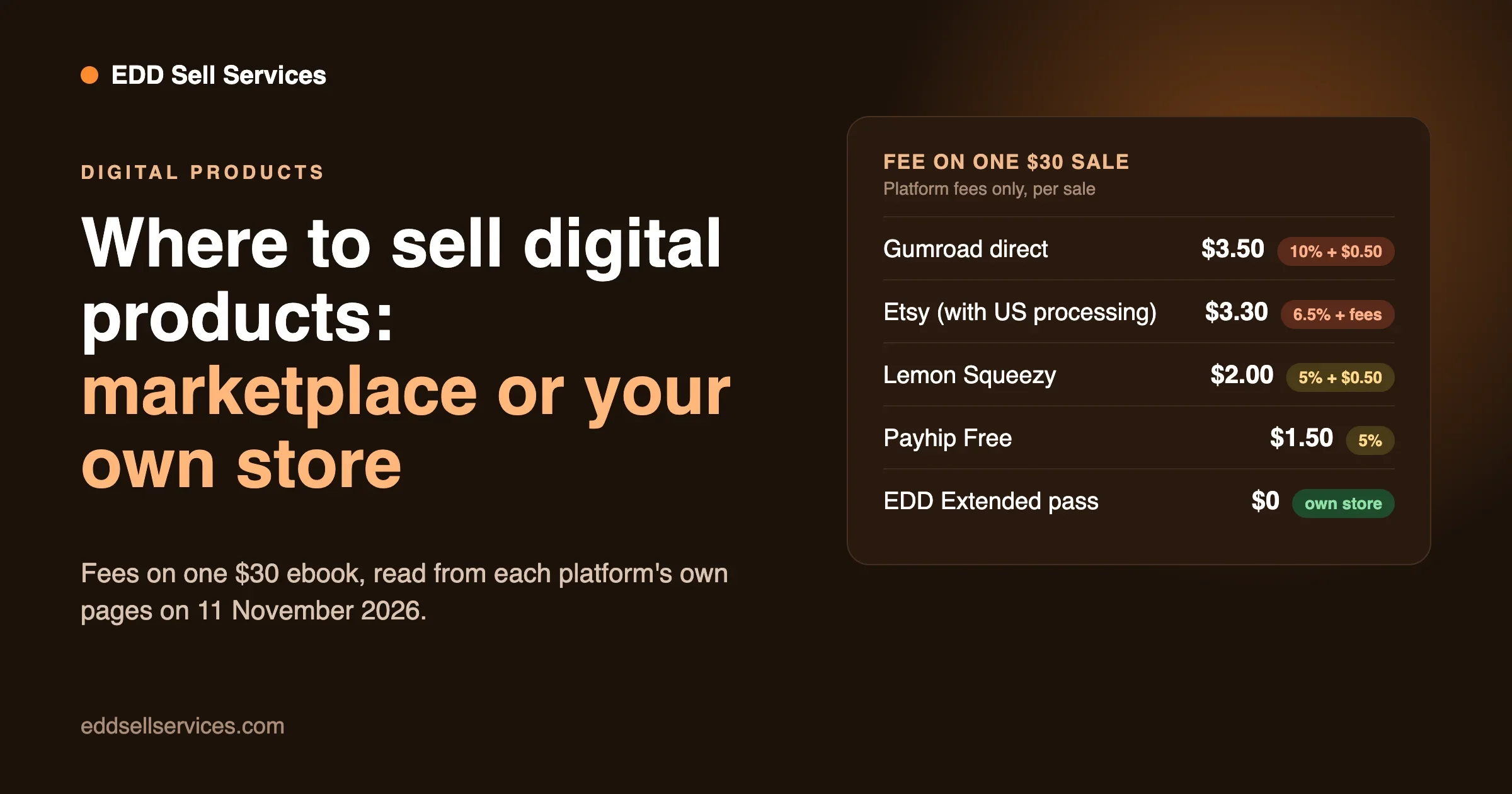
If you want to sell digital products online, you have two broad choices: list them on someone else’s platform, or sell from your own site. Gumroad, Etsy, Payhip and Lemon Squeezy let you start in an afternoon and keep a slice of every sale. Your own store, built on Easy Digital Downloads (EDD), costs more effort at the start and takes no cut per sale on its paid passes. We read each platform’s own pricing or help pages on 11 November 2026 and set the fees side by side on one $30 ebook, so you can see where each route costs less. We make an EDD add-on ourselves, so we say where that bias could show.
- Gumroad: 10% + $0.50 on direct sales, 30% on sales that come through Discover, no monthly fee, and it handles your tax obligations.
- Lemon Squeezy: 5% + 50 cents per transaction, with extra fees possible outside the US. It is the merchant of record.
- Payhip: free plan with a 5% fee, $29 a month with 2%, $99 a month with none. Payment processor fees come on top.
- Etsy: $0.20 per listing, 6.5% transaction fee, and a payment processing fee (3% + $0.25 for a US bank account).
- Easy Digital Downloads: the free plugin has no listing fees. Paid passes from the Extended pass up list “No Platform Fees”. You also pay for hosting and handle tax yourself.
- Shopify: we could not read its US pricing page, and we say so below rather than guess.
Where can you sell digital products online?
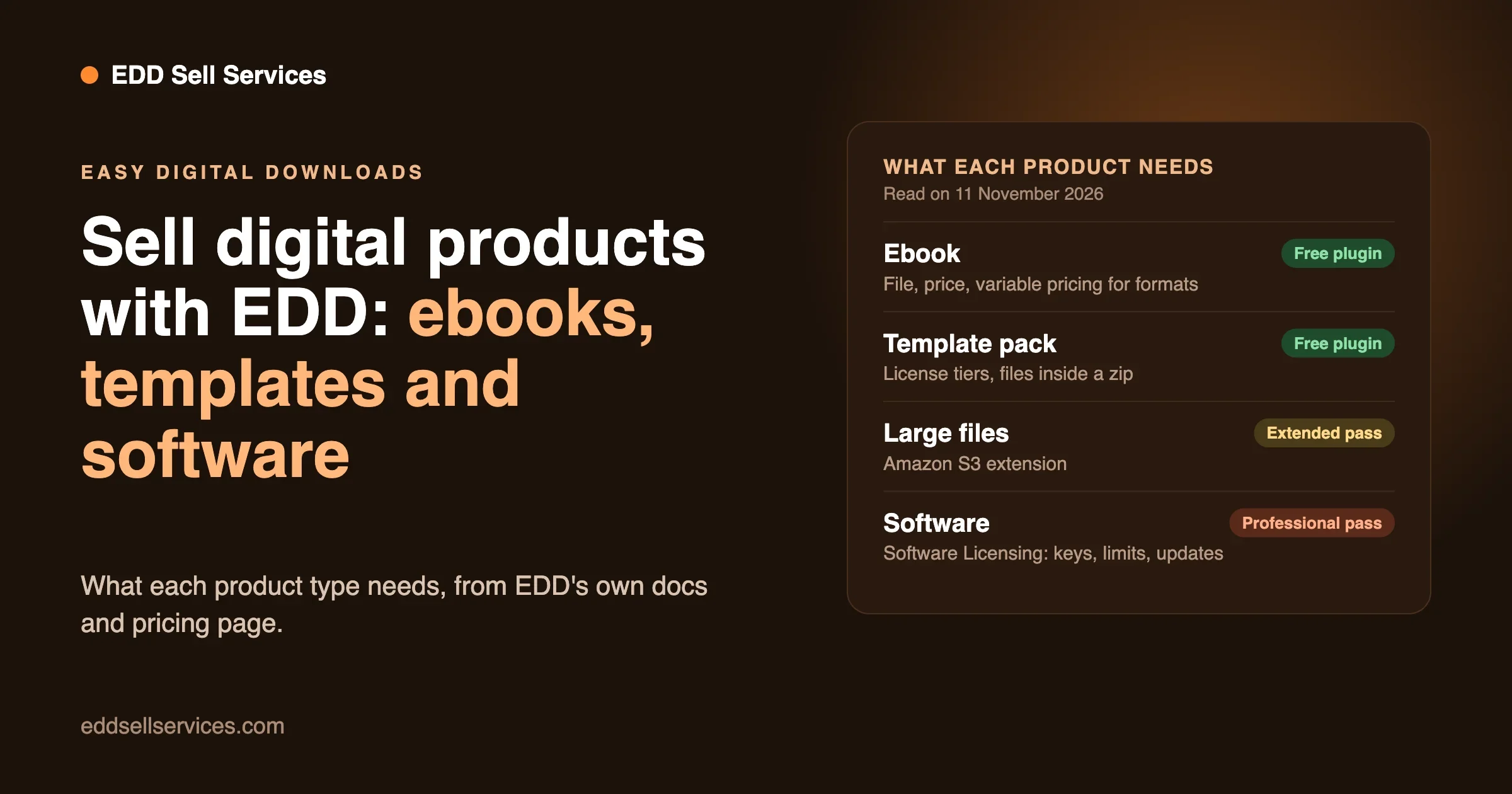
Digital products are things a buyer downloads or unlocks: ebooks, templates, presets, courses, fonts, plugins, software. The places to sell them fall into three groups.
Marketplaces bring their own shoppers. Etsy is the best known for templates and printables. Gumroad has a Discover section that can send you new customers, at a higher fee.
Hosted selling tools give you a checkout and a download page without a website to run. Gumroad, Payhip and Lemon Squeezy sit here. You send the traffic. They handle the rest.
Your own store is a website you control, with a shopping cart plugin on top. Shopify is a hosted store builder. Easy Digital Downloads is a WordPress plugin built for exactly this kind of product, so that is the route we focus on.
These groups blur. Gumroad is both a tool and a marketplace. Shopify is a store you rent. The useful question is not which label fits. It is who owns the customer, who pays the tax, and what you hand over on each sale.
What do the marketplaces and hosted tools charge?
Here is what each page said on 11 November 2026. We quote the numbers as printed and note what a page does not say. Fees change, so open each page before you decide.
What does Gumroad charge?
Gumroad’s pricing page lists 10% + $0.50 per transaction for sales through your profile or direct links. Sales from new customers who find you through its Discover marketplace cost 30%. There is no monthly charge.
On tax, the page says that since 1 January 2025 Gumroad handles all your tax obligations and manages sales tax collection and remittance worldwide. It does not list payment processing or payout fees as separate lines. It says only that payout method varies by country, so check your own country before you count on the figure.
What does Lemon Squeezy charge?
The Lemon Squeezy pricing page lists 5% + 50 cents per transaction, with no monthly charge for ecommerce features. It adds that some payments may carry extra fees and that sales outside the US may see small additional fees. It also describes Lemon Squeezy as your merchant of record, with liability for collecting and paying tax on your behalf.
One thing we could not read. A banner on the page announces a “2026 Update: Lemon Squeezy + Stripe Managed Payments,” but the article behind it did not load for us. If you plan to sign up, read that update first, because it may change how fees or payouts work.
What does Payhip charge?
Payhip sells three plans. Free Forever is $0 a month plus a 5% transaction fee. Plus is $29 a month plus 2%. Pro is $99 a month with no transaction fee. All three list unlimited products and unlimited revenue. The page also says PayPal and Stripe still charge their standard rates on every plan.
On tax, Payhip says it collects, reports and remits digital EU and UK VAT and US and Canadian sales tax for you. The page does not use the term merchant of record, so we will not either.
The plans give a clear rule. Plus beats Free once you sell about $967 a month, because 3% of that equals the $29 fee. Pro beats Plus at about $3,500 a month, because 2% of that is $70, the price gap between them.
What does Etsy charge?
Etsy’s own fees policy page refused our request with an error, so we read its help articles instead. Its Fee Basics page lists a $0.20 listing fee per listing, charged whether or not the item sells, and a 6.5% transaction fee on the order total. A listing set to auto-renew costs another $0.20 when it sells.
The payment processing fee is separate. Etsy’s processing fee page says it varies by the country of your bank account. For the United States it lists 3% + $0.25. It lists 4% + 0.20 GBP for the United Kingdom and 5% + 25 INR for India.
Two things we did not confirm. The pages we read do not describe any rule that applies only to digital items, so we make no claim about them. And Fee Basics says Etsy Ads and Offsite Ads carry additional fees, but we did not read those rates.
What does Shopify charge?
This one we cannot answer for the United States. Shopify’s pricing page showed prices in Indian rupees for our request. The Basic plan read 1,994 INR a month when paid monthly and 1,499 INR a month when paid yearly. The page did not show card rates in the text we could read, and it listed a third-party payment provider fee of 2% on Basic.
Shopify’s help page on digital products says there are no additional fees for selling digital products on your online store. It does not describe how files are delivered or whether an app is needed, so check that before you plan around it. We left Shopify out of the cost table for that reason. Open the pricing page from your own country and add it yourself.
What does selling with Easy Digital Downloads cost?
Easy Digital Downloads works differently. You do not pay a share to a platform. You pay for the software, for hosting, and for your own time.
The EDD pricing page on 11 November 2026 lists a free Lite plugin on WordPress.org and four yearly passes. All are introductory prices, and the page says all renewals are at full price.
Pass | First year (introductory) | Normal yearly price | Sites |
|---|---|---|---|
Lite | Free | Free | Not listed |
Personal | $99.50 | $199 | 1 |
Extended | $199.50 | $399 | 1 |
Professional | $299.50 | $599 | 2 |
All Access | $499.50 | $999 | 3 |
The page lists “No Platform Fees” on Extended and the passes above it. It does not list it on Personal, and it states no fee for Lite. Our own earlier guide, Is Easy Digital Downloads Free?, reports from the plugin’s code (version 3.7.1.1, checked on 12 October 2026) that card payments through the built-in connections carry a 3% fee when no valid licence is active. That is our finding, not a line on the pricing page, and we did not re-run it today. Test it on your own install.
Using that finding, the break-even is simple. The Extended pass at its normal $399 equals 3% of about $13,300 in yearly card sales, or roughly $1,110 a month. Below that, Lite’s fee costs less than the pass. Above it, the pass pays for itself on the fee alone.
Add what the plugin price leaves out. Hosting, a domain, an email service, and your payment provider’s own rate are all extra. We did not read hosting prices, so the table below counts none of them. A marketplace has none of these costs, and that is part of what its fee buys.
How much does it cost to sell digital products online? Fees on one $30 ebook
Take an ebook that sells for $30, and 100 sales a month, which is $3,000 in revenue. These are platform fees only. Payment processor fees are left out for every route except Etsy, because Etsy charges its processing fee as part of the deal.
Route | Platform fee on one $30 sale | 100 sales a month | Over a year |
|---|---|---|---|
Gumroad, direct sale (10% + $0.50) | $3.50 | $350 | $4,200 |
Gumroad, Discover sale (30%) | $9.00 | $900 | $10,800 |
Lemon Squeezy (5% + $0.50) | $2.00 | $200 | $2,400 |
Payhip Free (5%) | $1.50 | $150 | $1,800 |
Payhip Plus (2% + $29 a month) | $0.60 | $89 | $1,068 |
Payhip Pro ($99 a month) | $0 | $99 | $1,188 |
Etsy, platform fees (6.5% + $0.20) | $2.15 | $215 | $2,580 |
Etsy, with US processing (3% + $0.25) | $3.30 | $330 | $3,960 |
EDD Lite, no licence (3%, our finding) | $0.90 | $90 | $1,080 |
EDD Extended pass | $0 | $0 | $199.50 first year, $399 after |
Two notes on the sums. The Etsy line assumes one $0.20 listing charge per sale, which holds if your listing auto-renews each time it sells. If your listing sells many times before it renews, the real figure is lower. And the Gumroad Discover line applies the page’s 30% with no added 50 cents, because the page lists only the percentage.
What stands out? The fee on a cheap product bites harder than the percentage suggests. The flat 50 cents on Gumroad and Lemon Squeezy is 1.7% of a $30 sale. On a $5 template it is 10% before the percentage even starts.
At 100 sales a month, the gap between Gumroad direct and the EDD Extended pass is about $4,000 a year. At 10 sales a month it is under $400, and the free routes with a small fee may be the better deal while you test whether anyone wants the product. Run the sum with your own price and volume. Your numbers decide it, not ours.
What do the fees not show?
A fee table is only half the picture. Four other things change the real cost.
Who collects and pays the sales tax?
This is the largest hidden difference. Gumroad and Lemon Squeezy say they handle tax on your behalf. Payhip says it collects, reports and remits digital EU and UK VAT and US and Canadian sales tax. On Etsy and on your own store, we did not find a page that promised the same, so treat tax as your job.
On EDD, the tax settings doc shows how to turn tax on, set rates by country or state, and show prices with or without tax. It does not say that EDD files or pays tax to any authority. The EU VAT doc says EU VAT collection and VAT number checks need the Pro plugin with an active licence. Ask an accountant what you owe where you sell. We are not tax advisers.
For many solo sellers this is the real reason to stay on a tool like Gumroad or Lemon Squeezy. A fee of 5% can be cheaper than the hours and the risk of filing in several countries yourself.
Who owns the customer?
On your own store, the buyer is a customer record in your database. You can email them about the next product, offer a discount code, or move them to a new tool later. On a marketplace, the buyer belongs to the platform first. What you can do with their details depends on that platform’s rules, which we did not audit here.
EDD’s own case study of ThemeSelection, a seller that left ThemeForest for its own EDD store, makes the same point. It lists weaker customer relationships and limited marketing options among the reasons. It is EDD’s blog promoting EDD, last updated 29 April 2025, and the sales and savings figures in it are self-reported. We cannot verify them, so read it as one seller’s account.
Who brings the buyers?
A marketplace sends traffic. Your own store sends none. That is the trade you pay Gumroad’s 30% Discover rate for, and why Etsy’s 6.5% is easier to accept for a seller with no audience. If nobody knows you, a store with a perfect checkout sells nothing. Plan how people will find you before you plan the plugins.
Who runs the machine?
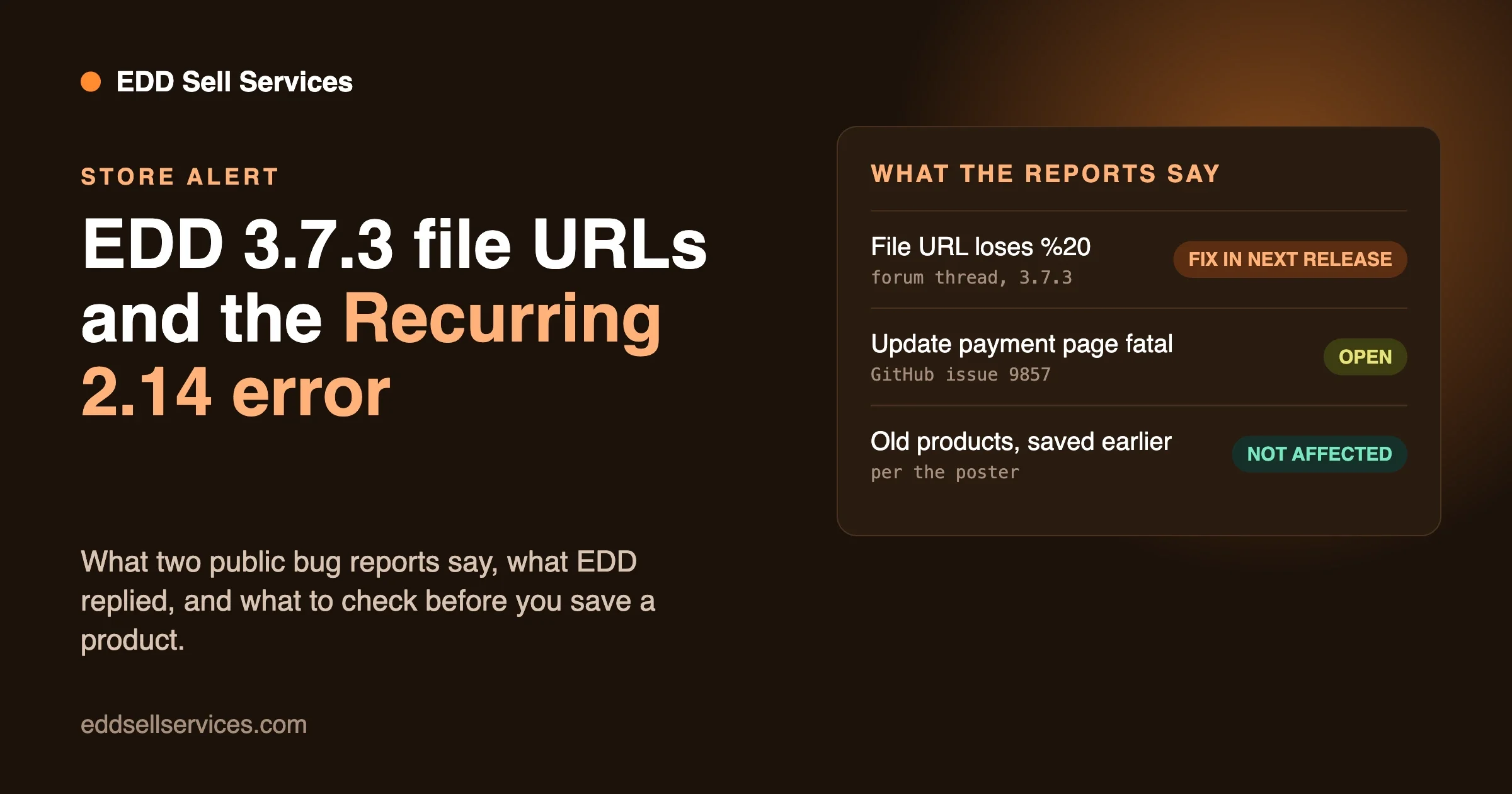
On your own store you handle updates, backups, security and the day a plugin update breaks something. We wrote about one such case in our EDD 3.7 update notes. A hosted tool takes that off your plate. If you do not want a second job, count it as a cost.
What is the best place to sell digital products online?
There is no single best place to sell digital products online. There is a best place for where you are now. Here is how we would pick.
Your situation | A route to look at first | Why |
|---|---|---|
First product, no audience, no site | Etsy for templates and printables, or a hosted tool such as Gumroad or Payhip | Setup takes hours. A marketplace can bring a first buyer. Fees are only paid on a sale. |
You have an audience and want simple tax handling | Lemon Squeezy or Gumroad direct | Both say they handle tax. You pay a percentage for that. |
You sell steadily and want a lower fee without running a store | Payhip Plus or Pro | The fee falls as volume rises, and Payhip says it handles digital VAT and sales tax. |
You sell to your own list at $1,000 a month or more | An own store on Easy Digital Downloads | No per-sale platform fee on the paid passes, and you keep the customer list. |
You sell software that needs license keys and updates | EDD with Software Licensing | Keys, activation limits and update checks live in your store. It needs the Professional pass. |
You sell services as well as downloads | EDD with a service workflow add-on | A service needs a brief, a conversation and a delivery, which a download page does not give. |
Many sellers use two routes at once. They keep a shop on Etsy for discovery and send repeat buyers to their own store. That costs more attention but uses each channel for what it does well.
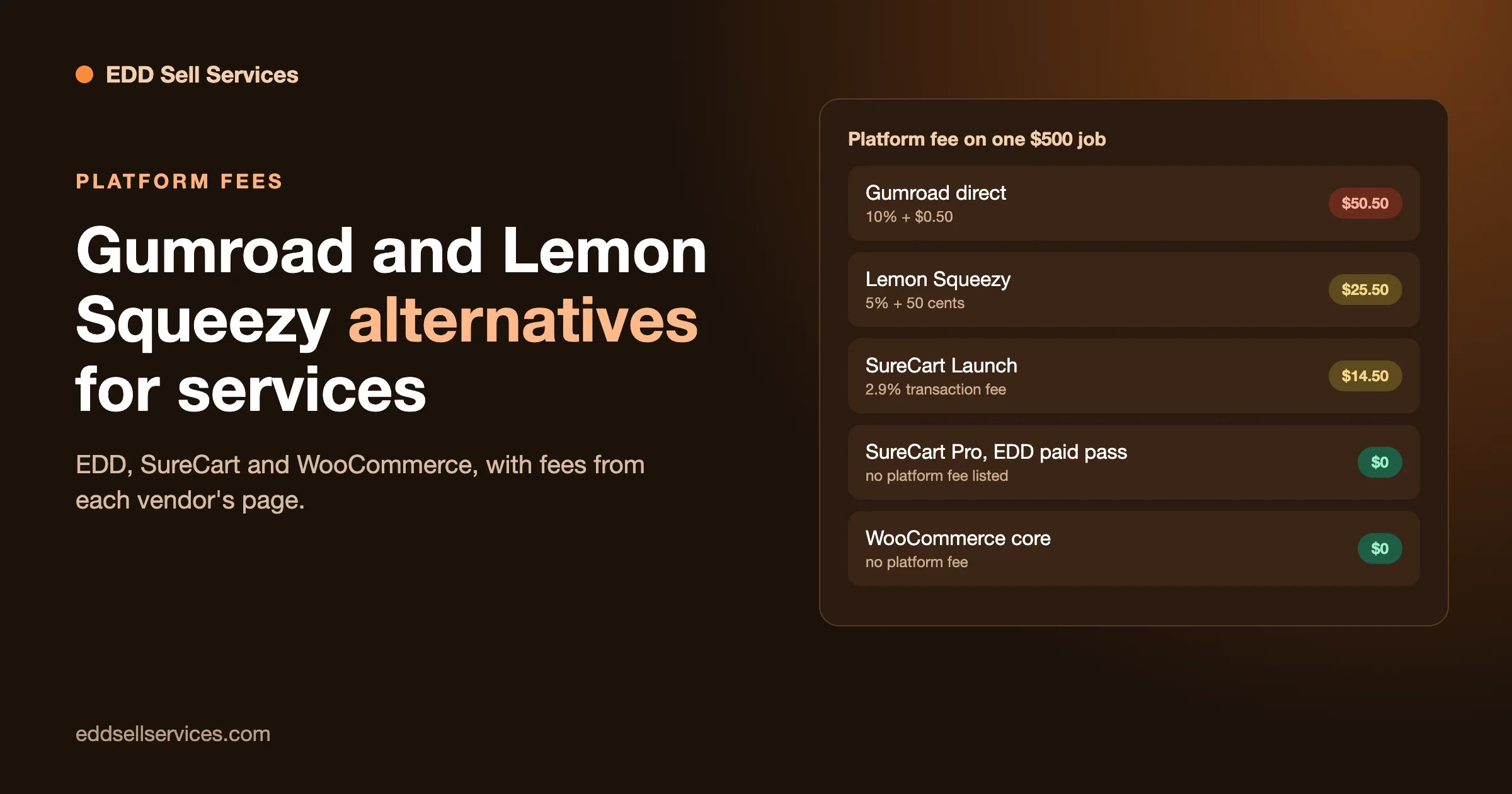
If you sell services such as design, writing or setup work, our guide on Gumroad and Lemon Squeezy alternatives for selling services looks at the same fee question on a $500 job, with SureCart and WooCommerce in the mix. This post stays on downloads.
How do you move from a marketplace to your own EDD store?
You do not have to jump all at once. A calm move looks like this.
- Set up the store on a staging copy. Install EDD, create one product, and run a test order. EDD’s test and launch doc walks through turning on test mode, placing an order with Stripe’s test card, and checking the receipt email and the download.
- Rebuild your products. The EDD guide on migrating from Gumroad maps Gumroad features to EDD ones. Limited sales map to Purchase Limit, versions to Variable Pricing, license keys to Software Licensing and pay-what-you-want to Custom Prices. The guide does not name an import tool or say whether customer data transfers, so plan to recreate products by hand.
- Recreate your discount codes. They live under Downloads, then Discounts.
- Connect payments. The same guide describes a one-click connection for Stripe and PayPal under Downloads, Settings, Payments.
- Set up tax if you owe it. This is where you speak to an accountant before launch, not after.
- Tell your list. Send existing customers to the new store, and keep the old shop open until the new one has earned your trust.
The guide notes that membership products need the Recurring Payments feature, which needs a paid pass, and that restricting content by purchase history needs an Extended pass or higher. If your products depend on either, price the pass in before you decide.
What can go wrong on your own store?
We prefer to name the sharp edges. Three come up most.
Files that are not protected. EDD keeps download files in the wp-content/uploads/edd/ folder and guards it with an .htaccess file. Its doc on NGINX says this only works on Apache. On NGINX, anyone with the direct link can fetch a file unless your host adds a rule. Ask your host which server you are on before you launch, and test a direct link in a private window.
Payment fees that surprise you. Check which gateway you connected and whether a licence is active. Our guide to EDD payments, fees and refunds covers gateways, refunds and a test-mode checklist.
Refunds and withdrawal rules. EDD’s refund doc says you can refund from the order screen and, with Stripe, tick a box so EDD also refunds the money at the gateway. Selling to EU consumers may bring a withdrawal rule too. EDD has a page on a withdrawal button for that, and it does not give legal advice. Neither do we.
Questions people ask
Can I sell digital products online for free?
You can sell digital products online without paying upfront. Gumroad, Payhip’s free plan and Etsy charge only when you list or sell. The Lite version of EDD is free, but you pay for hosting, and our own finding is that card payments carry a 3% fee without a licence. Free to start rarely means free to run.
Which platform has the lowest fees?
It depends on your volume. At 100 sales of a $30 product, Payhip Plus cost $89 a month in our table and Gumroad direct cost $350. At low volume the percentage routes win, and at high volume a flat monthly price or a pass wins. Processor fees apply on most routes, so add them.
Do I have to charge sales tax on digital products?
That depends on where you and your buyers live. Gumroad and Lemon Squeezy say they handle it for you. On your own store you set it up and, in most cases, you are responsible for filing. Ask an accountant who knows your countries.
Is Easy Digital Downloads better than Gumroad?
It is better for control and for fees at volume. Gumroad is better for speed and for tax handling. Neither wins for every seller, and the table above shows where the line sits for a $30 product.
Can I sell both downloads and services?
Yes. EDD has a Service product type that removes file uploads, and add-ons give a service a brief, a chat and a delivery step. Our EDD Sell Services add-on does that, and our start-to-finish guide shows the full path.
If you decide to sell on your own EDD store and want a hand with the move, our team can talk it through on the custom development page, or you can contact us with a short description of what you sell. If you sell services, the EDD Sell Services page has the live demo.