Gumroad and Lemon Squeezy Alternatives for Selling Services From WordPress: EDD, SureCart and WooCommerce
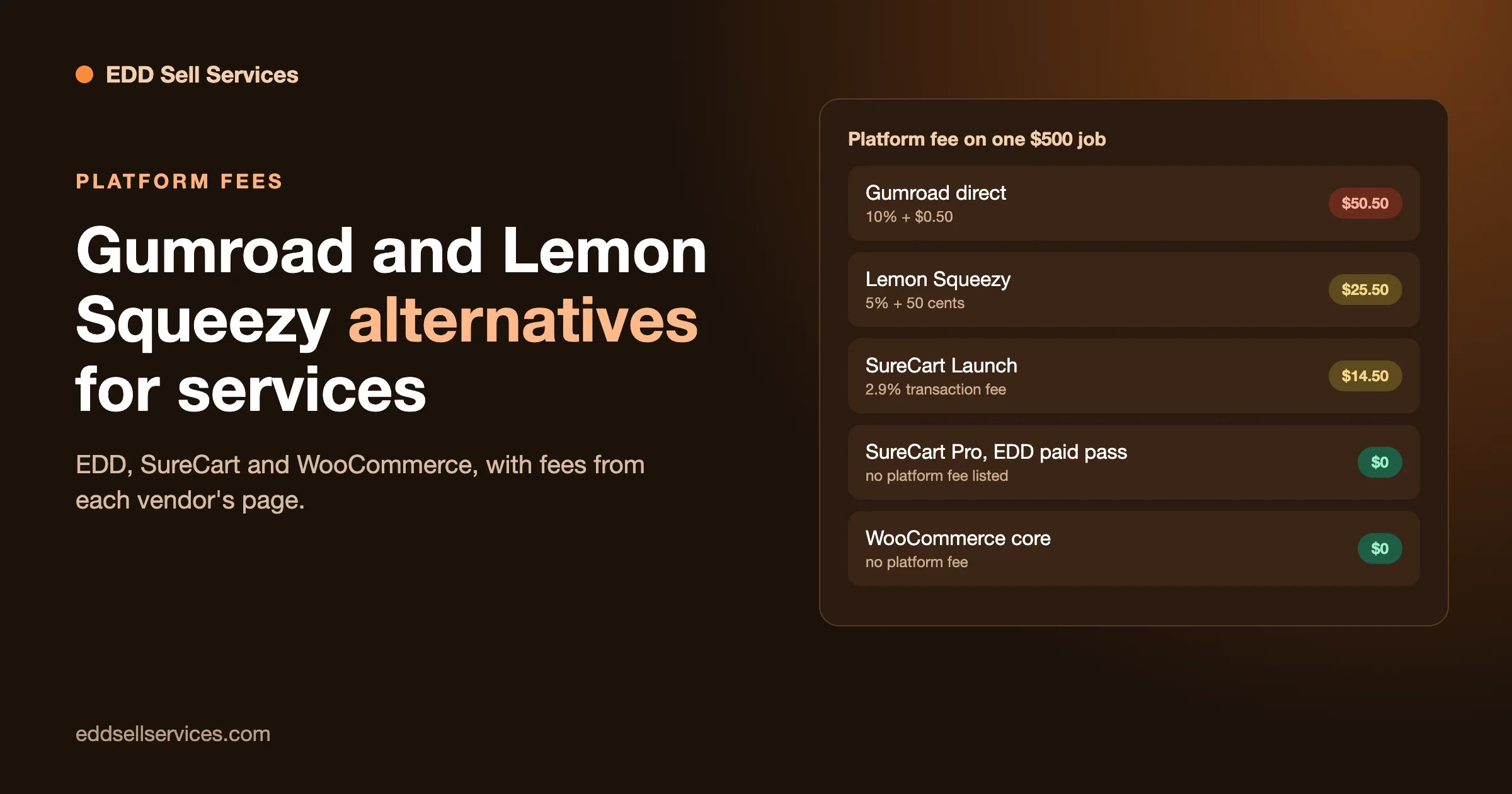
Gumroad and Lemon Squeezy alternatives for selling services from WordPress: EDD, SureCart and WooCommerce, with fees from each vendor's pricing page on one $500 job.

The best Gumroad and Lemon Squeezy alternatives for selling services from WordPress are Easy Digital Downloads, SureCart and WooCommerce. All three run on your own site, so you stop paying a share of every sale to a platform and pay for software instead. The trade is real: Gumroad and Lemon Squeezy act as merchant of record and handle sales tax for you, while on your own store the tax duty is yours. We read each vendor’s own pricing page on 3 November 2026, and this guide sets the fees side by side on one $500 service job so you can see where each route breaks even.
- Gumroad: 10% + $0.50 on direct sales and 30% on Discover sales, with no monthly fee, according to its pricing page.
- Lemon Squeezy: 5% + 50 cents per transaction and no monthly charge for ecommerce features, according to its pricing page.
- SureCart: a free Launch plan with a 2.9% transaction fee, or Pro from $199 a year for one store with no transaction fee.
- Easy Digital Downloads: paid passes from $99.50 a year (introductory price) list no platform fees. We use EDD for services with our own add-on, so we say where we stand below.
- WooCommerce: no platform fee on the core plugin. You pay for hosting, extensions and payment processing.
- What you take on: on your own store you handle tax collection, hosting and updates. That is the price of keeping the customer list and the margin.
Why do freelancers look for Gumroad and Lemon Squeezy alternatives?
Three reasons come up again and again. The fee is a percentage, so it grows with every job you win. The customer sits on the platform’s side of the fence, so your email list is not fully yours. And neither tool is built around a service order, which needs a brief from the client, a conversation, a delivery and often a second round.
Gumroad and Lemon Squeezy are good products. They get you from nothing to taking payments in an afternoon, and they take the tax paperwork off your plate. If you sell a few templates or one workshop a month, they may still be the right answer. This guide is for the point where a fee that was fair at $500 a month feels heavy at $5,000 a month.
For the wider question of marketplace, hosted tool or own store, see How to Sell Services With Easy Digital Downloads, Start to Finish. This post stays on the fees and on the three WordPress routes.
What do Gumroad and Lemon Squeezy actually charge?
Here is what each pricing page said on 3 November 2026. We quote them exactly and note what a page does not say, because a fee table with gaps is worse than a short one.
Gumroad
According to Gumroad’s pricing page, direct sales through your profile or links cost “10% + $0.50” per transaction. Sales that come through Gumroad Discover cost 30% per transaction. The page says it has no monthly fee. Since 1 January 2025, Gumroad is merchant of record, so it collects and remits sales tax. The page does not itemise payment processing or payout fees, and says the payout method varies by country, so read the fee notes for your country before you count on a figure.
Gumroad lists podcasts, online courses and SaaS subscriptions among the things people sell. It gives no separate rate for services, so the rates above are the ones to plan on.
Lemon Squeezy
Lemon Squeezy’s pricing page gives one consolidated fee of “5% + 50¢” per transaction, and says there are no monthly charges for ecommerce features. Email marketing is free for up to 500 subscribers. It says transactions outside the US may see small additional fees, and that some payments may be subject to extra fees, with a link to a separate fees page. Lemon Squeezy is also a merchant of record, taking on tax calculation, collection and filing. Payouts by bank wire and PayPal run twice a month.
The page carries a banner about a 2026 update with Stripe Managed Payments, and the footer shows a Stripe badge. We could not read the details of that change from the pages we reached, so check what it means for your fees and payouts before you decide.
One honest note on services
We did not read either company’s acceptable-use terms for selling services, as opposed to digital products. If you sell consulting, design or development hours, read those terms before you build a business on either platform.
What do the WordPress alternatives charge?
SureCart
SureCart’s pricing page showed, in US dollars, a free Launch plan with a 2.9% transaction fee, and Pro plans with no transaction fee. For one store, Pro was $199 a year (marked down to $159 for the first year in a Black Friday offer running to 30 November) or a one-time $699 (sale price $419). Plans for five stores and for unlimited stores are listed at higher prices. The page notes that introductory pricing renews at the full price shown at checkout.
The page says every plan has the same features, including subscriptions, installment plans, secure file delivery, client accounts and an agency suite with service fees and client commissions. It also lists 100-plus payment methods. The feature list does not describe a brief-and-delivery workflow for a service order, so for that you would look at how SureCart’s order flow fits your work.
Easy Digital Downloads
The EDD pricing page listed these passes on 3 November 2026, with introductory prices and a note that all renewals are at full price:
Pass | Per year (introductory) | Sites |
|---|---|---|
Lite | Free, on WordPress.org | Not listed |
Personal | $99.50 | 1 |
Extended | $199.50 | 1 |
Professional | $299.50 | 2 |
All Access | $499.50 | 3 |
The paid passes list “No Platform Fees”. The page does not state a fee for Lite. Our own guide, Is Easy Digital Downloads Free?, reports from the plugin’s code and settings text that without a valid licence, card payments carry a 3 percent fee on top of the payment provider’s fee. Treat that as our finding rather than a statement on the EDD pricing page, and check it on your own install.
Personal includes unlimited products, checkout, major payment gateways, discount codes, EU VAT compliance, abandoned cart recovery and revenue reporting. Professional adds licensing, a multi-vendor marketplace and commissions.
WooCommerce
WooCommerce’s own page describes it as having no monthly platform fees, with extensions in a marketplace of over 1,000 and hosting bought separately. Its payments product, WooPayments, says it has no setup costs or monthly fees and charges as you go. We could not read its per-transaction rates from the page, so check its fees page for your country.
How do the fees compare on one $500 service job?
Take a single $500 job and ten of them in a month, which is $60,000 of work over a year. The table shows the platform side only: what the platform or software takes, not card processing, which every route has in some form. We kept to each vendor’s own figures.
Route | Platform fee on one $500 job | Ten jobs a month | Over a year |
|---|---|---|---|
Gumroad, direct sale (10% + $0.50) | $50.50 | $505 | $6,060 |
Lemon Squeezy (5% + 50 cents) | $25.50 | $255 | $3,060 |
SureCart Launch (2.9%) | $14.50 | $145 | $1,740 |
EDD Lite without a licence (3%, our finding) | $15.00 | $150 | $1,800 |
SureCart Pro, one store | $0 | $0 | $199 (list, first year) |
EDD Personal | $0 | $0 | $99.50 (introductory, first year) |
WooCommerce core | $0 | $0 | $0, plus any extensions |
Two things stand out. At ten jobs a month, Gumroad’s direct rate costs roughly $6,000 a year in platform fees, and the self-hosted routes cost a few hundred dollars at most. And the break-even is quick: a year of EDD Personal at $99.50 equals the Gumroad fee on two $500 jobs.
The table leaves out costs that belong to self-hosting: hosting, a domain, your time to set up, and maintenance. A fair comparison adds those. For many sellers they come to a few hundred dollars a year plus an afternoon or two, but they are not zero.
What do you give up by leaving a merchant of record?
This is the part most comparisons skip. When Gumroad or Lemon Squeezy is the merchant of record, the platform is the legal seller to your customer. It calculates, collects and pays sales tax and VAT. On your own WordPress store you are the seller, and tax is your duty.
That does not mean you are on your own. EDD’s pricing page lists EU VAT compliance on the Personal pass, and SureCart lists automatic tax calculations. WooCommerce has its own tax settings. Those tools calculate tax; filing and paying it is still on you or your accountant. If tax is the part of selling you want off your desk, a merchant of record is worth a share of each sale, and the higher fee may be fair.
Ask these questions before you move:
- Where are your customers? Sales to a few large countries are easier than sales to many small ones.
- Do you have an accountant who knows digital sales tax in your country?
- Would the fee saved pay for that accountant’s time and the software?
Which of the three is best for selling services?
Fees are one part of the answer. The other part is what happens after payment. Selling a service is different from selling a file: the buyer pays, you need their details, you do the work, you hand it over, and sometimes you change it. Here is how the three routes handle that, going only by what each vendor lists.
Question | Easy Digital Downloads | SureCart | WooCommerce |
|---|---|---|---|
Platform fee | None on paid passes | 2.9% on Launch, none on Pro | None on core |
Starts at | $99.50 a year (Personal, introductory) | $0 (Launch) or $199 a year (Pro) | $0 plus hosting and extensions |
Recurring billing | Not stated on the pricing page; check which pass covers recurring payments | Subscriptions, installment plans and free or paid trials in all plans | WooCommerce Subscriptions is a paid extension |
Brief, chat and delivery on the order | With our EDD Sell Services add-on | Not listed on the pricing page | With Woo Sell Services, our sister add-on |
Other sellers on your site | Multi-vendor marketplace on Professional | Agency suite listed | Vendor plugins such as Dokan, WCFM |
We have a stake here and we say so: we make EDD Sell Services and Woo Sell Services, and the table points to both. On the other route, SureCart, we did not find a service order workflow on its pricing page, which may simply mean it lives elsewhere in the product, so ask SureCart before you assume either way.
Choose Easy Digital Downloads if
- You already sell files, templates or licences and want to add services next to them.
- You want a store that looks after downloads, receipts and licensing, with a low yearly cost.
- You would like a service order with a brief, conversation and delivery, which the EDD Sell Services add-on provides.
Our Easy Digital Downloads vs WooCommerce for Selling Services guide goes through that choice in detail.
Choose SureCart if
- You want a simple checkout that works fast, and the 2.9% fee on the free plan is acceptable while you test.
- Your service sells as a fixed offer with a payment link, subscription or installment plan.
- You value 100-plus payment methods and automatic tax calculations as listed on its page.
Choose WooCommerce if
- You want the largest set of extensions and developers who know it.
- You sell physical goods, bookings and services together.
- You are happy to assemble the pieces. Our sister guide on what selling services on WooCommerce really costs adds up the extensions.
Stay on Gumroad or Lemon Squeezy if
- Your volume is small and the fee is a few dollars a month.
- You value a merchant of record handling tax more than the margin.
- You do not want to run a website.
What does EDD Sell Services add to an EDD store?
Easy Digital Downloads sells products and files well. A service needs more, and EDD Sell Services is the add-on our team makes for that gap. According to its product page (version 4.3.0, updated March 2025), the order runs in four steps:
- The seller creates a service as an EDD product, sets the price and an estimated delivery time.
- After payment, the buyer answers the seller’s requirement questions. Question sets can be saved and reused.
- Chat, file sharing and a status tracker sit on the order, with notifications to both sides and an email to the vendor on each new order.
- The seller attaches the final file and marks it delivered, and ratings follow. If the customer does not respond within a set number of days after delivery, the order moves to review automatically.
It also works with the Frontend Submissions extension, so other vendors can list and manage their own services. Plans are Personal at $59 a year for one site or $199 once, Professional at $129 a year for five sites or $299 once, and Agency at $299 a year for unlimited sites or $499 once. Every plan has the full feature list, and renewals after the first year are billed at 30 percent of the base price. EDD itself, and any EDD pass you need, is bought separately.
If you want to see how the pieces fit before buying, our guide to the EDD addons a service store needs lists what to add and what to skip, and productized services on EDD shows how to package an offer.
How do you move from Gumroad or Lemon Squeezy without losing customers?
- Export your customer list. Do this first, and check what each platform lets you take. Email addresses and purchase history are the ones to look for.
- Build the new store beside the old one. Do not turn anything off yet.
- Place a test order. Pay, answer the brief, receive the delivery, ask for a change. Our payments guide has a test-mode checklist for EDD.
- Move new sales first. Point new links, your site and your social bios at the new store.
- Keep the old product page up. Leave existing customers where they are, and tell them where to buy next time.
- Review after a quarter. Compare the fees you would have paid with what the new set-up cost in money and time.
If your customers pay by subscription on the old platform, moving them takes more care than a one-off sale. Check how each platform handles payment methods and consent before you promise a date.
How do you work out your own break-even?
The table above uses a round $500 job. Your numbers are different, so do the sum yourself in four steps.
- Add up last year’s fees. Open your Gumroad or Lemon Squeezy payout reports and total the platform fees for twelve months. If you cannot find a single number, multiply your sales by the rate on the pricing page.
- Price the replacement. Write down the yearly cost of hosting, a domain, your EDD pass or SureCart plan, and any add-on. For a first estimate, use the introductory prices and then add the renewal price from the vendor’s page, because renewals can be higher.
- Add your time. Give the move an honest number of hours, then give each month of upkeep an hour or two. Multiply by what an hour of your time is worth.
- Compare the two totals. If the fees you pay now are larger than the new yearly cost plus your time, moving pays. If they are close, the better reason to move is control of the customer list, not money.
A freelancer who makes $1,500 a month through Lemon Squeezy pays about $75 plus 50 cents a sale. That is a fee most people accept. A studio that sells $15,000 a month pays ten times that, and the maths changes. Fees scale with your success, while software costs stay flat, and that is the whole case for moving.
What mistakes do sellers make when they switch?
- Counting the fee and forgetting tax. A merchant of record carries a legal duty for you. Price the tax work before you decide the fee is too high.
- Comparing a headline fee with an all-in fee. Some pages list a platform fee only, and the payment processor charges its own on top. Compare the same things on every row.
- Leaving buyers without an order page. A service customer wants to know where their order stands. If the new store shows only a receipt, you will answer that question by email for every job.
- Switching all at once. Move new sales first and leave existing customers where they are until the new store has run a few real orders.
- Forgetting the renewal. Introductory prices on EDD and on SureCart renew at the full price. Put that figure in your year-two sum.
Frequently asked questions
What is the best Gumroad alternative for WordPress?
For selling digital products and services on your own site, Easy Digital Downloads, SureCart and WooCommerce are the three main choices. EDD fits file and licence sellers, SureCart fits a quick checkout setup, and WooCommerce fits stores that sell a mix. None replaces the merchant-of-record tax service.
What does Gumroad charge in 2026?
Gumroad’s pricing page said 10% + $0.50 on direct sales and 30% on Discover sales on 3 November 2026, with no monthly fee. It does not itemise payment processing or payout fees, so check them for your country.
What does Lemon Squeezy charge?
Its pricing page said 5% + 50 cents per transaction and no monthly charge for ecommerce features, with possible extra fees outside the US and on some payments. Check the fees page it links to.
Is SureCart free?
There is a free Launch plan with a 2.9% transaction fee. Paid Pro plans list no transaction fee, from $199 a year for one store on 3 November 2026, with a Black Friday discount shown until 30 November.
Is Easy Digital Downloads free?
The Lite version is free on WordPress.org. Paid passes start at $99.50 a year at the introductory price, with renewals at full price. Our free-or-paid guide explains the fee we found on unlicensed card payments.
Who handles sales tax if I leave Gumroad or Lemon Squeezy?
You do. Both are merchant of record, so they collect and remit sales tax now. On your own store you are the seller. The plugins calculate tax, but filing and paying it is your responsibility, so talk to an accountant first.
Can I sell services, not just downloads, from these WordPress options?
Yes, with different levels of help. Our add-ons give EDD and WooCommerce a brief, conversation and delivery on each order. SureCart lists subscriptions, installment plans and client accounts, but its pricing page does not describe a service order workflow.
How much will I save by moving?
On ten $500 jobs a month, the platform fee alone ran from about $255 a month on Lemon Squeezy to $505 on Gumroad direct sales. Self-hosted routes cost a few hundred dollars a year plus hosting and your time. Run the same sum with your own numbers.
If EDD is your route, the EDD Sell Services page has the live demo, and our pricing page lists the plans. For help moving a store, our team can talk it through on the custom development page.