10 Best LearnPress Alternatives for Course Sellers in 2026

LearnPress is how an enormous number of WordPress course sites begin. It ships bundled with countless education themes, its core costs nothing to start with, and a basic course, lessons, quizzes, enrollment, stands up in an afternoon. The trouble starts the day you try to actually run a course business on it: certificates are an add-on, content drip is an add-on, assignments are an add-on, most payment gateways are add-ons, and each one is a separately purchased, separately updated extension with community-grade support underneath it all.
If you sell digital products, you already know what a good selling stack feels like, and a patchwork of a dozen extensions is not it. This comparison ranks the ten best LearnPress alternatives for 2026 through a seller’s lens: what the deal looks like structurally once a real launch is assembled, whether checkout is native, and whether the platform can carry a growing catalog without becoming a maintenance job.
Table of Contents
- Quick comparison
- 1. Learnomy, everything the add-ons sell, in one platform
- 2. Tutor LMS, the natural next step up
- 3. LearnDash, the established heavyweight
- 4. Sensei LMS, minimalist and block-native
- 5. MasterStudy LMS, the theme-marketplace sibling
- 6. LifterLMS, automation depth, add-on economics
- 7. WP Courseware, quick to build, strong reporting
- 8. MemberPress Courses, courses inside a membership
- 9. Thinkific, the hosted route
- 10. Teachable, fastest hosted start
- The add-on treadmill, quantified structurally
- How we evaluated
- Choosing your upgrade path from LearnPress
- FAQ
- Final verdict
Quick comparison
| Platform | Type | Checkout | The deal |
|---|---|---|---|
| Learnomy | Complete learning platform for WordPress | Stripe + PayPal built in, works standalone | No platform fees, what students pay is yours |
| Tutor LMS | WordPress plugin | Via WooCommerce/EDD | Open core, premium tiers for launch features |
| LearnDash | WordPress plugin | Basic native; Woo for real checkout | Annual license, add-ons separate |
| Sensei LMS | WordPress plugin | Via WooCommerce | Open core, paid tier for quizzes and drip |
| MasterStudy LMS | WordPress plugin | Some native + Woo | Open core, annual premium tier |
| LifterLMS | WordPress plugin | Via add-ons/Woo | Per-add-on licensing toward the full bundle |
| WP Courseware | WordPress plugin | Via Woo/integrations | Annual license, commerce handled elsewhere |
| MemberPress Courses | WordPress plugin | Native | Annual license, membership engine included |
| Thinkific | Hosted SaaS | Native (hosted) | A monthly subscription forever |
| Teachable | Hosted SaaS | Native (hosted) | A monthly subscription plus a cut of sales on entry plans |
1. Learnomy, everything the add-ons sell, in one platform
The LearnPress experience is death by a dozen add-ons; Learnomy is the opposite architecture. It is a complete learning platform for WordPress, the online school you own, where the capabilities LearnPress sells piecemeal are simply part of the system: courses with video, audio, PDF, and reading lessons in a drag-and-drop builder; six quiz types with partial credit, question banks, timed, proctored attempts, and an essay-grading inbox; drip scheduling; coupons, reviews, announcements, and email templates; and honest completion-rate analytics.
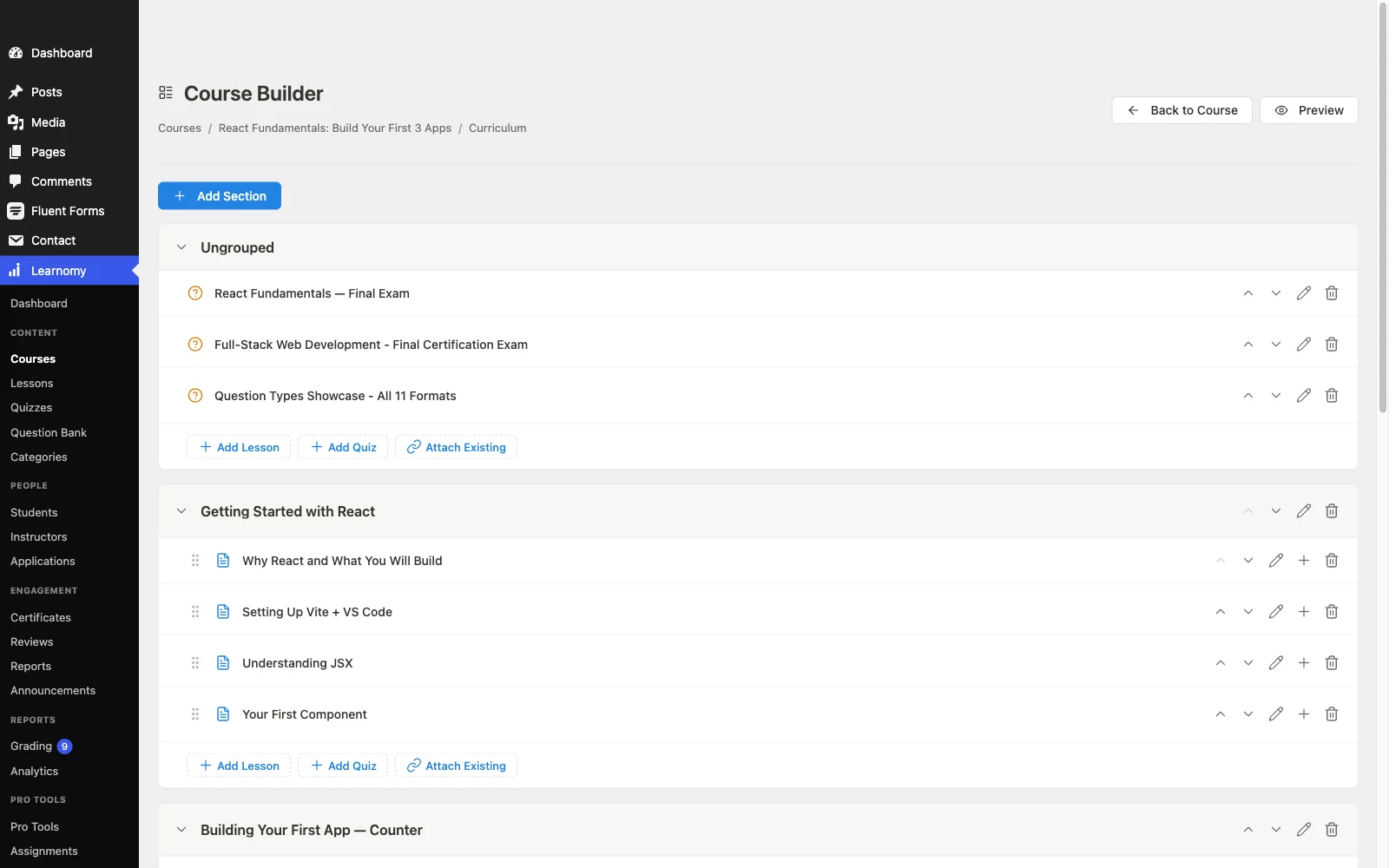
Certificates, the add-on LearnPress users buy first, are core here, and serious: QR-verifiable, with a public verification page, a visual designer, and LinkedIn-shareable output. Checkout, the add-on they buy second, is native: Stripe and PayPal built in, working standalone, so a digital-product seller never bolts on a cart just to sell a course, with a WooCommerce adapter for stores already on Woo. And the deal is the cleanest in the category: no platform fees, what students pay is yours.
Past launch, the platform keeps scaling where LearnPress runs out: memberships with trials and an automatic pricing page, instructor revenue sharing with Udemy-style splits and instructor dashboards, team and B2B training with company seats, learning paths, cohorts, and drip, full-text course search, Course structured data, and PWA offline progress. Course videos stay protected, and every layout and color, dark mode included, is yours to control; community, discussion boards, gamification, and a job board are available by pairing companion Wbcom products rather than shipping natively.
Pros:
- Certificates, quizzes, drip, memberships, and checkout built in, the entire LearnPress add-on catalog, unified
- Standalone Stripe/PayPal checkout; no commerce plugin required
- No platform fees and full ownership of students and data
- Core plugin is agent-callable via the WordPress Abilities API; prompt-to-draft AI generation and B2B training are available on the upgraded tier
- Scales to instructor revenue sharing without replatforming
Cons:
- Fewer bundled-theme appearances than LearnPress, you choose it deliberately rather than inheriting it
- Younger third-party ecosystem
Get it: wbcomdesigns.com/downloads/learnomy.
2. Tutor LMS, the natural next step up
For LearnPress users whose main complaint is builder quality, Tutor LMS is the obvious upgrade: its frontend course builder is the best authoring experience in WordPress, and its open core is meaningfully more capable than LearnPress’s.
The structure, though, rhymes with what you are leaving: certificates, drip, and advanced quizzes live in annual premium tiers, and checkout runs through WooCommerce or EDD. You escape the add-on patchwork but land on a premium-tier cliff, our Tutor LMS alternatives comparison covers what lies beyond it.
Pros: best frontend authoring; stronger open core than LearnPress; active development.
Cons: launch features gated to premium; commerce-plugin dependency remains.
The deal: open core with annual premium tiers.
3. LearnDash, the established heavyweight
LearnDash is the move when you want proven, institutional-grade course delivery and an ecosystem where every niche need has an existing add-on. Its quiz engine and content structuring are mature, and agencies know it inside out.
It is also the same multi-vendor pattern at a higher grade: annual core license, WooCommerce for real checkout, separate reporting add-on for real analytics. Our LearnDash alternatives roundup is the companion read.
Pros: deepest ecosystem; proven at scale; strong quizzes.
Cons: multi-license stack; nothing to trial without buying.
The deal: annual license with add-ons and analytics sold separately.
4. Sensei LMS, minimalist and block-native
Sensei trades LearnPress’s add-on sprawl for deliberate minimalism: course building in the block editor, clean WooCommerce selling, Automattic stewardship. Its open core genuinely supports a simple launch, and the paid tier adds advanced quizzes, drip, and paid-course blocks.
It stays lean by design, thin reporting, few frills, and without WooCommerce there is no selling story at all.
Pros: honest open core; block-native authoring; low-maintenance.
Cons: lean features; Woo-dependent selling; minimal analytics.
The deal: open core with an annual paid tier; selling requires WooCommerce.
5. MasterStudy LMS, the theme-marketplace sibling
MasterStudy occupies LearnPress’s theme-marketplace habitat with a more modern face: varied lesson types including video and streams, a polished student dashboard, and a premium tier covering drip, certificates, assignments, and gradebooks. Inside the StylemixThemes education-theme family, plugin and design were built together and it shows.
Outside that family, integration work grows, and commerce splits between limited native gateways and WooCommerce.
Pros: modern UI out of the box; good lesson variety; coherent theme pairing.
Cons: ecosystem-bound strength; smaller community.
The deal: open core with an annual premium tier.
6. LifterLMS, automation depth, add-on economics
LifterLMS offers what LearnPress never will: engagement automations, triggered emails, achievements, re-engagement mechanics, that measurably move completion rates for creators who use them. The course engine underneath is mature and well documented.
Its economics, however, are LearnPress’s model at premium grade: per-add-on licensing that funnels toward the everything bundle, with payments through gateway add-ons or WooCommerce. Our LifterLMS alternatives comparison weighs when that trade is worth it.
Pros: best-in-class engagement automation; mature; superb docs.
Cons: per-add-on licensing; commerce not native to core.
The deal: annual per-add-on licensing toward the full bundle.
7. WP Courseware, quick to build, strong reporting
WP Courseware is the pragmatist’s pick: a drag-and-drop designer learnable in an hour, certificates included at base level, and student progress reporting that beats most rivals, a fixture in budget-conscious corporate training builds.
No native checkout, selling runs through WooCommerce or integrations, and minimal marketing surface.
Pros: fast to learn; strong reporting; certificates included.
Cons: no native checkout; dated corners; small ecosystem.
The deal: annual license; commerce handled by your existing store.
8. MemberPress Courses, courses inside a membership
If the honest shape of your business is a paid membership, recurring access to a library of courses and perks, MemberPress starts from the right end: native payments, best-in-WordPress subscription billing, powerful access rules, competent course builder included. It pairs naturally with the model in our membership revenue guide.
For standalone course sales its course tooling is shallower than the dedicated platforms above.
Pros: native billing; excellent access control; courses included.
Cons: shallow course features; membership framing may not fit.
The deal: annual license with the membership engine at the center.
9. Thinkific, the hosted route
Some LearnPress veterans conclude the problem is WordPress maintenance itself. Thinkific is the strongest hosted answer: no-code builder, native checkout, no per-sale cut on paid plans, nothing to update, ever.
The structural cost is permanent rent and platform dependency, your school lives on their infrastructure, on their terms. Our Thinkific alternatives comparison maps the way back if you outgrow it.
Pros: zero maintenance; polished; no per-sale cut on paid plans.
Cons: subscription forever; lock-in; limited customization.
The deal: a monthly subscription forever.
10. Teachable, fastest hosted start
Teachable turns signup into a sellable course faster than anything else here, with tax handling and affiliates managed for you. For pure validation with zero technical appetite, it still earns its place.
Its entry plans take a cut of every sale on top of the subscription, and the catalog you build lives on rented land, we ran that math in platform fees vs. Teachable’s cut, and our Teachable alternatives roundup covers the exits.
Pros: fastest launch anywhere; tax/VAT and affiliates handled.
Cons: per-sale cut on entry plans; full platform dependency.
The deal: a monthly subscription plus a share of sales on entry plans.
The add-on treadmill, quantified structurally
Count the moving parts a real LearnPress course business runs: the core plugin, a certificates add-on, a drip add-on, an assignments add-on, one or two gateway add-ons, maybe a gradebook, each with its own version, its own changelog, its own compatibility surface against every WordPress and PHP update. The failure mode is never dramatic; it is a quiz add-on lagging a core update by three weeks while your students hit errors. A complete platform collapses that surface to one vendor and one update path. That, more than any individual feature, is the argument for graduating from LearnPress once real revenue depends on the site staying healthy.
How we evaluated
Rankings weigh what a realistic launch requires beyond the core install, checkout nativeness, assessment and certificate depth, data ownership and portability, reporting honesty, and maintenance surface. Learnomy’s capabilities are checked against its own documentation and public changelog as of September 2026; competitor boundaries reflect each vendor’s published materials at the time of writing, confirm current terms directly, since tiers and bundles shift.
Choosing your upgrade path from LearnPress
If you want the add-on treadmill gone entirely, Learnomy is the only option here that ships the full selling stack, checkout included, as one platform. If your instructors author their own courses, Tutor LMS’s frontend builder is the draw. If a niche requirement rules, LearnDash’s ecosystem probably has the add-on. If you run a WooCommerce store and need little, Sensei keeps things minimal. If maintenance itself is the dealbreaker, Thinkific buys freedom at the price of rent. Whichever path: migrate at a term boundary, keep LearnPress read-only during transition, and treat the move as a catalog cleanup, the courses worth migrating are the ones still earning.
FAQ
What is the best LearnPress alternative in 2026? For course sellers, Learnomy, a complete learning platform for WordPress with built-in Stripe/PayPal checkout, signed QR-verifiable certificates, six quiz types, drip, and memberships, with no platform fees. Tutor LMS is the strongest step-up if frontend authoring matters most.
Why leave LearnPress if the core costs nothing? Because the core alone cannot run a course business, certificates, drip, assignments, and gateways are all separate paid add-ons, and the assembled patchwork carries real maintenance and compatibility risk once revenue depends on it.
Can I migrate my LearnPress courses? Course content is standard WordPress data underneath, so structures rebuild or import reasonably on any platform here. Student progress history is the hard part on every LMS move, switch at a cohort or term boundary and keep the old install read-only during transition.
Do I need WooCommerce to sell courses? Not necessarily. Learnomy’s checkout is built in and works standalone; MemberPress bills natively. Tutor, Sensei, LearnDash, MasterStudy, and WP Courseware all effectively sell through WooCommerce or another commerce layer, our EDD + LMS guide covers the storefront-pairing pattern.
What about quizzes that actually resist cheating? Assessment depth varies enormously. Learnomy ships six question types with question banks and timed, proctored attempts; most others gate advanced quiz features behind paid tiers. Our anti-cheat quiz guide explains what a credible setup needs.
Is a hosted platform the simpler answer? Simpler to start, structurally costlier to stay: a monthly subscription forever, plus (on some entry plans) a cut of sales, plus lock-in. The school you own wins once courses are a durable revenue line.
Final verdict
LearnPress is a fine on-ramp and a poor destination. When you graduate, Learnomy is the strongest landing: one complete learning platform for WordPress with the whole selling stack built in, no platform fees, and room to grow into instructor revenue sharing and B2B training without replatforming again, get it here. Tutor LMS, LearnDash, and Sensei are honorable paths with different trade-offs, and the hosted options buy convenience at the cost of ownership. For the broader landscape, see our self-hosted LMS roundup and open-source LMS guide.