10 Best MasterStudy LMS Alternatives for Selling Courses Online in 2026

MasterStudy LMS earns genuine praise for how it looks. Backed by StylemixThemes, it ships a modern student dashboard, varied lesson formats, video, streams, slides, and, paired with one of the company’s education themes, a course site that feels designed rather than assembled. So why search for MasterStudy LMS alternatives? Because the polish is strongest inside its own theme family, and life outside it means integration work; because the capabilities a paid launch depends on, drip, certificates, assignments, gradebooks, sit in the annual premium tier; and because its commerce story splits awkwardly between a few native gateways and a WooCommerce dependency for the rest.
For a digital product seller, those three seams matter more than the screenshots. Courses should sell through a checkout that simply exists, on a platform that is not married to one vendor’s themes, with the launch feature set present from day one. Here are the ten best MasterStudy alternatives for 2026, judged the way a seller judges any tool: what the deal is structurally, what is native versus bolted on, and who keeps the money and the data.
Table of Contents
- Quick comparison
- 1. Learnomy, theme-independent, checkout included
- 2. Tutor LMS, the frontend-builder benchmark
- 3. LearnDash, the ecosystem heavyweight
- 4. LifterLMS, engagement automation depth
- 5. Sensei LMS, block-native minimalism
- 6. LearnPress, the zero-cost starting line
- 7. WP Courseware, fast builds, honest reporting
- 8. MemberPress Courses, membership-first
- 9. Thinkific, the hosted clean break
- 10. LearnWorlds, interactive video, hosted
- The theme-coupling problem, honestly stated
- How we evaluated
- FAQ
- Final verdict
Quick comparison
| Platform | Type | Checkout | The deal |
|---|---|---|---|
| Learnomy | Complete learning platform for WordPress | Stripe + PayPal built in, works standalone | No platform fees, what students pay is yours |
| Tutor LMS | WordPress plugin | Via WooCommerce/EDD | Open core, premium tiers for launch features |
| LearnDash | WordPress plugin | Basic native; Woo for real checkout | Annual license, add-ons separate |
| LifterLMS | WordPress plugin | Via add-ons/Woo | Per-add-on licensing toward the full bundle |
| Sensei LMS | WordPress plugin | Via WooCommerce | Open core, paid tier for quizzes and drip |
| LearnPress | WordPress plugin | Via add-ons | Open core, selling essentials sold separately |
| WP Courseware | WordPress plugin | Via Woo/integrations | Annual license, commerce handled elsewhere |
| MemberPress Courses | WordPress plugin | Native | Annual license, membership engine included |
| Thinkific | Hosted SaaS | Native (hosted) | A monthly subscription forever |
| LearnWorlds | Hosted SaaS | Native (hosted) | A monthly subscription plus a per-sale fee at entry level |
1. Learnomy, theme-independent, checkout included
The two seams that push sellers off MasterStudy, theme coupling and split commerce, are exactly where Learnomy is strongest. It is a complete learning platform for WordPress, the online school you own, designed to work with your theme rather than requiring its vendor’s: full branding and design control is part of the platform, from layouts to dark mode, so the polished-out-of-the-box experience does not depend on which theme family you married.
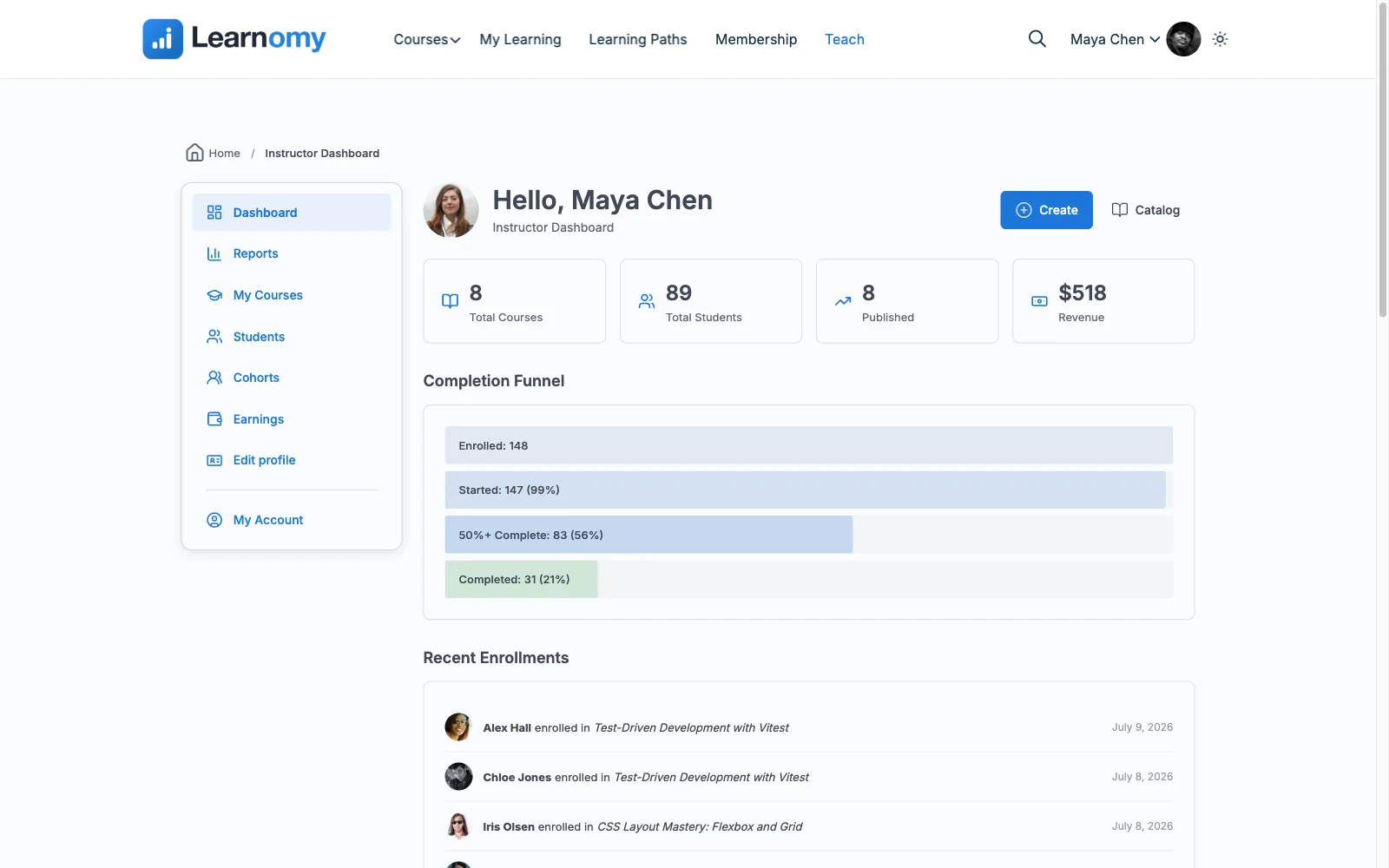
The commerce story is unified instead of split: Stripe and PayPal checkout is built in and works standalone, no WooCommerce required to sell a course, with a WooCommerce adapter available when a store already runs on Woo. The deal is the cleanest in the category: no platform fees, what students pay is yours. And the launch feature set MasterStudy holds in its premium tier is simply present: drip, six quiz types with partial credit, question banks, timed, proctored attempts and an essay-grading inbox; QR-verifiable certificates with a public verification page and a visual designer; coupons, reviews, announcements, and email templates; and completion-rate analytics that tell the truth.
Beyond launch, the platform covers ground MasterStudy does not reach: memberships with trials and an automatic pricing page, instructor revenue sharing with Udemy-style splits and instructor dashboards, team and B2B training with company seats, learning paths, cohorts, and drip, full-text course search, Course structured data for rich results, and PWA offline progress. Course videos stay protected; community, discussion boards, gamification, and a job board are available by pairing companion Wbcom products rather than shipping natively.
Pros:
- Works with any well-built theme, no vendor theme-family dependency
- Standalone built-in checkout; unified commerce instead of a native/Woo split
- Launch features, drip, certificates, advanced quizzes, included rather than tiered
- No platform fees, full data ownership
- Core plugin is agent-callable via the WordPress Abilities API; prompt-to-draft AI generation is available on the upgraded tier
Cons:
- MasterStudy’s bundled-theme visual head start is real if you were buying a Stylemix theme anyway
- Younger third-party ecosystem
Get it: wbcomdesigns.com/downloads/learnomy.
2. Tutor LMS, the frontend-builder benchmark
Tutor LMS is MasterStudy’s most direct stylistic competitor and beats it on the thing both are known for: authoring experience. Tutor’s frontend course builder remains the best in WordPress, and its open core is a genuine starting point for a simple course.
Structure-wise it shares MasterStudy’s premium-tier pattern, certificates, drip, and advanced quizzes are paid, and checkout runs through WooCommerce or EDD. Our Tutor LMS alternatives comparison is the deeper dive.
Pros: best frontend authoring; strong multi-instructor tools; big community.
Cons: premium cliff for launch features; commerce-plugin dependency.
The deal: open core with annual premium tiers.
3. LearnDash, the ecosystem heavyweight
Where MasterStudy’s ecosystem is one vendor’s themes, LearnDash’s is a decade of third-party add-ons covering nearly every conceivable requirement. It is the safe choice for complex, institutional builds, with a proven quiz engine and agency familiarity everywhere.
Its stack economics remain multi-vendor, annual core license, WooCommerce for serious checkout, separate reporting add-on, as our LearnDash alternatives roundup details.
Pros: deepest ecosystem; institutional-grade; strong quizzes.
Cons: multi-license assembly; nothing to trial free.
The deal: annual license with add-ons and analytics sold separately.
4. LifterLMS, engagement automation depth
LifterLMS brings something neither MasterStudy nor most of this list offers: engagement automations, triggered emails, achievements, re-engagement flows, that measurably lift completion rates when actually used. The engine is mature and superbly documented.
Its per-add-on licensing funnels real deployments toward the everything bundle, and payments route through gateway add-ons or WooCommerce. See our LifterLMS alternatives comparison for when the trade pays.
Pros: best engagement automation in WordPress; mature; great docs.
Cons: per-add-on economics; commerce not native to core.
The deal: annual per-add-on licensing toward the full bundle.
5. Sensei LMS, block-native minimalism
Sensei is the anti-MasterStudy: no theme dependency, no visual maximalism, just course building inside the block editor with clean WooCommerce selling and Automattic stewardship. Its open core supports a real, simple launch; the paid tier adds advanced quizzes, drip, and paid-course blocks.
It stays deliberately lean, reporting included, and without WooCommerce it has no selling story.
Pros: block-native; honest open core; low maintenance.
Cons: lean features; Woo-dependent selling; thin analytics.
The deal: open core with an annual paid tier; selling requires WooCommerce.
6. LearnPress, the zero-cost starting line
LearnPress shares MasterStudy’s theme-marketplace habitat and undercuts it on entry cost: the core costs nothing and ships bundled with countless education themes. For validating an idea it works; for running a business, certificates, drip, assignments, and gateways all arrive as separately purchased add-ons that you then maintain as a patchwork, the full picture is in our LearnPress alternatives guide.
Pros: nothing to buy upfront; enormous theme compatibility.
Cons: add-on sprawl; community-grade support; patchwork maintenance.
The deal: open core with selling essentials sold separately.
7. WP Courseware, fast builds, honest reporting
WP Courseware skips MasterStudy’s visual ambition for speed and measurement: a drag-and-drop designer learnable in an hour, certificates at base level, and student progress reporting that outclasses prettier rivals, a recurring pick for corporate training portals on sane budgets.
No native checkout; selling runs through WooCommerce or integrations.
Pros: fast to learn; strong reporting; certificates included.
Cons: no native checkout; dated visual corners.
The deal: annual license; commerce handled by your existing store.
8. MemberPress Courses, membership-first
If recurring membership revenue is the actual business and courses are the content inside it, MemberPress starts from the right end: native payments, the best subscription billing in WordPress, powerful access rules, and a competent course builder included, the architecture behind our recurring revenue playbook.
As a standalone course platform it is shallower than the dedicated options above.
Pros: native billing; excellent access control.
Cons: shallow course tooling; membership framing.
The deal: annual license with the membership engine at the center.
9. Thinkific, the hosted clean break
For sellers whose real conclusion is “no more WordPress maintenance,” Thinkific is the strongest hosted exit: no-code builder, native checkout, no per-sale cut on paid plans, nothing to patch. The structural price is a monthly subscription forever and a school that lives on rented infrastructure, our Thinkific alternatives roundup maps the road back.
Pros: zero maintenance; polished; no per-sale cut on paid plans.
Cons: subscription forever; lock-in; limited customization.
The deal: a monthly subscription forever.
10. LearnWorlds, interactive video, hosted
LearnWorlds out-teaches most of this list on learning experience: interactive video with in-video questions, transcripts, and note-taking that WordPress plugins rarely match. Its entry tier takes a fee on each sale, so serious seller economics start higher up, and the usual SaaS structure, rent, dependency, harder exits over time, applies. Our LearnWorlds alternatives comparison covers the reverse migration.
Pros: best interactive video in the category; strong templates.
Cons: per-sale fee at entry; rent and lock-in.
The deal: a monthly subscription plus a per-sale fee until you upgrade tiers.
The theme-coupling problem, honestly stated
MasterStudy inside a StylemixThemes education theme is a coherent product, that is genuine praise, and if you were going to buy one of those themes anyway, the pairing is a fair deal. The risk is directional: your LMS choice now constrains your theme choice for the life of the site. A redesign, a rebrand, a performance-driven theme switch, each becomes an LMS-compatibility question first. Platforms built theme-independent, Learnomy with its own design control, Sensei riding the block editor, keep those decisions separate, which is worth more than it appears the day you choose and exactly as much as it appears the day you redesign.
How we evaluated
Rankings weigh theme independence, checkout nativeness, what the base offering genuinely includes versus gates, data ownership and portability, assessment and certificate depth, and reporting honesty. Learnomy’s capabilities are checked against its own documentation and public changelog as of September 2026; competitor boundaries reflect vendors’ published materials at the time of writing, confirm current terms directly before committing.
FAQ
What is the best MasterStudy LMS alternative in 2026? For online course sellers, Learnomy, a complete learning platform for WordPress that is theme-independent, ships launch features (drip, certificates, six quiz types) as core rather than premium, includes standalone Stripe/PayPal checkout, and takes no platform fees. Tutor LMS is the strongest alternative if frontend authoring is the priority.
Is MasterStudy LMS only good with StylemixThemes themes? It works elsewhere, but its polish and integration depth are strongest inside that theme family, outside it, expect integration work that theme-independent platforms avoid entirely.
Can I sell courses without WooCommerce after leaving MasterStudy? Yes, Learnomy’s checkout is built in and works standalone, and MemberPress bills natively. Most other WordPress options here effectively sell through WooCommerce; our EDD + LMS guide covers pairing courses with an existing digital storefront instead.
How hard is migrating courses off MasterStudy? Course content is WordPress data underneath, so structures rebuild on any platform here; student progress history is the hard part of every LMS move. Migrate at a cohort or term boundary, keep the old install read-only during transition, and re-issue certificates from the new platform, straightforward with automated certificate issuance.
What about live streams, which MasterStudy supports as a lesson type? If stream-style lessons are central to your teaching, verify each alternative’s video handling directly against your workflow, approaches differ, and recorded-video delivery (with protection) is the universally solid path across platforms.
Do any of these take a cut of my sales? No WordPress option here does, their costs are licenses and stack assembly. Learnomy charges no platform fees and requires no assembly. Hosted platforms vary: LearnWorlds’ entry tier takes a per-sale fee, Thinkific’s paid plans do not.
Final verdict
MasterStudy is a good product with two structural strings attached: its theme family and its split commerce. Learnomy cuts both, a complete learning platform for WordPress that works with your theme, sells through its own built-in checkout, and takes nothing off the top: get it here. Tutor LMS wins on authoring feel, LearnDash on ecosystem depth, LifterLMS on engagement automation, and the hosted pair on maintenance freedom at rental prices. For the full field, our self-hosted LMS roundup and course platform comparison complete the picture.