8 Best WordPress LMS Plugins with Membership Features in 2026

Somewhere between “sell one course” and “run a school,” almost every course business rediscovers the membership model: recurring access to a growing library beats one-off sales for revenue predictability, retention, and lifetime value. The tooling question is which direction to approach it from, an LMS that grew membership features, or a membership plugin that grew course features, and the answer shapes your architecture for years.
This comparison ranks the eight best WordPress options for combining courses with memberships in 2026: subscriptions and trials, tiered access to course libraries, drip inside a membership window, and the pricing-page mechanics that convert. It builds on our membership recurring-revenue guide and slots into the wider 2026 LMS comparison.
Table of Contents
- Quick comparison
- 1. Learnomy, memberships native to the school
- 2. MemberPress, the billing engine with courses attached
- 3. LifterLMS, the LMS with the deepest membership add-on
- 4. LearnDash, memberships by assembly
- 5. Tutor LMS, subscriptions via the commerce bridge
- 6. Sensei LMS, Woo memberships, lean core
- 7. MasterStudy LMS, bundles and subscriptions, premium tier
- 8. Restrict Content Pro + any LMS, the modular route
- Choosing your membership model
- How we evaluated
- FAQ
- Final verdict
Quick comparison
| Platform | Membership approach | Trials? | The deal |
|---|---|---|---|
| Learnomy | Native to the platform, with automatic pricing page | Yes | No platform fees, what students pay is yours |
| MemberPress | Membership engine first, courses inside | Yes | Annual license |
| LifterLMS | LMS + memberships add-on | Yes | Per-add-on licensing |
| LearnDash | Assembled: LMS + membership plugin + Woo | Via stack | Annual license, add-ons separate |
| Tutor LMS | Subscriptions via WooCommerce/EDD extensions | Via stack | Open core, premium tiers |
| Sensei LMS | Woo Memberships pairing | Via stack | Open core, paid tier |
| MasterStudy LMS | Bundles/subscriptions in premium tier | Premium | Open core, premium tier |
| Restrict Content Pro + LMS | Modular gating over any engine | Yes | Annual license + LMS costs |
1. Learnomy, memberships native to the school
Learnomy tops this list because memberships are not an add-on grafted onto a course engine, they are part of the platform’s commerce core. As a complete learning platform for WordPress, the online school you own, Learnomy ships memberships with trials and an automatic pricing page: define your tiers and the platform generates the conversion surface, no page-builder session or third-party pricing plugin required. Recurring billing runs through the same built-in Stripe and PayPal checkout that handles one-off sales, standalone, no WooCommerce, no subscriptions extension, and the deal extends to recurring revenue too: no platform fees, what students pay is yours.
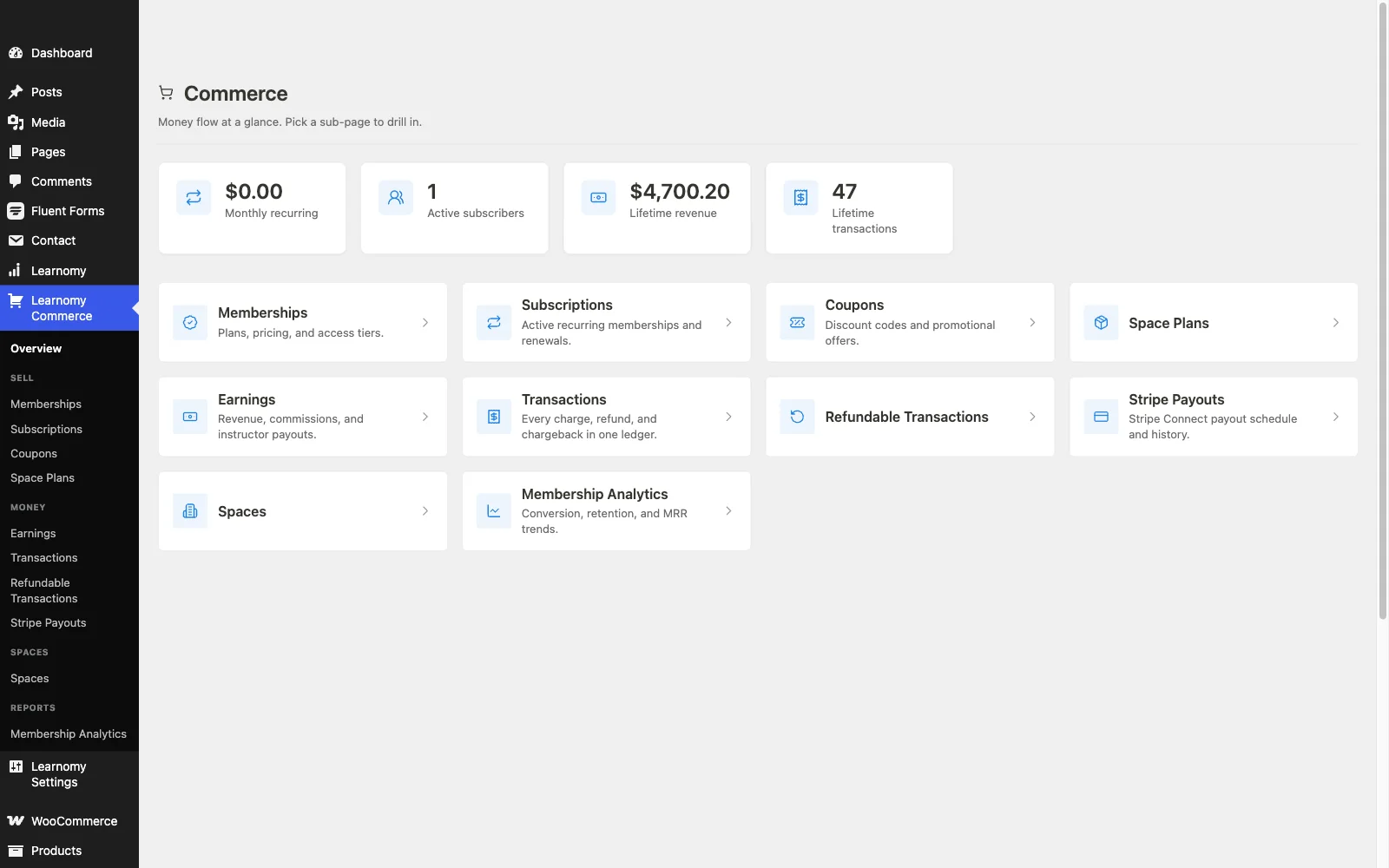
The membership wraps a school worth subscribing to: drag-and-drop courses with video, audio, PDF, and reading lessons; drip, cohorts, and learning paths that give a subscription its cadence; six quiz types with timed, proctored attempts and an essay-grading inbox; signed, QR-verifiable certificates members can earn as they progress; coupons for win-back offers; announcements and email templates for member communication; and honest completion analytics so you can see which library content actually retains. Retention mechanics pair in when you want them: BuddyPress, BuddyNext, or Jetonomy add a learning community, discussion boards, and Q&A around your school, and WB Gamification adds points, badges, and streaks, the daily-return loops membership economics depend on. Team plans extend the same model to B2B: company seats, learning paths, and cohorts sold as organizational memberships.
Pros:
- Memberships, trials, and an automatic pricing page native, zero assembly
- Recurring billing through built-in standalone checkout; no platform fees on subscriptions
- Retention loops (community, gamification, streaks) built into the platform
- B2B seats turn the same machinery into corporate deals
Cons:
- Subscription mechanics (prorations, complex upgrade paths) are less configurable than MemberPress’s dedicated engine
- Younger ecosystem
Get it: wbcomdesigns.com/downloads/learnomy.
2. MemberPress, the billing engine with courses attached
Approached from the membership side, MemberPress is the reference: the deepest subscription billing in WordPress, trials, upgrades, downgrades, prorations, dunning, with access rules that gate anything on the site and a competent course builder included. If your business is subscriptions first and courses are the content, this is the purpose-built architecture.
The course layer is the trade: shallower assessment, credentials, and learning features than any dedicated platform above it on this list. You get the best billing and a workable classroom, not the reverse.
Pros: best subscription mechanics in WordPress; gate-anything rules; native payments.
Cons: shallow LMS layer; everything framed as membership.
The deal: annual license with billing at the center.
3. LifterLMS, the LMS with the deepest membership add-on
Among course engines, LifterLMS has the most mature membership story: its memberships add-on bundles courses into tiered access, auto-enrolls members, and ties into the platform’s signature engagement automations, lapsed-member win-back emails, achievement-driven retention, which is genuinely the right toolset for subscription retention.
The economics are the usual: memberships, gateways, and advanced features are separately licensed, funneling toward the bundle, per our LifterLMS alternatives guide.
Pros: course-native memberships; engagement automations aid retention.
Cons: add-on licensing; commerce not native to core.
The deal: annual per-add-on licensing toward the full bundle.
4. LearnDash, memberships by assembly
LearnDash has no native membership engine; it has an ecosystem, pair it with MemberPress, Restrict Content Pro, or WooCommerce Subscriptions via well-documented integrations, and any membership architecture becomes possible. Agencies build sophisticated subscription schools on exactly this stack.
Possible is not simple: three or four vendors, an integration surface that spans every update cycle, and the assembled economics our LearnDash alternatives comparison tallies.
Pros: any architecture achievable; deep course engine underneath.
Cons: multi-vendor assembly and maintenance; no native path.
The deal: annual license plus your chosen membership stack.
5. Tutor LMS, subscriptions via the commerce bridge
Tutor LMS reaches memberships through its commerce bridges: WooCommerce Subscriptions (or EDD’s recurring extension) sells the subscription, Tutor delivers the courses, and premium-tier features handle content control. For EDD-based stores specifically, that bridge is the most natural among dedicated engines, the wiring is in our EDD + LMS guide.
Pros: works with the storefront you already run; best authoring UX.
Cons: membership logic split across systems; premium gates.
The deal: open core with premium tiers plus commerce extensions.
6. Sensei LMS, Woo memberships, lean core
Sensei pairs cleanly with WooCommerce Memberships and Subscriptions, Automattic products aligning neatly, to gate course access by membership plan on a Woo store. The result is honest and lean like Sensei itself: it works, it stays simple, and it never gets deeper than the lean core allows.
Pros: clean pairing within the Woo family; low complexity.
Cons: lean LMS features; entirely Woo-dependent.
The deal: open core with a paid tier, plus Woo membership extensions.
7. MasterStudy LMS, bundles and subscriptions, premium tier
MasterStudy’s premium tier includes course bundles and subscription selling, a self-contained membership-lite that suits its polished, theme-coherent world. Depth is moderate (simpler tiering and trial mechanics than the leaders) and the usual notes apply about life outside the StylemixThemes family, per our MasterStudy alternatives comparison.
Pros: self-contained bundles and subscriptions; polished student UX.
Cons: premium-gated; moderate depth; theme coupling.
The deal: open core with an annual premium tier.
8. Restrict Content Pro + any LMS, the modular route
The modular purist’s answer: Restrict Content Pro (from the EDD family, and a natural fit for readers of this site) handles subscriptions and gating with admirable focus, layered over whichever course engine you prefer. It is the cleanest separation of concerns on this list, and one more vendor, one more integration, and membership analytics that live apart from learning analytics.
Pros: focused, well-built gating; pairs with any engine; EDD-family pedigree.
Cons: split-brain data; integration surface; two products to maintain.
The deal: annual license plus your LMS’s costs.
Choosing your membership model
Three questions settle most cases. Is the subscription the product, or the school? If members pay primarily for an evolving library and community, a platform where memberships are native to the learning experience (Learnomy) keeps everything, billing, content, retention loops, analytics, in one system. If the subscription itself is the product and courses are one perk among downloads, coaching, and perks, MemberPress’s billing-first architecture fits better. How complex is your billing? Simple tiers and trials: native platforms handle it. Prorated upgrades, pause states, complex dunning: MemberPress or a Woo/EDD subscriptions stack earns its complexity. What retains members? Content cadence alone churns; community, streaks, and visible progress retain, which is why platforms with those loops built in convert membership mechanics into membership economics. Whatever you pick, the revenue logic in our recurring-revenue guide applies unchanged.
How we evaluated
Rankings weigh how natively memberships integrate with course delivery, trial and tier mechanics, billing robustness, retention tooling, pricing-page quality, and total assembly required. Learnomy’s behavior is checked against its own documentation and public changelog as of September 2026; competitor boundaries reflect vendors’ published materials at the time of writing, confirm tier placement and extension requirements before building.
FAQ
What is the best WordPress LMS with membership features in 2026? Learnomy, memberships with trials and an automatic pricing page are native to the platform, billed through built-in standalone checkout with no platform fees, wrapped in the community and gamification loops that make subscriptions retain.
LMS with memberships, or membership plugin with courses? Match the center of gravity: school-first businesses want the former (Learnomy, LifterLMS), subscription-first businesses with mixed perks want the latter (MemberPress). The wrong choice works, it just fights you at every feature.
Can I offer free trials? Natively on Learnomy, MemberPress, and LifterLMS; via subscription extensions on the Woo/EDD-bridged stacks. Trials plus drip content is the classic conversion pattern, gate the good stuff behind week two.
Do memberships work alongside one-off course sales? Yes, and hybrid catalogs, flagship courses sold individually, the library by subscription, often outperform either pure model. Learnomy runs both through one checkout; assembled stacks need product-type configuration per path.
How do I reduce membership churn? Cadence (drip, cohorts), community (discussion, Q&A), and visible progress (streaks, badges, certificates), the retention triad. Platforms with all three native make churn management configuration; platforms without make it a plugin hunt. Our peer-community refund study shows the same forces cutting refunds.
What about B2B / team memberships? Learnomy’s company seats, learning paths, and cohorts handle organizational plans natively, the pattern from our corporate training portal guide without enterprise pricing. Elsewhere, B2B usually means custom access-rule work.
Final verdict
Membership is where course businesses become durable, and the 2026 field offers two strong centers: Learnomy when the school is the product, native memberships, trials, automatic pricing page, retention loops, and no platform fees on recurring revenue, all in the platform you own: get it here, and MemberPress when billing complexity is the product. LifterLMS bridges the two worlds best among the veterans, and the assembled routes remain valid for teams that want every part hand-picked. Continue with our payment integration comparison and 2026 LMS guide.