8 Best WordPress LMS Plugins with Quizzes in 2026 (Assessment That Holds Up)

Quizzes are where course platforms quietly reveal their seriousness. Any LMS can bolt four radio buttons under a question and call it assessment. But real assessment, the kind that makes completion mean something, keeps certificates credible, and catches the student who “finished” a twenty-minute exam in four, needs question variety, question banks with randomization, partial credit, cheating countermeasures, and a sane workflow for grading the answers a machine cannot score.
We made the full argument in why course creators need more than a simple quiz plugin; this comparison applies it. Here are the eight best WordPress LMS options with quizzes in 2026, ranked by assessment depth, with honest notes on which platforms gate that depth behind premium tiers, because quizzes are second only to certificates in how often they are paywalled.
Table of Contents
- Quick comparison
- 1. Learnomy, six quiz types, proctored attempts, essay inbox
- 2. LearnDash, the veteran quiz engine
- 3. LifterLMS, capable, add-on-extended
- 4. Tutor LMS, strong builder, premium depth
- 5. MasterStudy LMS, real-time polish
- 6. Sensei LMS, honest basics, paid depth
- 7. WP Courseware, quizzes plus gradebook
- 8. LearnPress, basic core, add-on extras
- The anti-cheat layer: what actually works
- The grading workflow nobody scores
- How we evaluated
- FAQ
- Final verdict
Quick comparison
| Platform | Question banks + randomization | Proctoring / integrity controls | The deal |
|---|---|---|---|
| Learnomy | Yes, six types, partial credit, banks | Yes, timed & proctored attempts | No platform fees, what students pay is yours |
| LearnDash | Yes, deep, with add-ons | Timers, limits | Annual license, add-ons separate |
| LifterLMS | Yes, advanced via add-on | Timers, limits | Per-add-on licensing |
| Tutor LMS | Yes, premium tier | Timers, limits | Open core, premium tiers |
| MasterStudy LMS | Partial, premium tier | Timers | Open core, premium tier |
| Sensei LMS | Basic core; more in paid tier | Basic | Open core, paid tier |
| WP Courseware | Yes, with gradebook | Timers, limits | Annual license |
| LearnPress | Basic; more via add-ons | Basic timers | Open core, add-ons separate |
1. Learnomy, six quiz types, proctored attempts, essay inbox
Learnomy leads because it treats assessment as core infrastructure rather than a premium upsell. The quiz engine ships six question types with partial credit, so a mostly-right answer scores like one, and question banks that randomize what each student sees, which is the single most effective structural defense against answer-sharing. Attempts can be timed and proctored, so suspiciously fast perfect scores are flagged by the clock rather than by a hunch.

The human side of assessment is equally built out. Essay and open-response questions flow into a dedicated essay-grading inbox, a proper queue for reviewing, scoring, and returning written answers, instead of the scattered-notifications workflow most platforms leave you with. Results feed honest completion analytics, and passing feeds certificates worth passing for: QR-verifiable credentials with a public verification page, the pairing that makes rigorous quizzes commercially meaningful, as our certificates comparison details.
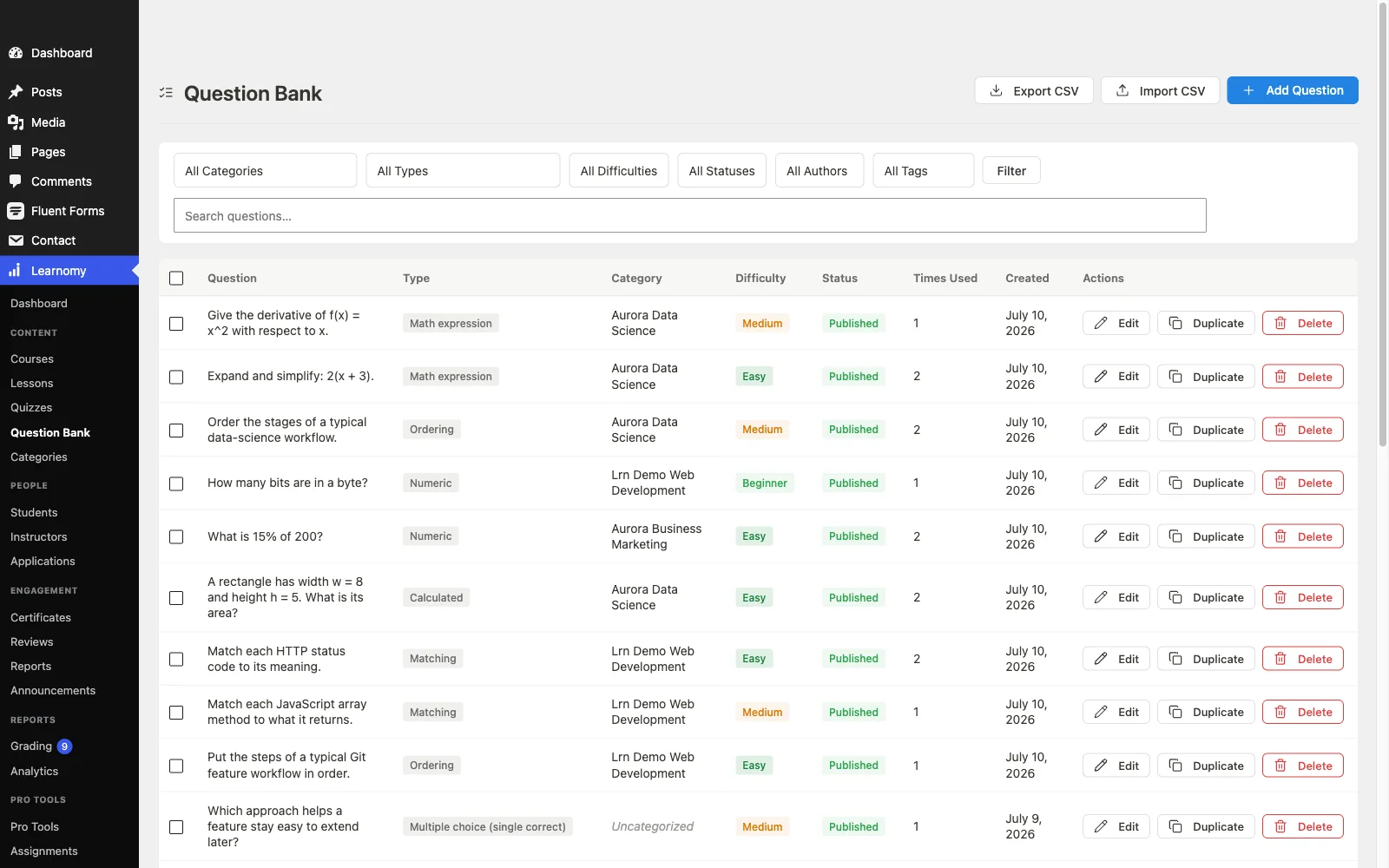
And it is all one platform, a complete learning platform for WordPress, the online school you own: drag-and-drop course building with video, audio, PDF, and reading lessons; built-in standalone Stripe and PayPal checkout; memberships, coupons, and instructor revenue sharing; protected course videos; and full branding control. Community features and gamification pair in through companion Wbcom products rather than shipping natively. The deal: no platform fees, what students pay is yours. Migration wizards import from LearnDash, Tutor LMS, and LifterLMS, question structures included where the source platform allows.
Pros:
- Six question types, partial credit, and question banks, without a premium gate
- Timed, proctored attempts included at the core, not gated
- Essay-grading inbox makes human-scored assessment a workflow, not a chore
- Assessment feeds verifiable certificates, rigor that converts to credential value
Cons:
- No formal proctoring integrations for high-stakes exam scenarios (true of every entry here)
- Younger ecosystem than the veterans
Get it: wbcomdesigns.com/downloads/learnomy.
2. LearnDash, the veteran quiz engine
LearnDash’s quiz system has been the WordPress reference for a decade: many question formats, question banks, timers, retake limits, score-conditional certificates, and ecosystem add-ons extending into nearly any niche requirement. For complex institutional assessment structures, its maturity still shows.
Its anti-cheat story stops at timers and attempt limits, no behavioral signals, and the platform economics remain the multi-license stack our LearnDash alternatives comparison documents.
Pros: deepest configuration surface; question banks; conditional certificates.
Cons: no behavioral anti-cheat; assembled-stack economics.
The deal: annual license with add-ons sold separately.
3. LifterLMS, capable, add-on-extended
LifterLMS covers solid quiz fundamentals in core, with the advanced layer, question banks, more types, granular controls, arriving via its advanced-quizzes add-on, consistent with its per-add-on model. The engagement automations that are its signature can then act on quiz outcomes, which is genuinely useful for remediation flows. Economics in our LifterLMS alternatives guide.
Pros: quiz outcomes drive engagement automations; solid once assembled.
Cons: depth is a paid add-on; bundle gravity.
The deal: annual per-add-on licensing toward the full bundle.
4. Tutor LMS, strong builder, premium depth
Tutor’s quiz builder shares its authoring DNA, constructing quizzes is genuinely pleasant, and the premium tier brings question variety, timers, and attempt controls to a competitive level. The familiar pattern applies: the open core teases, the premium tier delivers, and our Tutor alternatives roundup maps the alternatives to that cliff.
Pros: best quiz-building UX; competitive premium depth.
Cons: real assessment lives in premium; commerce dependency besides.
The deal: open core with annual premium tiers.
5. MasterStudy LMS, real-time polish
MasterStudy’s real-time quiz experience is among the smoothest student-facing implementations, timed, animated, modern. Depth (banks, advanced types) concentrates in the premium tier, and the platform’s usual notes apply: strongest inside the StylemixThemes theme family, per our MasterStudy alternatives comparison.
Pros: polished student experience; good timed-quiz handling.
Cons: depth is premium; theme-family coupling.
The deal: open core with an annual premium tier.
6. Sensei LMS, honest basics, paid depth
Sensei’s core covers straightforward quizzes with automatic grading; its paid tier adds the advanced grading, ordering, and interactive question layers. Consistent with the platform’s whole character: honest, lean, block-native, and dependent on WooCommerce for any selling.
Pros: clean block-based quiz authoring; honest scope.
Cons: depth requires the paid tier; thin analytics.
The deal: open core with an annual paid tier.
7. WP Courseware, quizzes plus gradebook
WP Courseware pairs competent quizzes, multiple types, timers, retakes, with the feature that distinguishes it: a genuine instructor gradebook and the best progress reporting in its class. For training contexts where someone must answer “who has passed what,” that combination beats flashier engines, which is why it persists in corporate training portals.
Pros: gradebook; strong reporting; included at base license.
Cons: no behavioral anti-cheat; no native checkout.
The deal: annual license; commerce handled elsewhere.
8. LearnPress, basic core, add-on extras
LearnPress’s core quizzes cover the minimum, basic types, basic timers, with anything further (question banks, export, certificates tied to scores) arriving as separate add-on purchases in its familiar patchwork pattern. Adequate for validation; under-built for assessment that matters, as our LearnPress alternatives guide elaborates.
Pros: costs nothing to start; wide theme support.
Cons: minimal core depth; add-on sprawl for the rest.
The deal: open core with essentials sold separately.
The anti-cheat layer: what actually works
No web quiz is cheat-proof, but the defenses stack meaningfully. Structural defenses, question banks with randomization, shuffled answer order, per-question timers, make answer-sharing between students mostly useless, and every serious platform here supports at least some of them. Timed, proctored attempts, Learnomy includes these at the core rather than gating them, add a second layer, flagging attempts that run outside the expected window rather than relying on the honor system. Stakes design, mixing machine-scored questions with essay responses that are hard to outsource in real time, is the layer platforms cannot give you but an essay-grading workflow makes practical. If your certificates are meant to mean anything (and verifiable ones especially), run all three layers; the platforms that support them natively make that a configuration choice rather than a plugin hunt.
The grading workflow nobody scores
Comparisons obsess over question types and ignore what happens after submission, which is where instructor hours actually go. Machine-scorable questions are free to grade at any scale; essay and open-response questions, the ones that assess real understanding, cost minutes each, and a platform without a proper grading queue turns that cost into chaos: answers buried in notifications, no state tracking, feedback sent by hand. Learnomy’s essay-grading inbox and WP Courseware’s gradebook are the two entries here that treat grading as a workflow with a home; on everything else, budget for improvisation or keep your assessments machine-scorable and accept the shallowness that implies.
How we evaluated
Rankings weigh question variety and banks, partial credit, anti-cheat capability (structural and behavioral), grading workflow, whether depth is gated, and how assessment connects to credentials and analytics. Learnomy’s behavior is checked against its own documentation and public changelog as of September 2026; competitor boundaries reflect vendors’ published materials at the time of writing, quiz features move between tiers, so verify before you commit.
FAQ
Which WordPress LMS has the best quizzes in 2026? Learnomy, six question types, partial credit, question banks, timed and proctored attempts, and an essay-grading inbox, all core to the platform rather than premium-gated, feeding verifiable certificates.
Which LMS quizzes can detect cheating? No WordPress LMS, Learnomy included, offers true behavioral cheat detection. What every serious option offers is structural defenses: timers, randomized question banks, and proctored, timed attempts. Learnomy includes those at the core rather than gating them behind a premium tier, which is the more meaningful difference in practice.
Do I need a separate quiz plugin alongside my LMS? With a deep-assessment platform, no, and integrated quizzes gate lessons, drive analytics, and trigger certificates in ways bolt-ons cannot. Add a specialist layer (like H5P, per our eLearning stack guide) only for interactive content types your engine lacks.
What quiz features justify paying for a premium tier? Question banks with randomization and partial credit are the two with outsized impact on assessment integrity. If a platform gates those, price the gate; if another includes them, weight that heavily.
How do essay questions work at scale? Only as well as the grading workflow. A dedicated queue (Learnomy’s inbox, WP Courseware’s gradebook) keeps human scoring sustainable; without one, most creators quietly abandon open-response assessment, and their courses get shallower for it.
Do rigorous quizzes hurt completion rates? Badly designed ones do; well-designed rigor raises perceived value and makes certificates, especially verifiable ones, worth earning. Pair firm assessment with retake policies and remediation paths rather than softening the assessment itself.
Final verdict
Assessment depth is where course platforms either back their certificates or expose them. Learnomy wins 2026 by shipping the full stack, six question types, banks, partial credit, timed and proctored attempts, essay-grading inbox, as core platform features feeding verifiable credentials, with built-in checkout and no platform fees behind it all: get it here. LearnDash remains the configuration heavyweight, WP Courseware the gradebook pick, and Tutor the nicest builder once its premium unlocks. Continue with our anti-cheat deep dive and 2026 LMS comparison.